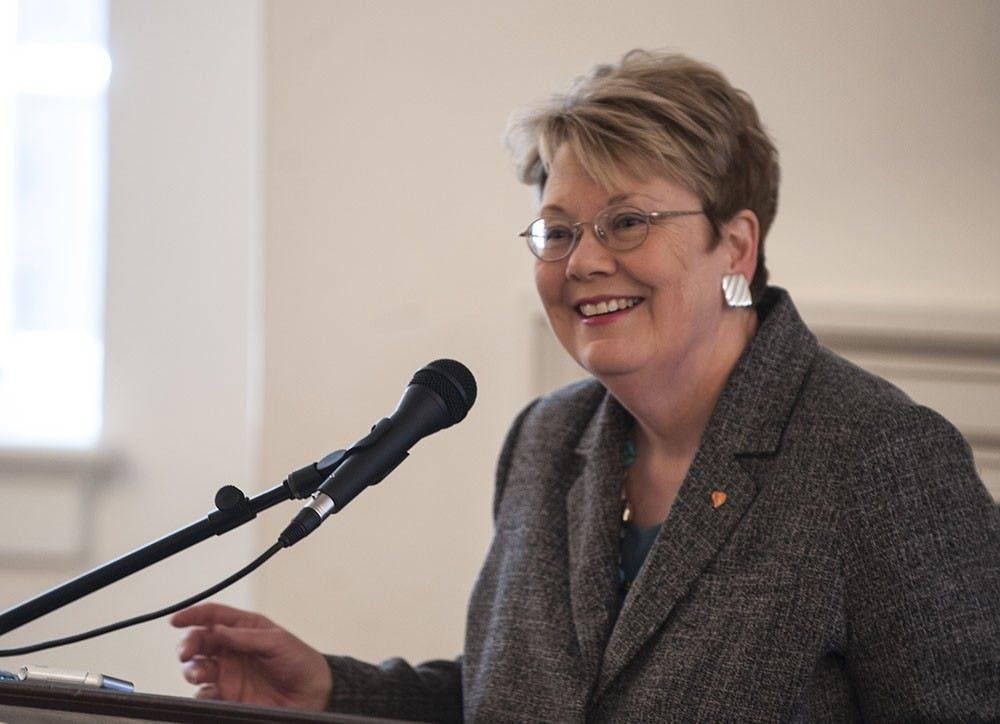
“The University is much more than its leadership writ large, and I think [that is] really important to remember,” Sullivan said.
Teresa Sullivan, former University president and former professor of sociology, weighed in on the stability of the University and higher education on a national scale. Sullivan served as president from 2010 to 2018, but in 2012, the Board of Visitors temporarily ousted her as president and reinstated her two weeks later. Fourteen years since the ousting of Sullivan, and one year since the resignation of former University President Jim Ryan, The Cavalier Daily interviewed Sullivan, who asserted that the University is stable but expressed worry for the landscape of higher education nationwide.
In June 2012, then-Board Rector Helen Dragas and then-Vice Rector Mark Kington met with Sullivan to tell her they were not satisfied with her performance and handed her a letter with a separation agreement. According to ABC News, Dragas said the University was not working quickly enough to “address state and federal funding reductions [and] online education delivery.” At this point in her tenure, Sullivan had only served two years.
In the days following the announcement of her resignation — much like the days following Ryan’s announcement of his resignation — community members spoke out, many protesting the Board’s decision. An alumnus ultimately started a petition and collected over 5,000 signatures to reinstate Sullivan. Over two weeks after her resignation, the Board voted to reinstall her as University president — a position she held until 2018 when her contract expired.
While there was pressure behind both Sullivan’s oust in 2012 and Ryan’s resignation last summer, Sullivan said she does not see many parallels between the two situations. She specifically pointed out that there was no implication that the federal government had interest in her case, and that the Board at the time of her resignation in 2012 was mainly bipartisan, with appointed members from two different governors. The Board at the time of Ryan’s departure was composed entirely of former Gov. Glenn Youngkin’s (R) appointees.
Regarding both resignations and leadership turnover more generally, Sullivan emphasized that the University can overcome these challenges because she said the majority of University constituents are not directly impacted by leadership “turmoil.”
“No matter how much turmoil is going on at the top, patients are having their lives saved at the hospital, students are learning, and then they’re leaving to go on to careers of promise,” Sullivan said. “The most important work of the University is going on, and … to some extent, it doesn’t matter what’s happening at the top.”
However, she did acknowledge problems that can arise when the University lingers too long in distress. One big issue Sullivan pointed out from this lingering is that prospective faculty and students may look to join other institutions over the University. For the University, application numbers from prospective students are consistently high each year — 82,118 students applied to the University during the 2025-26 application cycle, a 27.4 percent increase from the previous year of 64,463 applications. Contrastingly, regarding faculty, under 30 percent left the University following the 2025-26 academic year, and of that group, 26 percent listed “retirement” and 26 percent listed “relocation” as the reason behind their departure.
Writ large, Sullivan said that from her view, the University is stable. Specifically in the context of higher education, Sullivan emphasized the University has strong fundamentals, with four main stabilizers to keep operations afloat. First are the record-breaking application numbers the University sees from prospective students each year. Sullivan said that while some colleges worry they will not have an incoming freshman class, the University does not face that issue.
Second of the main stabilizers, she said, is the University’s endowment, noting that it provides a cushion for expenses like financial aid and professor salaries. Next, Sullivan emphasized that the third stabilizing factor for the University is its faculty, many of whom she said have served in their roles long-term.
“[The faculty] know how things are done, they know how to keep things running, they’re dedicated to the University [and] they care a lot about their students,” Sullivan said. “That’s really a huge asset.”
Sullivan also underscored the value of University alumni. She said the alumni are a large group of people who all care very much about the University and should not be overlooked.
Months after the reconstitution of the new Board and the appointment of University President Scott Beardsley, Sullivan said she is hopeful for the direction in which the University is moving with its new leadership.
“There seems to be a strong willingness on the part of Scott Beardsley and the Board to do some listening,” Sullivan said. “That’s not top-down leadership, that’s grassroots leadership — listening to what’s going on with people and what they’re concerned about.”
Since assuming office Jan. 1, Beardsley has embarked on a tour titled “Grounds for Conversation," in which he aims to hear from the entire University community. So far, he has met with leaders and representatives of all 12 University schools, U.Va. Health, the College at Wise and U.Va. Northern Virginia, as well as past and present student leaders of class councils, the Honor Committee, the University Judiciary Committee and Student Council.
Sullivan also pointed to the volume of leadership turnover at U.Va. Health. Since February 2025, over nine prominent positions within the Health System have experienced resignations, some with multiple interim appointments while search committees looked for permanent replacements. Other positions are still not permanently filled — Sullivan said that the Health System needs to continue stabilizing, and she is optimistic the situation will be fully resolved.
While the University is stable as it comes out of the last year, according to Sullivan, she pointed out areas where there is room for growth — both within the University and on the broader national scale of higher education.
For the University, Sullivan said with 10 new members, the Board will need to learn how to work as a team. She said this challenge is simply “different” — neither bad nor good. She also said that beyond learning to work together, serving as a Board member requires institutional knowledge.
“Some of [the new members] have served before, and so they do have a good bit of institutional knowledge, but institutional knowledge at this point is going to be an important thing for Board members to get,” Sullivan said. “It’s going to be a steep learning curve.”
An “interesting idea” to address this learning curve for institutional knowledge, in Sullivan’s view, is the proposal of longer Board member term lengths. She acknowledged Senate Bill 494 and House Bill 1385, which were identical bills vetoed by Gov. Abigail Spanberger (D) May 19, but would have extended term lengths for members from four to six years.
Another key subject to address for the Board, according to Sullivan, is specifying the professions of prospective Board appointees. The Board is made up largely of lawyers and businessmen. Going forward, Sullivan said she would like to see a requirement instated for a scientist or engineer to hold a member seat.
“We’ve got a lot of people who understand finance — and of course that’s important too — and lots of lawyers, but I think that there are some real skills … that would be useful to represent on boards,” Sullivan said.
Looking more broadly to the state of higher education across the country, Sullivan said she is concerned for the quickening turnover of university presidents. She also said there is a lack of clarity of roles within the federal government regarding which departments are responsible for which tasks relating to higher education. Finally, Sullivan warned about the continuing political polarization of higher education and U.S. Vice President JD Vance’s speech “The Universities are the Enemy” in November 2021.
Regarding demographics of university presidents and the increasing turnover, the American Council on Education conducted a survey in 2023. The results showed that the average tenure of presidents was less than six years in 2022 and that 55 percent of presidents plan to step down from their roles within the next five years. Placing the University in this national context, Sullivan pointed out that she and Ryan served relatively long terms — she served eight years and Ryan served seven. She said rapid turnover “builds up fatigue,” which can be dangerous for institutions.
The federal government has also taken a special role in influencing universities’ operations and governance nationwide within the past year. Sullivan said that when she was president, federal departments had clear responsibilities, which allowed for clarity when reporting to and speaking with federal officials. Now, she said, it is unclear who is “running the show.”
“When I was president, the Education Department had clear responsibilities, and we understood what they were, and we communicated well with them,” Sullivan said. “Now, I’m not really sure who’s running the show. It looks to me like it’s maybe the Justice Department … basically all the relationships that used to be there are probably not there anymore.”
Sullivan posited that this uncertainty makes normal daily operations difficult, mentioning tasks like submitting forms and reports and keeping up on new software.
Analyzing Vance’s quote that “universities are the enemy,” Sullivan expressed deep opposition to its implications. She explained that not only is it dangerous for the scale of higher education to believe that universities are evil, but that it is untrue of what she experienced during her time at the University.
“When I was president, we had six U.S. senators who were alumni of the University,” Sullivan said. “There were three Republicans and three Democrats — that doesn’t sound like indoctrination to me, or if it is, we’re not doing a good job of it.”
Sullivan continued, saying Vance’s belief could lead to countries abroad recruiting American students to their schools and companies, instead of those students remaining in the U.S. She also said she worries about new immigration regulations and how that will fare for international students. At the University, Iranian students are facing issues obtaining visas, and nationwide, international student enrollment in higher education is declining.
In all, Sullivan said she remains hopeful for the future of the University, but she acknowledged the many challenges facing the state of higher education, including leadership turnover and federal overreach. She reiterated her belief that universities remain vital to America and its students.
“The University is in no way an enemy of the United States or anybody else that I know of,” Sullivan said.
Lauren Seeliger is a news editor of the 137th term and enjoys covering U.Va. Health and University governance. Lauren is a fourth-year Behavioral Neuroscience student from Fairfield, Connecticut.
Read More

Jefferson Trust awards $812,064 in Fall Major Cycle Grants
By Charlotte Gabriel | 14 hours agoThe Jefferson Trust awards both Flash Grants and Major Cycle Grants on a monthly and biannual basis, respectively.
At City Council meeting, staff preview snow removal efforts for anticipated winter weather
By Luca Bailey | 14 hours agoThey also heard from a Charlottesville community member who argued for the importance of large-scale development by-right, received updates on the new emergency homeless shelter at 2000 Holiday Drive and invested in several new affordable housing projects.
From the Archives: Fashion on Grounds
By CD Archive Staff | 14 hours agoMerchants found that many students also opt to blend traditional, preppy basics with punk elements.