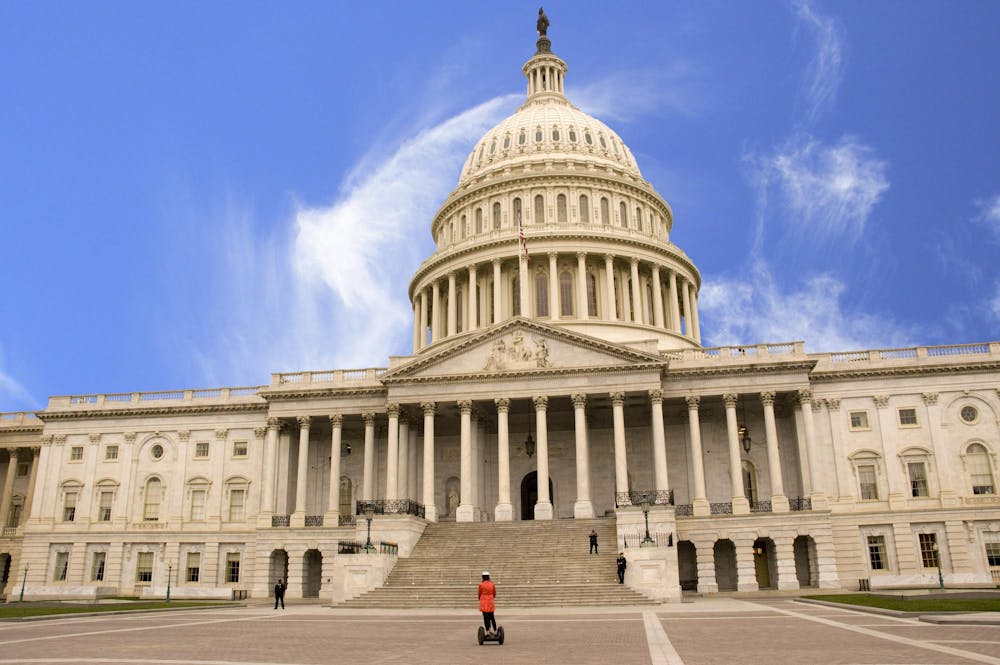
The University spent roughly $250,000 on federal lobbying in 2025 — about 25 percent more than in 2023 and 2024 — according to quarterly disclosure reports filed with the U.S. Senate. The increase in federal lobbying spending came as research universities nationwide confronted federal funding pauses, proposed cuts to research cost reimbursements and experienced a sweeping overhaul of federal student aid.
The University has one federal lobbyist, Julia Smith, who leads the University’s Office of Federal Relations. Smith is the only lobbyist named in the University’s disclosure filings, and she described herself to The Cavalier Daily as the primary liaison between the University and federal government. Her role is to advocate for the University’s interests in front of Congress and federal agencies. According to Smith, she spends most of her time in Washington meeting with members of Congress — specifically with the Virginia delegation — and staff from committees of jurisdiction over University priorities.
Beyond Capitol Hill, Smith said her work includes connecting the University’s own researchers to federal opportunities.
“A big part of my work is also supporting faculty directly — helping researchers understand federal priorities, connecting them with potential opportunities and making sure U.Va.’s expertise is visible to federal agencies and policymakers,” Smith said.
General issue areas that U.Va. lobbying targets, according to its fourth-quarter 2025 filing, include federal budget and appropriations, defense, immigration, science and technology, sports and athletics, education, medical research and health issues and small business.
What does the $250,000 buy?
Unlike most major universities that hire outside lobbying firms, the University runs its federal advocacy in-house. Under federal disclosure requirements, Smith said, the $250,000 includes advocacy efforts along with the University’s dues to national higher education associations that lobby on behalf of their members, such as the Association of American Universities and the Association of American Medical Colleges.
Smith said most of those associations significantly increased their federal advocacy beginning in 2025 because of broader changes to higher education funding.
“The work has certainly become more demanding, and there are longer days and more urgency than in previous years,” Smith said. “But that has made the moments where we make progress more meaningful.”
Smith described the University’s advocacy agenda as a product of University-wide efforts rather than only her own. She said it is shaped with help from the Office of the Vice President for Research, the Office of the Executive Vice President and Provost and, when policies carry financial or operational consequences, finance and operations leadership.
“Federal relations is a team sport,” Smith said. “The agenda is revisited continuously because the federal landscape changes quickly."
The University Counsel — led by Interim University Counsel Barry Meek — does not play a direct role in the University’s government relations work. The distinction means the University’s dealings with Washington run through its dedicated advocacy staff rather than its legal office.
What do the disclosure reports show?
Under the federal Lobbying Disclosure Act, organizations that employ in-house lobbyists must file quarterly reports disclosing their lobbying-related spending, the issues they worked on and the federal offices they contacted. The University’s five most recent filings — the last quarter of 2024 and the four quarters of 2025 — list a variety of advocacy categories primarily focused on research.
Each of the five filings list appropriations advocacy — requests for what the University calls “robust funding” in the annual federal spending bills. Specifically, the University urged Congress to fund agencies that support research and public health work, including the National Institutes of Health, the National Science Foundation, the Centers for Disease Control and Prevention and National Aeronautics and Space Administration. The filings also call for continued support for federal student aid programs, including Pell Grants and Federal Work-Study.
On student aid, earlier filings list lobbying on the College Cost Reduction Act and improvements to Free Application of Federal Student Aid. By late 2025, the fourth-quarter filing shows the University was lobbying in support of the Grad PLUS loan program — which Congress voted to eliminate for new borrowers in the One Big Beautiful Bill Act. The University also raised concerns about how the U.S. Department of Education defines “graduate” and “professional” students as it implements that law, a distinction that determines borrowing limits for the University’s own graduate and professional students.
Defending research dollars
The disclosures corroborate what Smith called 2025’s defining battle — research funding. The University’s fourth-quarter 2025 filing added a medical research category for the first time, joining longstanding categories such as budget, education and immigration. In the last 2025 filing, the University registered support for NIH and CDC funding and explicit concern with a proposed 15 percent cap on the facilities and administrative — or F&A — cost rate at NIH. F&A reimbursements fund laboratories, compliance and research infrastructure.
According to the same filing, the University simultaneously lobbied in support of the FAIR budget model, an alternative reimbursement framework developed by higher education groups.
“When proposals emerged that would have changed how the federal government reimburses universities for the costs of conducting research, we recognized the existential threat this posed to the research enterprise and worked with our partners to make sure policymakers understood what was at stake,” Smith said.
Smith pointed to language in the fiscal year 2026 appropriations bills protecting existing F&A rates as one of the year’s most significant lobbying successes for the University.
“The FY26 language we collectively negotiated helps project existing F&A rates and recognizes the importance of maintaining a strong research enterprise,” Smith said. “I see that as an important example of advocacy, making sure policymakers understand the practical impact of federal policy decisions on universities, researchers, students and the broader economy.”
Lobbying efforts for student visas, athlete compensation
On immigration, the University reported in its third- and fourth-quarter 2025 filings lobbying about a proposed Department of Homeland Security rule affecting international students. The proposal would replace the “duration of status” system, which generally allows international students to remain in the country while they maintain their academic status. The new system would instill fixed admissions periods that could require these students to apply for extensions to complete longer academic programs.
DHS finalized that rule July 17 over higher education groups’ objections. Effective Sept. 15, the rule generally limits international students’ initial authorized admission periods to the length of their academic programs with a maximum of four years. Students who need additional time to complete longer programs may apply to U.S. Citizenship and Immigration Services for an extension, although approval is not guaranteed.
The fourth-quarter filing also registered concerns about the impact of a $100,000 fee on certain new H-1B visa petitions — the visa program that employers, including universities, use to hire foreign workers such as international faculty and researchers. The fee is being challenged in federal court by the AAU — an association that the University also pays dues to as a part of its total lobbying expenditures — alongside the U.S. Chamber of Commerce.
The University has also been lobbying on college athlete compensation since at least late 2024, when its final 2024 filing shows it engaged the Virginia delegation supporting potential federal legislation governing name, image and likeness rights. By mid-2025, the disclosures named a specific bill — the SCORE Act, which would set national NIL rules, bar student athletes from being classified as employees and grant the NCAA limited antitrust protection. The bill cleared two House committees in July 2025 but stalled after House leadership pulled a planned December floor vote, and it has not passed.
How do University lobbying efforts compare to other universities?
The University reported approximately $200,000 in federal lobbying in both 2023 and 2024 before the 2025 increase to roughly $250,000. Virginia Tech, by comparison, reported $140,000 in early 2025, while Virginia Commonwealth University spent roughly $472,000 across 2023 to 2025. Harvard spent $950,000 on federal lobbying in 2025, while Yale University, the University of Pennsylvania, Cornell University and the University of Michigan each spent more than $1 million.
Smith explained she believes the University’s lobbying investments are proportionate to its research operations, noting the University has more than $650 million in sponsored research. She said the lobbying investments match the “size and complexity” of this research.
“Federal decisions affect so many parts of the University — from research funding to student programs to regulations — so having a strong presence in Washington helps ensure U.Va.’s interests are represented and that we’re positioned to compete for opportunities that benefit the Commonwealth,” Smith said.
According to Smith, for students and taxpayers, the Office’s work is largely invisible, since they focus on preserving existing opportunities for students rather than making headlines.
“A lot of that work happens behind the scenes,” Smith said. “My job is to make sure U.Va. has a seat at the table in Washington so that when decisions are made about higher education, research or student programs, our interests are represented.”
Komal Reddymachu is a second-year student in the College majoring in Government and English. He is a staff writer on the news desk and has been writing for The Cavalier Daily since his first semester at U.Va. Komal enjoys writing about all topics, but he especially enjoys covering events around Charlottesville.
Read More

Darden event in Tel Aviv draws condemnation from pro-Palestinian group on Grounds
By Luca Bailey | 12 hours agoSJP’s statement Friday primarily highlighted the destruction of Gaza’s educational system by Israel’s government as a major point of concern.

With legal remedies running low, community members protest ‘The Mark’ at City Council
By Luca Bailey | 12 hours agoCity Council’s May 4 vote to award “The Mark at Charlottesville” a necessary Certificate of Appropriateness for construction cannot be reversed, City Attorney John Maddux explained at the Council’s first regular meeting of the month July 20.
New housing legislation set to alter Charlottesville’s tenant-landlord relationships
By Luca Bailey | 3 days agoThe new laws are the latest in a series of reforms aimed at curbing Virginia’s record-high eviction rates.