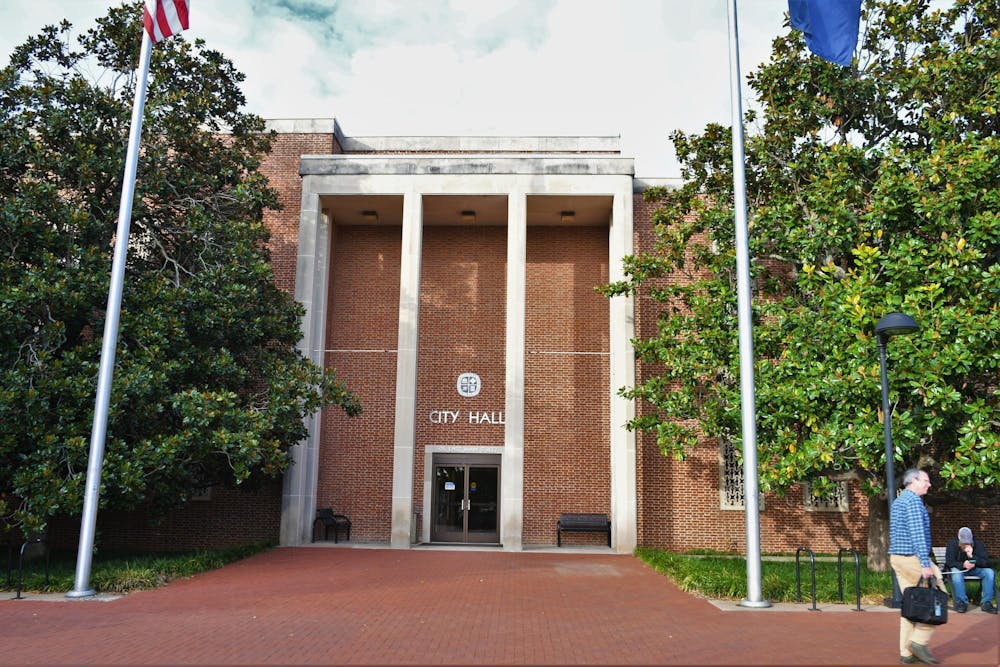
A regular meeting of the Charlottesville City Council took place Aug. 17, where the Council received a presentation on ongoing efforts to update local plans for coordinating sustainable waste removal in and around the City. Residents also appeared during public comment, petitioning Council members to reconsider plans to clear a homeless encampment along the Rivanna Trail, and to consider restoring a plaque commemorating 19th century slave auctions which took place at a historic building downtown.
At a 4:30 p.m. work session — an afternoon period where City staff deliver presentations and no formal votes are taken — staff presented on the ongoing efforts to update a plan for managing waste in the Charlottesville region through 2031.
The Regional Solid Waste Management Plan is a five-year plan that “establishes a structure for coordinated regional action” for the recycling and reuse of solid waste in the Thomas Jefferson Solid Waste Planning Unit — a district composed of the City of Charlottesville, Albemarle County, Fluvanna County and Greene County.
According to the Aug. 17 meeting’s policy summary of the issue, the Management Plan establishes broader goals for the region's waste disposal practices — including ensuring it averages a recycling rate of at least 25 percent — while localities within the TJSWPU are then responsible for developing more localized action plans in alignment with these goals.
Isabella O’Brien, a regional planner with the Thomas Jefferson Planning District Commission, noted that the region is currently averaging well above its 25 percent quota for recycling waste, with available data from 2021 to 2024 showing the region recycles approximately 34 to 41 percent of recorded waste. Charlottesville, Albemarle and the University usually recycle roughly 41 to 49 percent of reported waste, according to O’Brien’s data. O’Brien explained, however, that only public facilities must report this data, leaving the full picture of localities’ waste disposal practices — especially from more rural areas — incomplete.
“The recycling rate should be viewed as a useful compliance metric … rather than a complete picture of all of the activity occurring within a specific locality,” O’Brien said.
Despite the Charlottesville region’s overperformance on most metrics, the plan will make several changes to further invest in sustainable practices and address areas of concern residents expressed in public feedback.
O’Brien and Director of the Office of Sustainability Kristel Riddervold noted that only a fraction of Charlottesville residents — roughly 16 percent — expressed satisfaction with the accessibility of composting options in the City, according to a public feedback survey. Currently, City residents can drop off compost at the City Market from January to October, at 24/7 composting bins for residents located throughout the City and at the McIntire Recycling Center.
Riddervold explained that the City is investing in at least three new drop-off spots for compost in the near-term to “meet the need and interest” for more compost options. She further noted a separate $536,000 grant from the Virginia Department of Environmental Quality for the University to increase compost collection in “predominantly student housing areas” as a positive sign of progress from back in April. According to the University’s Office of Sustainability, this grant will count towards both increasing composting options near residential areas and preventing food waste on Grounds.
The Charlottesville-specific plan will also aim to invest further in the McIntire recycling center’s operations, and to increase the sustainable disposal of food and yard waste in particular in the City, among other goals.
The broader region-wide Management Plan will aim to more comprehensively analyze waste disposal in the region. O’Brien said that in addition to surveys, the Commission referenced a 2021 report by University graduate student MaeEllen Megginson on rural waste diversion to assist in their planning efforts. The 40-page report ultimately suggested a model which would charge residents for waste disposal based on how much they throw away as opposed to a flat tax to pay for waste removal services.
O’Brien said the broader Management Plan will remain under public consideration, and residents wishing to comment on the process can do so by emailing the TJDAC or at a public hearing scheduled for 7 p.m. Sept. 3. The finalized draft for the plan is scheduled for submission to the Department of Environmental Quality in October, while the Council will take up approval of the City-specific plan at its next regular meeting in September.
During the Community Matters segment of the meeting — the public portion in which residents can address the Council for up to three minutes each — Council continued to face pushback for its plans to clear a homeless encampment along the Rivanna Trail by Tuesday. The Council announced that it will clear the encampment amid public safety concerns, including reports of rape and one death at the site in recent weeks.
At its previous regular meeting Aug. 3, the Council voted to set aside $4 million to assist with the development of an emergency homeless shelter on Holiday Drive for residents of the Free Bridge encampment. The City will further invest the money in direct to housing initiatives aimed at helping the Free Bridge residents with finding actual homes. Additionally during the Aug. 17 meeting, the Council further voted to budget $3 million to the local Salvation Army.
Community members who oppose the facilitated transition argue that removing residents on a deadline will disrupt their lives without solving the root cause of homelessness, while others note the alleged criminality that has occurred at the site as a sign of imminent risk for the public. City resident Jennifer Grant was one of the residents who appeared to express her continued discontent with the City’s decision Aug. 17.
Grant argued that the cameras the City has placed at the site as part of the removal process are not promoting safety in the interim. She said that she was recently admitted to the University Medical Center and when she returned, her tent had been slashed. According to Grant, the cameras at the site did not catch the events on camera.
Grant also disagreed with the notion that the emergency homeless shelter will enhance safety, noting her discomfort with the idea that men and women at the shelter will have to shower outside, and expressing the belief that the process will drive away residents — including those committing crimes at the encampment — away from the homeless shelter. According to Grant, this process will ultimately disperse those who are committing the crimes across a wider area as they look for other places in the City and Albemarle County.
“This is how we want to live,” Grant said. “You cannot say, ‘oh okay, a shelter is going to solve all the problems and get people out of this one neighborhood’ … it’s not. We’re going to find other places to go … Then guess what you’re going to have? More violence, more rape issues … [and] you’re going to … spread it all across the County.”
Also during the Community Matters segment, advocates with the Court Square Enslavement Memorial Advocacy Group appeared, petitioning Council members to restore a commemorative City plaque marking the site of a slave auction block which was in use downtown until 1865.
Court Square refers to the area which envelops the Albemarle County Courthouse near the Downtown Mall. 0 Court Square — also known as “Number Nothing” — was the site of a 19th century store which contained an 18-inch auction block on its southern side where slaves were sold until the end of the Civil War. According to the Historical Guide to Old Charlottesville, the auction block was removed from the site by mistake as part of street repairs to the building in the early 20th century. A number of commemorative plaques, and even a separate state historical marker were subsequently placed at Number Nothing to acknowledge the slave auctions which took place at the site.
The CSEM advocacy group notes, however, that one commemorative City plaque recognizing the slave auctions that took place in Court Square was removed in 2002. Now, according to City resident Heidi Dhivya Berthoud, advocates with the organization are petitioning Council members to restore the plaque at the site, and met with Deputy City Manager James Freas to discuss the issue as early as December.
Berthoud said that, in accordance with the City’s guidance, the group received outside statements of support from members of the National Association for the Advancement of Colored People and the University’s Descendants of Enslaved Communities Group, and officially asked the Council July 20 to place the issue on a subsequent meeting’s agenda.
“We join with hundreds of citizens whose ancestors were sold on the auction block who longed for truth and reckoning,” Berthoud said.
Berthoud asserted that City Manager Samuel Sanders has delayed a vote on the issue for several months now, and he asked Council members to use her remaining 23 seconds to answer whether they would take up the issue in September.
In response, City Mayor Juandiego Wade said that the Council was not prepared to comment on the issue, but indicated that the Council may still wish to hear more community input on the matter before restoring the plaque. Wade also said that he did not believe Berthoud’s portrayal of recent events was accurate.
“We will follow up on the next steps,” Wade said. “This is something that we have to … make sure that we get all of the input [for].”
The Council’s regular meeting schedule can be found on the City’s website. The next regular Council meeting will take place Tuesday, Sept. 8.

Luca Bailey is a third-year Politics student from Free Union, Va. As a staffer on the news and video desks, he has covered topics ranging from the General Assembly and state elections to local politics and University governance. He is also The Cavalier Daily’s beat writer for the Charlottesville City Council.
Read More
Acampora emphasizes need for human skills amid technological environment in first lecture
By Edward Christopher | 6 hours agoChrista Acampora, dean of the College and Graduate School of Arts and Sciences and professor of philosophy, delivered the First Lecture to students on the Lawn Monday morning.
What is the University’s role in the Commonwealth AI Institute?
By Melody Yuan | YesterdayThe Commonwealth Artificial Intelligence Institute is a partnership between several higher education institutions, industries and government agencies of the Commonwealth to coordinate AI resources.

After Supreme Court upholds birthright citizenship, students express relief and disappointment
By Jaylynn Perez and Luca Bailey | 2 days agoStudents at the University are expressing a range of emotions, with two who spoke to The Cavalier Daily signaling relief at the Court’s decision, and one expressing opposition.