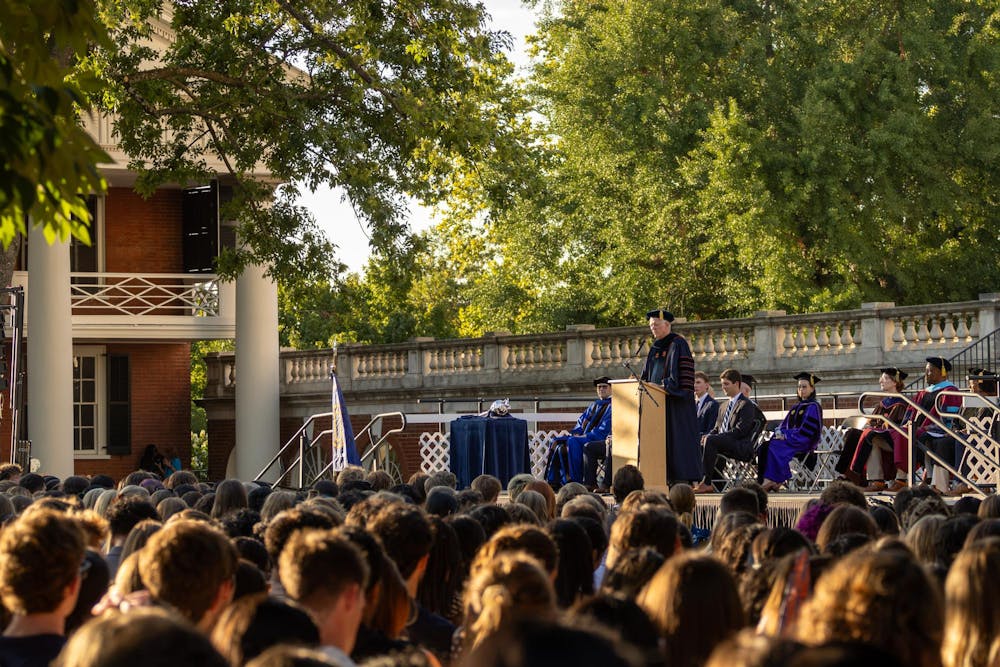
Marking one of the first major milestones of a new student’s University experience, the Opening Convocation and Honor Induction took place Sunday evening on the Lawn. The ceremony formally welcomed the University community's newest members, bringing together around 4,000 first-year and transfer students.
To many attendees, Convocation was a taste of what will define their time at the University — the feeling of belonging to a larger community. First-year College student Joseph Jackson felt that speeches by University and student leaders served as a reminder that they are now active members of an institution built on a tradition of student self-governance, introduced through addresses from the Student Council president, the chair of the Honor Committee and the chair of the University Judiciary Committee.
Starting around 6 p.m., new students began filing into seats lined up on the Lawn, facing the Rotunda. They waited attentively as University and student leaders walked onto the stage in traditional academic robes, accompanied by the chorus of University Singers performing “Gaudeamus Igitur.” When the music subsided, Brie Gertler, interim executive vice president and provost, introduced University President Scott Beardsley.
Beardsley took the stage to deliver a speech centered on what he called "the importance of opening doors.” Drawing on anecdotes from his professional and personal life, Beardsley urged students to stay open to academic exploration, engage with different viewpoints and prioritize face-to-face connection over social media. The message resonated with many listeners, especially first-year College student Ella Yarhouse.
"One of the things that really stuck out to me from President Beardsley was his analogy about doors opening,” Yarhouse said. “[How] you can open a door and step into a room ... You don't have to be the best academically or athletically, but you're in the room, and what you can control is how hardworking you are and the effort that you put into what you do in that room. And if the room isn't for you, then at U.Va., you have the ability to step out of it and choose another door."
Beardsley's speech set a warm, friendly tone that other speakers maintained throughout the evening. According to Yarhouse, new students who expected Convocation to be a mere formality were pleasantly surprised to find something much more genuine and welcoming.
“I was expecting it to be a lot more robotic and read from a paper,” Yarhouse said. “But I was definitely surprised that it wasn't like that at all. The speakers definitely seemed to care about the students that were in front of them, and they genuinely wanted us to feel welcome to U.Va.”
This sense of welcome was one of the evening’s major goals. For Michael Mitchell, Student Council president and fourth-year McIntire student, the honor of being a speaker at Convocation did not take away from addressing new students as his peers. In his address, Mitchell was open about how college did not feel like home right away, even for him, a native of Crozet. Mitchell’s decision to speak from the perspective of a peer reassured first-year College student Ronan Vora.
"I liked [Mitchell’s] simple remark about how his first weeks were not as he envisioned them, and college is a large transition that takes some time to get used to,” Vora said. “I may not be fully acclimated to this environment now, but his words give me hope that I'll find lots of joy within U.Va."
The evening also introduced new students to the concept of student self-governance, one of the University's most defining cornerstones. Zach Davidson, chair of the University Judiciary Committee and fourth-year College student, highlighted the progress made by the University since its founding as student-run organizations have evolved to be more inclusive.
Following Davidson, Genny Freed, Honor Committee chair and fourth-year College student, walked students through the principles of the University's community of trust, and students were invited to sign the Honor scroll. Jackson considered the act symbolic in more ways than one.
"[Signing the code] signifies all the work that was put down and that you put forward, but it's also a symbol of all the work to come,” Jackson said. “It's like a two-way mirror, if you will. One way we're looking back. One way we're looking forward to what's to come."
What struck new students was not just the idea of student self-governance itself, but also its deeper significance as a system conceived, maintained and operated entirely by students. Both Yarhouse and Jackson noted how elements of student self-governance at the University echo the founding principles of the country itself.
“When [Freed] mentioned that any of [us] could end up being a panelist listening to your fellow student, [I thought] that is what government should be like,” Jackson said. “By the people, for the people, for the sake of the common good of the people. … Seeing that progression [made me] feel like I'm participating … in a truer form of democracy, a more beautiful form of what good government should look like.”
Students also noted how the University’s Honor Code stood apart from the kind of honor codes typically found at academic institutions. Whereas most honor codes are imposed from higher administration and involve punitive elements, the University’s distinctive system is enforced from within and emphasizes reintegration into the Community of Trust.
“[The honor system at my high school] was solely adult-run,” Yarhouse said. “We didn't have hearings, we didn't have students being on a jury … It was just, you did something wrong and now you're getting punished for it. I really enjoy the [University] Honor Committee because if you do make a mistake, they're giving you the opportunity to come back and be welcomed into the community again, and it's not a one-and-done.”
The signing of the Honor scrolls marked the close of Convocation. Soon, students filed off the Lawn to join the ice cream social with their peers on South Lawn, or to speak to Lawnies, who opened their doors to their new classmates for over an hour after the event. The welcome extended to new students was shown both in action and in words.
Students and speakers agreed that the spirit of trust extended well beyond student self-governance. In his address, Mitchell extended this theme of respect and collaboration to the University as a whole.
“The biggest message I want to convey is the importance of civility and respect in our community,” Mitchell said in an interview with The Cavalier Daily. “We are not always going to agree with one another, and that's okay. What matters is how we treat each other when we disagree. We are all part of the same U.Va. community, and we should be building each other up rather than tearing each other down.”

Astrid Cheng is a senior writer on the life desk. She is a second-year College student, majoring in English and cognitive science. She enjoys covering University events and writing the occasional column. Outside of The Cavalier Daily, Astrid is involved in the Honor Committee, Humanitas Journal of Human Rights and Epsilon Eta.
Read More

Feeling the burn with Pilates Reformer at North Grounds Recreation Center
By Lily Notter | 6 hours agoReformer Pilates is a full-body, low-impact workout that focuses on strength, flexibility, mindfulness and stabilization.

The world kept scrolling
By Aditi Burra | 3 days agoI began to find a sense of peace in not knowing. I felt so much more at ease with myself and my life, all because I deleted a few apps on my phone.

College Mentors for Kids instills confidence with friendship
By Claire McGinn | 4 days agoOn Grounds, this CIO brings together nearly 230 University students and 200 elementary schoolers from five Charlottesville-area schools.