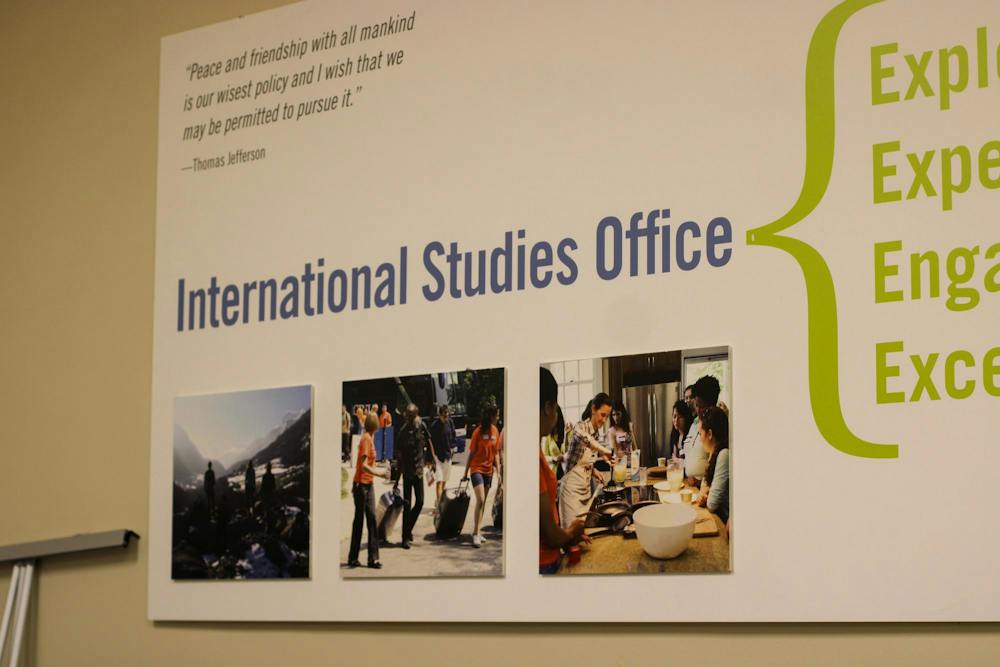
The University suspended the authorization of all curricular practical training requests that are not required for degree completion in August. The suspension was effective immediately, and it restricts international students’ ability to acquire off-Grounds internships or work experience that are not necessary for graduation from their degree program. The University has not provided information as to when this suspension may be lifted, if at all.
CPT is a type of university work authorization for students nationwide on F-1 visas — a nonimmigrant student visa for international students studying full-time in the U.S. — to participate in employment or internships directly related to their field of study. CPT authorization requires that the work was an “integral part” of the student’s curriculum, and it had to be completed while the student was enrolled at a U.S. university.
According to University Spokesperson Bethanie Glover, international students previously applied for CPT through the International Students and Scholars Program portal by uploading a job offer letter and naming an “approver” — usually the faculty member teaching course for which work experience is required. Once the approver verified the student’s academic eligibility, a Designated School Official — a university official responsible for ensuring international students’ compliance with immigration law — or ISSP advisor would review the request details and approve if appropriate.
Tricia Carpenter is listed as the University’s principal DSO, and she works alongside an advising staff that supports international students at the University.
The authorization suspension came following two broadcast messages in August from the Student and Exchange Visitor Program — a division of the U.S. Department of Homeland Security — to DSOs. The first broadcast, issued Aug. 12, announced that the SEVP had observed a rise in improper CPT authorizations, and the program was “increasing its scrutiny of CPT approvals to ensure compliance with federal regulations.” The broadcast emphasized that both the institutions and individual DSOs may face legal consequences should any violations be brought to light.
A second broadcast was issued Aug. 24. The broadcast laid out the provisions of CPT as “an integral part of an established curriculum” and “practical training required for all students participating in that curriculum.” The University, alongside many other universities nationwide, subsequently issued an update on its website reflecting it would only be processing CPT requests for required internship or work experience.
One academic program at the University requiring internship experience is the Bachelor of Science in Special Education. The curriculum requires the courses EDIS 4867, “Clinical Experience in Special Education” and EDIS 4887, “Teaching Internship — Special Education,” which both involve internship experience in special education classrooms. International students enrolled in these courses may still have their CPT requests approved.
The suspension impacts international students enrolled in many different University degree programs, including the Bachelor of Science in Commerce. COMM 4899, “Cross Cultural Experience” is a popular elective for upperclassmen that international students could formerly take to apply for CPT. However, as the course is not a requirement for the degree, students can no longer use this course to apply for CPT.
University Spokesperson Bethanie Glover said this suspension marks a loss for international students.
“The ability to get hands on work experience in their major has been a huge draw for international students who choose to study in the U.S,” Glover said. “The inability to engage in some of these opportunities may put international students at a disadvantage compared to their domestic peers who are able to get a more complete educational experience.”
This restriction only impacts international students on an F-1 visa. Students at the University on J-1 visas — a different kind of visa for international students participating in an approved exchange program — may pursue Academic Training, a work authorization similar to CPT that does not need to be a requirement for a degree. The vast majority of international students at the University are on F-1 visas, according to the International Students & Scholars website.
F-1 visa students looking for internship experience outside of their requirements can still acquire jobs and experiences through Optional Practical Training — a work authorization designed for optional internship or work experience. The experience must also be directly related to the student’s program of study, but it does not need to be tied to a certain course they are taking.
Students may engage in OPT either during or after completing their studies — however, students may be authorized for no more than 12 months through OPT unless they move to a higher degree level. At the University, students can obtain OPT authorization by applying through ISSP, then submitting a separate application to U.S. Citizenship and Immigration Services.
Amidst the suspension, Glover also outlined steps that the ISSP is taking to assist international students amidst the suspension, including email blasts, information sessions and one-on-one advising. The ISSP also co-hosts the International Student Support Circle every Friday to provide students with a welcoming environment to reflect and destress.
“We continue to keep in close contact with University Counsel and schools and departments, and to advocate for the creation of internal internship opportunities,” Glover said. “We will continue to post any developments to our CPT page.”
Beyond CPT, the Department of Homeland Security is also attempting to tighten regulations on the duration F-1 and J-1 students may study in the U.S. A federal judge issued a national injunction Sept. 14 to block the elimination of Duration of Status rule from taking effect. DHS finalized the elimination of Duration of Status rule in July, which would replace the current system for international students with fixed periods of admission generally lasting through a student's program or up to four years. The rule was scheduled to take effect Sept. 15, but a federal judge postponed its implementation while a legal challenge proceeds. The federal government appealed that ruling Sept. 30.
The elimination of Duration of Status rule would also limit students’ ability to change their program of study. F-1 undergraduate students would not be permitted to change their major or transfer to a new university during their first year unless SEVP authorizes an exemption for “extenuating circumstances.”
According to its website, the ISSP is evaluating long-term practices related to CPT requests.
Read More

Student discourse organizations reflect on state of free expression at the University
By Nicolas Biernacki and Austin Stegerwald | YesterdayThe Foundation for Individual Rights and Expression recently ranked the University No. 9 out of 261 colleges and universities in its 2027 College Free Speech Rankings.
U.Va. experts warn against emerging substances kratom, cychlorphine
By Michael Racz | 2 days agoIn the wake of recent deaths at the University of Mississippi, as well as suspicions surrounding the presence of the potent synthetic opioid cychlorphine in the drug supply, University officials, medical leaders and student organizations across the country have begun urging students to exercise increased caution around controlled substances.