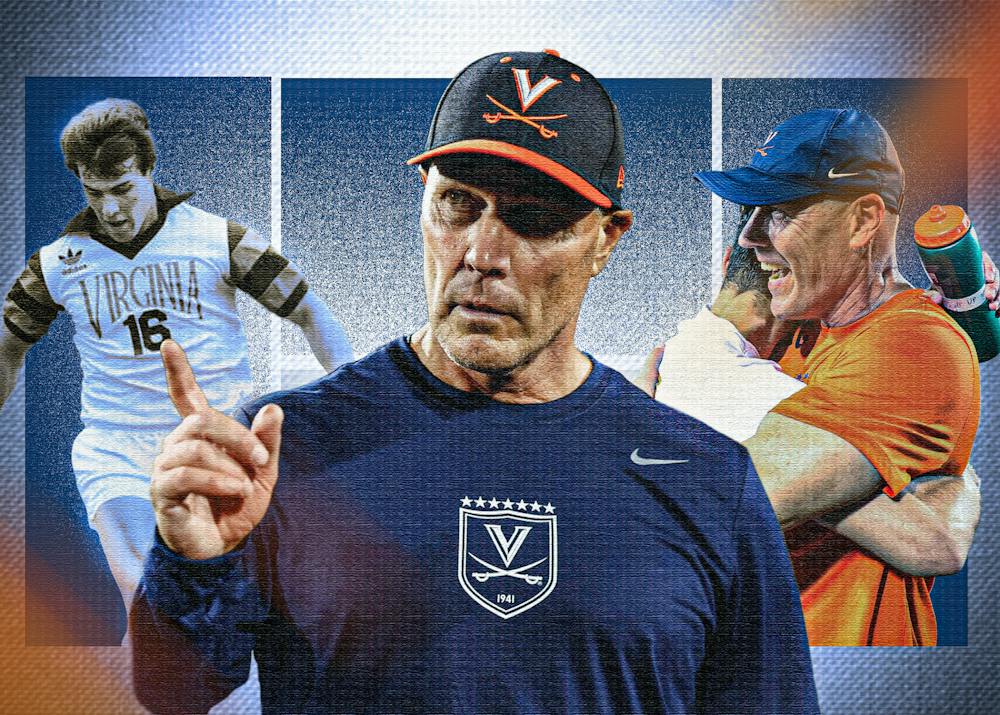
Back in Wall Township, N.J., in 1980, college soccer coaches on recruiting visits said goodbye at one house and then turned to its neighbor. George Gelnovatch, a blistering sophomore forward, lived next door to a senior named Tom Kain, and they were two of the most coveted prospects in the country.
Kain committed to Duke. Gelnovatch wanted to follow. There or UConn, the 1981 national champions under legendary coach Joe Morrone. But at a U.S. U20 national team camp Gelnovatch’s junior year, he befriended Jeff Gaffney, a senior already committed to another school in the southeast. Virginia joined the running.
Gelnovatch and Bruce Arena, Virginia’s fourth-year head coach, were touring the Lawn when they ran into Terry Holland and Ralph Sampson, the coach and star player of the well-known basketball team. A terrific ambassador for the school, Holland talked with Gelnovatch for a while. The soccer, though, was what tipped it.
These were the days a recruit could sit on the team bench. These were also the days Virginia played at Scott Stadium. Gelnovatch remembers 5,000, 6,000 people for a game against reigning national runner-up Alabama A&M. Virginia won 4-0, and it all started coming together.
The vibe on the bench. The dominant win against a national powerhouse. Friends in Gaffney and fellow U.S. U20 teammate Rob Stewart. What Holland had said.
Four years later, when Gelnovatch graduated from Virginia, the Cavaliers were the top program in the country. Not back when he committed. Sitting here all these years later, at the same school, it is enough to boggle a mind. The genesis of a 43-year relationship with a school in Virginia for a kid from the Jersey Shore?
“I think about it actually a lot,” Gelnovatch said. “Really, I do. Yeah, I do. The decision to come to a place that wasn't even a top 25 team yet.”
One deviation ended up etching the trajectory of his life. An “oddball” choice to play soccer here led to standing on the sideline as a part-time assistant coach for the program’s first national title in 1989. To lifting four in a row as a full-time assistant in 1991, 1992, 1993 and 1994. To becoming head coach and making 24 straight NCAA Tournaments and winning two national titles in 2009 and 2014.
“Gosh, man,” Gelnovatch said. “When I think about it, I almost think — like I say, fortunate. I’m almost like, man, did I just get lucky, or, you know? But yeah, pretty cool thing.”
Forty-three years later came win No. 400, a 4-3 result over Queens. When the tizzy of a game ended, a voice on the sound system boomed news of the milestone over the crowd.
Gelnovatch stood on the grass afterward, arms folded. He wore a sweatshirt and his trademark hat. The questioning eventually got around to win No. 400.
Over the last couple weeks, Gelnovatch said, as he became aware he was a win or two away, he thought some about the players and coaches that have passed through his program. All the people that created it.
But the milestone itself?
“To be honest with you, we're 5-5,” Gelnovatch said. “So I'm a little bit more concerned [about that].”
He digressed back to his team, after a few sentences. They are having a tough season, yet Gelnovatch believes they have it in them, knows they have it in them — they just need to clean up a few things, just need to turn the corner. It is frustrating. Time is running out to turn it around.
“400 wins,” Gelnovatch said. “I don’t give a damn.”
Back to Virginia
Before we move on, a little more history. Or is it already mythology?
In 1989, with stints in the American Soccer League and MLS and MISL behind him, Gelnovatch was preparing to move to a new phase of life. His LSATs were coming up, and he reached out to Arena looking for part-time work. Something to do while he studied.
Arena took on Gelnovatch, then aged 24, as a part-time assistant. That season Virginia won the national title, in a game that went four overtimes in what Gelnovatch remembers as 18-degree weather at Rutgers Stadium until enough was enough and Virginia and Santa Clara were declared co-national champions. Gelnovatch went home to New Jersey for Christmas and New Year’s.
When he came back for the spring semester, Arena had a question waiting for him.
“Why don’t you think about getting into coaching?” Arena asked.
Gelnovatch still took his LSATs. He did well enough, he maintains, not without a hint of stubborn pride, “to have some decent options.” Law school was on the table. So Gelnovatch double-checked — the scores were good for five years. Okay, he said, and became a full-time assistant.
It was not the only time Gelnovatch coached underneath Arena. When Arena got the head coaching job for the USMNT in 1998, Gelnovatch followed. He was an assistant at the 2002 World Cup in South Korea. He spent five years around the national team.
At some point, as he worked with the country’s best players, he had a realization.
“It occurred to me, this is what I need to do,” Gelnovatch said. “This is how I want to run my program. I don’t want to be a college soccer team. I want to run this thing like a professional organization.”
Among Gelnovatch’s favorite pictures from his Virginia career is one from the 2014 NCAA Tournament. It is not even from the final — it is from the immediate aftermath of a quarterfinal penalty kick win over Georgetown. Gelnovatch loves how it captures the euphoria.
But nothing can compare to his first national title, in 2009, when Virginia and Akron battled to a scoreless draw before the Cavaliers edged the Zips on penalties.
“The numbness that went through me,” Gelnovatch said. “Never experienced anything like that. I didn’t even have the joy, euphoria. I literally, for a couple seconds, my body was numb. But it was everything. I had a tingle in my face and my body. I’ll never forget that.”
All these years later, he wants to chase that feeling and embrace the process while doing it.
Loving the game
Gelnovatch wishes there were more soccer. Give him a split fall-spring season and two to three practices a week over the summer. More time on the field, on the grass, hat on his head, whistle around his neck.
These days, though, there are other things getting in the way.
Fundraising has always been a part of the job — increasingly now it’s what coaches are doing. There is pressure from everywhere now, and if the requests are not ultimatums, they are strongly worded hints.
Gelnovatch does not exactly love all this fundraising. It used to go toward an enhancement fund and the occasional endowed scholarship. Now he is “looking straight up a mountain.” Fundraising is a necessary evil, even if it’s important.
“I'm not denying it,” Gelnovatch said. “I'm just saying it's been a challenge, and I can't help but say, yeah, it's a little bit less fulfilling when you have that overhang.”
It wasn’t always that way.
In the early 2000s, Gelnovatch had it all — was it all — head coach, sporting director, general manager, with more resources than ever. In 2008, Gelnovatch said, if not for the financial crisis Virginia was planning an $8 million upgrade to Klockner Stadium, adding a bleacher where the hill is, two new locker rooms, VIP boxes.
That was part of the reason he turned down advances from MLS. There have been a handful. In 2013, he flew out to interview for the job at FC Dallas, in the middle of the season of a year that ended in the College Cup, and got flak from his players for the trip. There have been times where he has been worried people might spot him walking out of a Charlottesville hotel with a GM and owner from MLS.
He always stayed. He also stayed in 2010, when he entertained the idea of leaving for Rutgers.
Arena, Gelnovatch’s coach and then boss, coached for 18 years and won five national titles at Virginia. Then he left for MLS, on a path that led him to fame and infamy with the US Men’s National Team.
Gelnovatch is in his 31st year as head coach at Virginia, his 37th year as a coach, and his 41st year, all told, in the school’s soccer program. He will probably retire here, at this point. Arena is asked about it.
But first he has a question of his own.
“How many years you say he’s there now?”
Thirty-one.
“Where’s he going now?”
‘Ready to kick it in’
The night after losing a game, Gelnovatch goes home and rewatches the whole thing. He stays up until midnight watching it, and that makes him feel better. He wakes up still “cranky” and comes into the office to meet with his staff, which makes him feel better. Then he heads down to training, feeling much better.
By lunchtime, the loss is over and flushed. It’s onto the next thing.
This is his process, and every successful coach has these undergirdings, these scaffolds, that prop them up and keep them going. Gelnovatch thinks everyone has to find their thing.
“You gotta find a way … given what’s thrown at you, and if you can’t somehow find that, I don’t think you last,” Gelnovatch said. “I don’t think you last 30 years.”
After Virginia crashed out of the postseason last year, Gelnovatch’s mental rehydration process lasted longer, an extra day or two. There were another couple hard nights of sleep, time spent watching the game, conversations with the coaching staff.
The last three years, great teams and just disappointment in the NCAA Tournament. Does this disappointment eat at him more?
“It does,” Gelnovatch said. “It does.”
But nothing about it is existential. Gelnovatch and the staff look at themselves and at the age they’re living in — and, as everyone has to these days, they are looking for the edges, the little scraps. They’re finding them.
“We're reinventing ourselves almost every season, to be honest with you,” Gelnovatch said. “And I give our staff and everybody involved here a lot of credit for that. And I guess Ted Lasso would say, ‘Believe.’”
They have a feeling that the program is knocking on the door, despite the disappointing losses. Gelnovatch has been here 31 years, and he is no stranger to experience. So he compares this with past times. College Cup appearances in 1997, 2006, 2009, 2013, 2014, 2019. Each time, he felt like the program was knocking on the door leading up to that.
“Yes, you can make the argument that this has been a year or two extra of knocking on the door,” Gelnovatch said, “But I still think we're ready to kick it in. I do. I do believe that.”
He will be around to see it happen. This summer, Gelnovatch signed a five-year contract extension. It will take him through 2031.
“I'm at a point, man, like if I didn't love what I did, what I do, I'd walk away,” Gelnovatch said. “I wouldn't have signed the contract. I'm at a point in my career, my life. I love what I'm doing. Don't get me wrong. I love what I'm doing. I wish I could do it more.”
Michael Liebermann is a senior associate on the sports desk and formerly served as a sports editor for the 136th term of The Cavalier Daily. He is a fourth-year College student, majoring in English in the literary prose concentration. Michael is from Westfield, N.J., and enjoys writing about men’s soccer, basketball and lacrosse. Outside of The Cavalier Daily, Michael is involved in Men’s Club Soccer and the Alpha Epsilon Pi fraternity.
Read More

Virginia returns home with road blues in the rearview, a date with the Orange ahead
By Ben McNiff | 5 hours agoAfter suffering a brutal 38-7 loss to Florida State last week, the Cavaliers will have to rebound to turn their season afloat. A home affair with the Orange serves as their first challenge to do so.
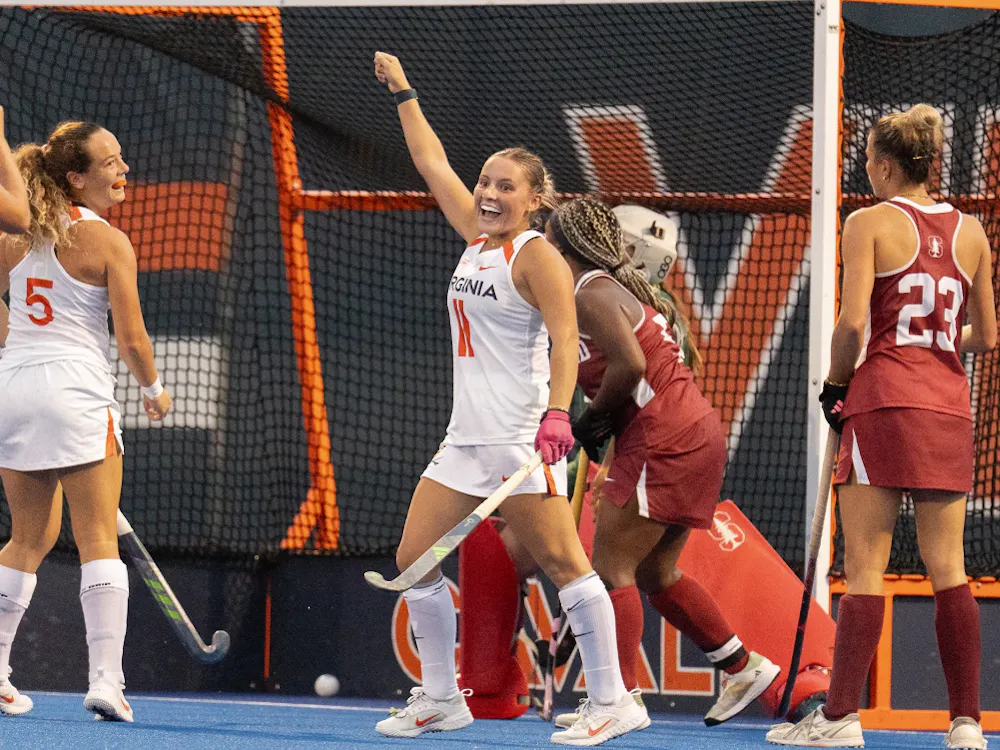
No. 13 Virginia field hockey splits weekend against Stanford, No. 11 California
By Jack Schocket and Eleanor Lynch | YesterdayThis weekend did not produce the clean sweep the Cavaliers wanted — instead yielding two different outcomes with separate lessons to be learned.

While playing in the back, Mia Abello is always looking forward
By Eleanor Lynch | YesterdayFor Virginia field hockey, a player who regularly steps up to take that shot is fourth-year back Mia Abello.