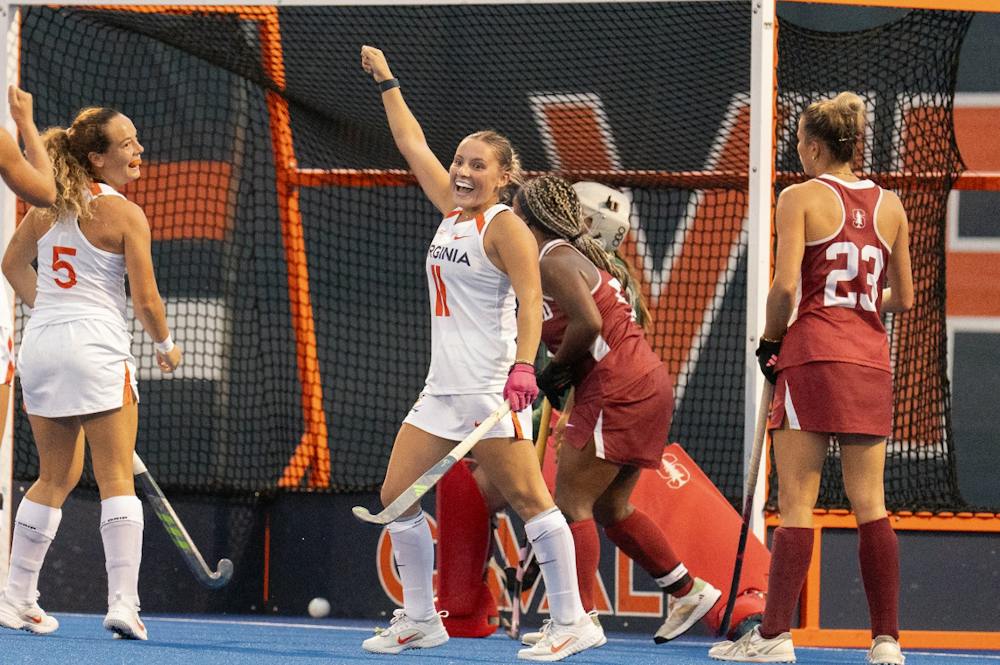
Last weekend, Virginia field hockey experienced two very different versions of itself. On Oct. 9, the Cavaliers (6-4, 2-3, ACC) turned what had been a close, 2-2 game into a 5-2 victory over Stanford, scoring three times in the final 16 minutes. On Sunday, Virginia managed just six shots against No. 11 California and spent much of the afternoon defending, eventually falling 2-1 in overtime.
The Cavaliers did not immediately turn their pressure into a lead when they faced the Cardinal (7-4, 0-3, ACC) — even though the Cavaliers earned two penalty corners in the first three minutes, Stanford was able to strike first.
Virginia quickly began to answer later in the opening quarter, despite being down a player due to a green card. Fourth-year back Mia Abello finished a penalty corner after a pass from fourth-year forward Emma Watchilla, and the Cavaliers’ energy continued into the second quarter when first-year forward Livvy Barker drove toward the cage and sent the ball into the goal.
The Cardinal continued to push, tying the game 2-2 on a penalty corner just before halftime. Although Virginia had controlled much of the action, they did not have much to show for it. The Cavaliers held a 9-2 advantage in shots at the break and had put six shots on goal, but Stanford’s junior goalkeeper Anya Jackson repeatedly kept the Cardinal in the game — that changed in the second half.
The third quarter passed largely without offensive excitement until Virginia earned a penalty corner with less than a minute remaining in the period. Stanford committed a violation on the ensuing play, giving the Cavaliers another opportunity.
Second-year forward Riley Savage sent the ball into the circle, and once again Watchilla was able to control it and find Abello — who scored again. For a player who has spent countless practices rehearsing the same sequence, the moment did not require time to stop and think.
“I visualize it,” Abello said. “I trust the inserter, trust the stick stopper and then I just do the fun part, and shoot the shot.”
Virginia had its first lead of the night — and they did not give it back. Five minutes into the fourth quarter, first-year midfielder Marisa Fahning sent a strong pass to Savage. Savage stopped, spun and sent a backhand into the top corner of the cage to give the Cavaliers a two-goal cushion.
Second-year midfielder Rylee Dennis added a fifth goal with less than four minutes remaining in the game, topping off Virginia's highest-scoring match of the season. The Cavaliers ultimately finished with 21 shots to Stanford's three, and nine penalty corners to the Cardinal's one.
More importantly, Virginia capitalized on the pressure that had been present in previous games. The week before, the Cavaliers were shut out 3-0 by Syracuse, despite generating enough opportunities to keep the game competitive. Against Stanford, those opportunities became goals, a difference that Coach Ole Keusgen attributed to execution.
“It’s just a matter of execution on corners and finishing those simple goals around the scoring area,” Keusgen said.
Sunday's matchup versus California presented an opposite challenge.
Virginia again scored first, with Abello awakening the scoreboard by converting a penalty corner early in the first quarter. But this time, the Cavaliers were not the team presenting the bulk of the pressure.
The Golden Bears (7-3, 1-2, ACC) recorded 12 shots in the opening quarter and earned six penalty corners — and Virginia held them off. The Cavalier defense repeatedly absorbed the force, while fourth-year goalkeeper Nilou Lempers kept California from turning its opportunities into an early lead.
Halfway through the game, Virginia still led 1-0 — but it could have been more. With less than a minute remaining in the second quarter, the Cavaliers earned a penalty stroke. Abello's attempt to send the ball straight back into the cage was stopped by the Golden Bears’ graduate goalkeeper Carine Van Weichen, a missed opportunity that became more significant as the game went on.
California eventually broke through late in the third quarter when its sophomore forward Josefina Moyano tied up the game. From there, Virginia spent the remainder of regulation trying to keep the Golden Bears from finding the decisive goal — a task Lempers was up to.
The Cavalier goalkeeper made 15 saves over the course of the game, repeatedly preventing California from taking control of the scoreboard despite a massive advantage in chances — the Golden Bears finished the game with 25 shots and 17 penalty corners.
“Nilou and our defense penalty corner unit did a great job,” Keusgen said. “They kept us in the game way longer than they should have. They have done a great job all year and especially Nilou, she has been exceptional.”
Virginia's defense held long enough to force overtime, but could not hold much longer after that. California earned a penalty corner fifty second into the extra period and converted the shot to end the game at 2-1.
This weekend did not produce the clean sweep the Cavaliers wanted — instead yielding two different outcomes with separate lessons to be learned. Against Stanford, Virginia's offense eventually caught up to its territorial advantage. Days later against the Golden Bears, the Cavaliers’ defense had to compensate when the offense could not create the same volume of chances.
Virginia went from 21 shots and nine penalty corners Friday to six shots and two corners Sunday — those numbers make the contrast clear. For a team that is still learning how to respond to different kinds of opponents, this may be instructive. The Cavaliers proved Friday they can recover after conceding and punish their opponent when the chances come. Sunday showed that Virginia can remain competitive even when the game is being played largely on the other end of the field.
As the Cavaliers continue their ACC slate Friday, traveling to Boston College, they will have to find a way to combine both.
Read More

While playing in the back, Mia Abello is always looking forward
By Eleanor Lynch | 14 hours agoFor Virginia field hockey, a player who regularly steps up to take that shot is fourth-year back Mia Abello.

Virginia begins backslide with Florida State loss
By Joe Schwiesow | YesterdayVirginia could not “get-right” between their first two losses, and now they lack much breathing room and time to right the ship.

With win over Queens, Virginia’s fuddling dilemma on full display
By Michael Liebermann | Yesterday“It’s balls into our penalty area,” Gelnovatch said. “It’s all it is.”