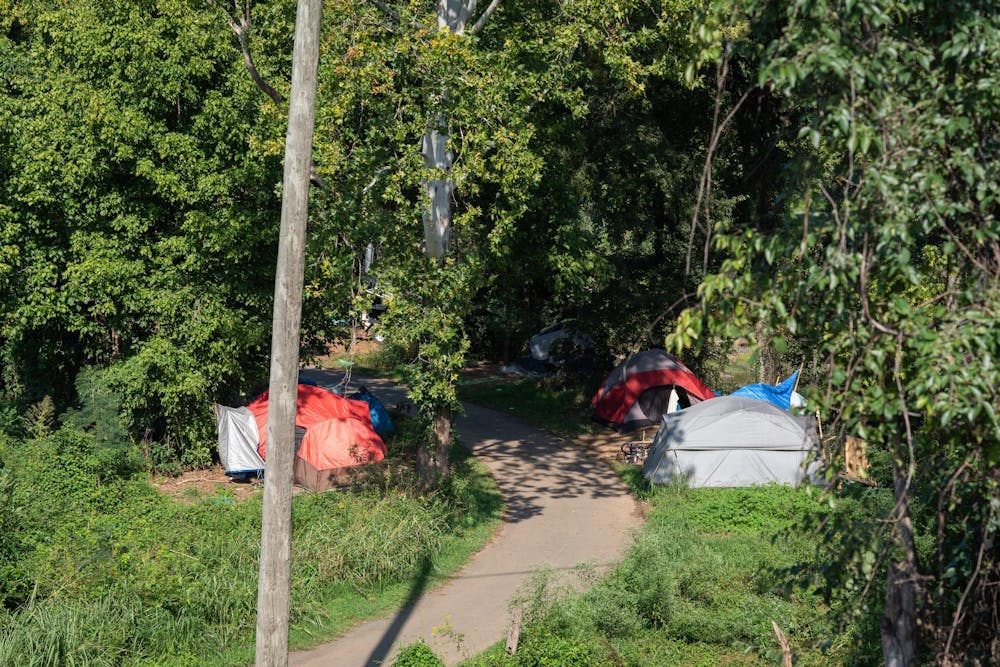
Over 100 Charlottesville residents filed into the Charlottesville City Council meeting July 20. The tension was palpable as citizens eagerly awaited their turn to voice concerns during the public comment session for a recent plan. Just three days earlier, the city had announced its plans to clear the homeless encampment that had formed along the Rivanna River near Free Bridge by Sept. 1. The air was thick with hostility between two distinct sides. A group of Charlottesville citizens praised the removal for breaking up a site where occupants “openly consume drugs, harass residents for money or create dangerous or unsanitary conditions,” as one Greenbrier resident put it. Shooting back, others emphasized the lack of options provided to them, and Free Bridge inhabitant Donez Chambers criticized the opposition for “blam[ing] the homeless people for being homeless.”
Like so many other American cities, Charlottesville is struggling to balance these competing stakeholders. And despite well-meaning efforts from the City to work with the homeless by visiting the Free Bridge encampment and providing a new shelter on Holiday Drive, many people at the site are likely to end up back on the streets and in worse, potentially life-threatening, conditions. The Free Bridge encampment removal is thus immoral and ineffective at addressing local homelessness. This controversial announcement exposes why unproductive solutions such as Charlottesville’s fail — it also exposes the erroneous way in which many of us, especially college students, perceive homelessness.
Within America, there are two incompatible perspectives on homelessness. Some citizens believe that this problem is the result of criminality, substance abuse and, above all, personal laziness. Rather than acknowledging the role of exploitative economic and housing systems, they argue that personal factors guide homelessness and push back against everyday people paying for policymaking solutions for housing. On the flip side, others treat the homeless as entirely passive victims without recognizing the need for drug treatment programs, financial training and mental illness services to help those experiencing homelessness on a personal level. In reality, both perspectives are flawed. Only by targeting larger systemic failures, as well as individual barriers to finding a job and later home, can a comprehensive solution to homelessness be produced.
The Free Bridge encampment clearing delivers a case study for examining these false narratives and inadequate solutions. To begin, it is important to grasp why the community is being broken up. Officials have pointed to safety concerns regarding potential flooding during the September flood season as a crucial risk for current inhabitants. In addition, within the span of a month, there were reports of a sexual assault, campsite fire and even a deceased person found in one of the tents. However, to call a spade a spade, this removal is not being done for the well-being of the homeless, but rather, to relieve the political pressure piled on by threatened Charlottesville citizens. A removal process that should occur over the course of many months has been fast-tracked to just over 40 days due to voter concerns. Furthermore, the ordinance criminalizing the encampment after Sept. 1 is a key example of how the city is using coercion to achieve this project rather than simply providing better options.
Despite the actions of Charlottesville's City Council, there are proven options to work toward solving homelessness. Instead of this chaotic and mandatory eviction that simply shifts the problem around the city, a combination of Permanent Supportive Housing, rather than mere shelters, along with inclusive entry-level job programs has shown great success in Virginia counties such as Henrico. PSH pairs affordable housing with key services like mental health care, substance use treatment and job training. Although Charlottesville does have PSH locations, they are often at capacity, and there are far too few options to support the community's needs. Studies show investments in PSH have decreased chronic homelessness by 30 percent since 2007 and reduced the costs endured by cities from the chronically homeless by almost 50 percent. Research has also emphasized the effectiveness of skill training and programs that can help the homeless overcome resource barriers. Charlottesville has the ability to satisfy both sides of the equation when it comes to homelessness prevention — housing and personal development — and in doing so could finally take a productive approach to the problem.
Rather than using the police to criminalize homelessness, cities like Wichita, Kan., and Houston used the police to create a homeless outreach team and work directly with these people to find shelters and jobs. In fact, these cities even created a system to remake identification cards for anyone who had lost theirs, a key barrier for many unhoused individuals attempting to apply for jobs and government benefits. Houston reduced homelessness by over 60 percent in a little over a decade. These data-backed solutions recognize people experiencing homelessness not merely as resigned victims, but as citizens trapped in the structural pitfalls of our society — individuals with whom they need to work on a personal level to solve this crisis. Although the outreach team on the Free Bridge encampment removal is a start, mobilizing law enforcement and creating larger programs is necessary for Charlottesville.
As students of the University, we hold a large amount of responsibility for driving up housing costs in Charlottesville. It is not just greedy landlords, but all of us who contribute to this issue. If we are to solve homelessness, temporary band-aid solutions like expelling or breaking up homeless communities will only displace more residents, alienate them from local governance and end up merely criminalizing this predicament. Indeed, substance abuse, mental health issues and criminal activity do play a role in exacerbating the problem, showing the need for programs that directly address these challenges. But homelessness is also the symptom of a failing society, one that has left behind a portion of the populace. We all have a duty to address this problem, and we can begin by opposing this rushed and ineffective Free Bridge encampment removal.
Nat Taylor is an opinion columnist who writes about politics for The Cavalier Daily. He can be reached at opinion@cavalierdaily.com.
The opinions expressed in this column are not necessarily those of The Cavalier Daily. Columns represent the views of the author alone.
Read More

DUTTENHOFER: A case for 287(g) agreements
By Lucy Duttenhofer | YesterdayICE is not going away. 287(g) agreements are not, either. Understanding and using them effectively must be a priority.

YOUNIS: University networks protect rapists
By Ayat Younis | 3 days agoWhen a university's response to sexual violence is limited, who is the institution actually protecting?

HAWKINS: The Cornell sexual assault scandal showcases the importance of student journalism
By Joshua Hawkins | 3 days agoWhile the Cornell University administration faltered, it was the students who rose to the occasion.