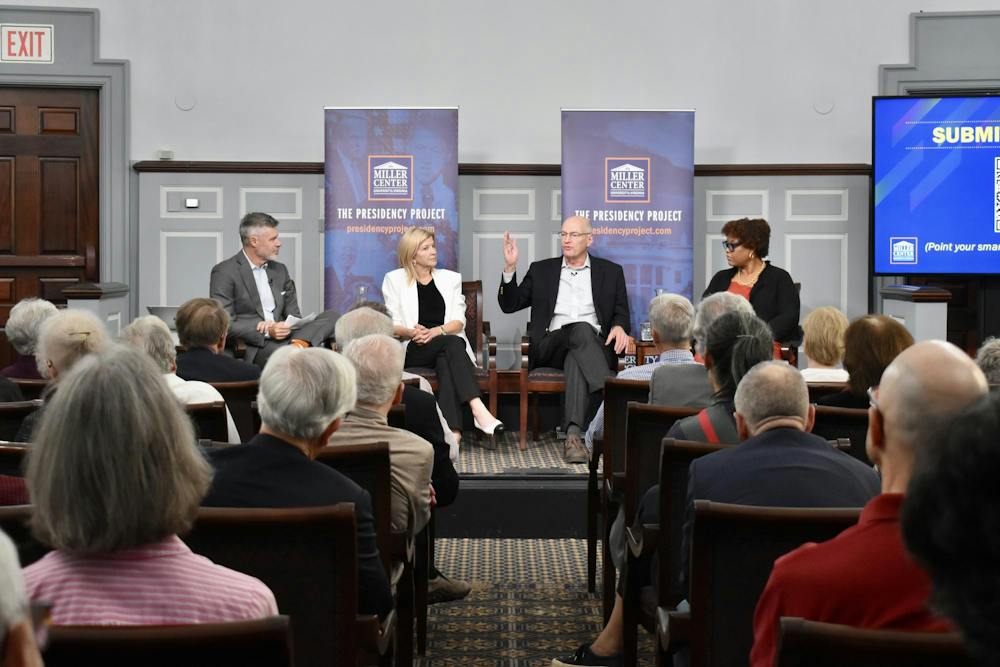
Maya MacGuineas, president of the bipartisan Committee for a Responsible Federal Budget, David Wilcox, senior fellow at the Peterson Institute for International Economics, and Shalanda Young, the Compton Visiting Professor at the Miller Center, were joined by moderator Michael Lenox, Tayloe Murphy professor of Business Administration, Thursday to discuss the state of federal debt. Panelists warned about the risks of the rising debt and interest rates to the future of the U.S. economy, as well as the difficulty of getting policymakers to address the issue.
The Miller Center is a nonpartisan institution specializing in how the U.S. presidency addresses national priorities. The Center hosts events to bring together scholars and other experts who discuss front-facing issues in America.
During Thursday’s event, MacGuineas first said that the federal debt crisis could already be upon us, citing the fact that current borrowing exceeds $2 trillion to fund the budget deficit, which crowds out other investments in the economy that would lead to more productivity. Additionally, she stated that this decreased productivity exacerbates the existing lack of productive workers, with the country’s elderly population growing and fewer immigrants entering the country.
Current borrowing, mostly through Treasury securities to both domestic and foreign investors, continues to be a problem MacGuineas said has existed for decades. This occurs when overborrowing in times of strong economic conditions means that necessary borrowing, such as during the COVID-19 pandemic and the Great Recession, augments the debt crisis and further adds to the currently $32 trillion tally.
“When you borrow too much, it slows the growth of your economy,” MacGuineas said. “We all make less money today than we would have if we hadn’t been borrowing so much in the past.”
The concrete effects of the fast-rising federal debt are numerous, the panelists agreed. The effects come in the form of rising federal interest payments which balloon the debt even further and restrict the government’s ability to adjust its budget, as well as increasing borrowing costs for businesses which only further hamstrings the economy, MacGuineas noted. Further, Young warned that the government’s ability to borrow during the next economic downturn could be reduced.
“I worry about the fiscal space,” Young said. “You get [into] another COVID [pandemic] or recession, and you can’t do spending in which to jumpstart the economy because your interest payments are a trillion dollars today and going to be double that in 10 years.”
Wilcox raised another issue with current conversations surrounding the deficit, which is that voters simply do not know that the problem exists.
“Serious conversation about this issue in front of the electorate, in the best of my ability to detect it, simply almost literally doesn’t exist,” Wilcox said.
In political spaces where the federal debt does get discussed, the panelists agreed partisan agreement is hard to come by. MacGuineas described recent shifts in partisan ideology where both Republicans and Democrats are on the side of cutting taxes and increasing spending, and neither group is incentivized to give their opponents a “win” with upcoming elections in mind.
Still, Young warned against turning the staggering federal debt number into a “political football,” where policymakers treat it as a talking point to fight over rather than something they need to actually act upon. She described the only way of making real progress toward a solution as being something that must be bipartisan — or even better, not political at all. Further, to really understand the federal debt, Young claimed policymakers cannot use intangible terms like “a trillion dollars” that mean nothing to the average American due to the unimaginable size and scale of the number.
“We need to elevate the conversation beyond just yelling at each other from red and blue, or we’re not going to fix any of this,” Young said.
The panelists agreed that any potential solution to the debt crisis will not be easy to come by, and will require sacrifices both by average Americans and the political elite. MacGuineas argued that spending changes or tax hikes alone will not be enough, and that a combination of the two would be the most likely to make an effective difference. Another key issue she stressed was the impending 2032 deadline to address Social Security’s financing problem, with this being a potential item of a future fiscal package.
Although the federal debt interest is currently one of the top items in the government’s budget, Social Security is the largest. And with the growing elderly population in the U.S., MacGuineas cited that the trust fund will run out in 2032 if the design of the program does not change, potentially causing more borrowing and a larger federal debt. Furthermore, Young warned that waiting until the trust fund runs out in 2032 may be too late.
“Social Security has a financing problem. We don't bring in enough to pay for the program we design, and we need to deal with that. And I hope we don't wait until 2032 to deal with that,” Young said.
Young argued that besides these fiscal measures, policymakers must also pay more attention to which investments could boost future growth. Additionally, she urged policymakers to look at fiscal indicators and the debt’s trajectory rather than the single headline number to make solutions. The panelists agreed that it is not too late for the U.S. to make meaningful changes to avoid a real debt crisis, but that action must occur soon.
“We know what the problems are, we know what the options are to fix it. And then we have a debt and deficit problem. We know it’s high … and we need to have more serious conversations,” Young said.
Solomon Ross-Milligan is a staff writer on the news desk from Charlottesville. He is a second-year College student.
Read More
U.Va. launches asynchronous pathway for bachelor of interdisciplinary studies degree
By Sophie Smith | 55 minutes agoThe BIS degree program offers a flexible way to earn a degree while considering adult life and busy schedules, according to Joshua Katz, senior associate of communications at SCPS.

Latest compliance report details Community Engagement and Equal Opportunity hiring freeze, Law School anti-discrimination updates
By Grace Little | 9 hours agoWednesday’s report also includes granular changes in the School of Law, primarily regarding new formal documentation of anti-discrimination compliant policies having to do with recruiting, promotions and admissions.
Student Council appoints members to election reform commission
By Lucia Gambacini | 2 days agoStudent Council also announced several other cabinet appointments and discussed concerns surrounding parking on Central Grounds.