
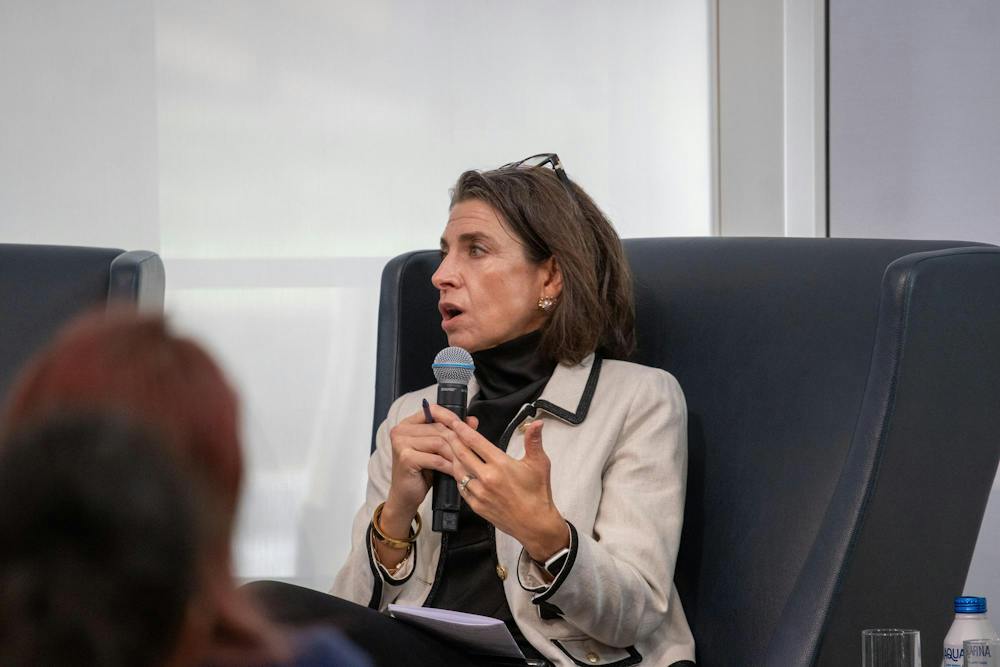
The School of Law held a book panel Thursday titled “Predicted: How AI Is Restructuring Social Life,” by Mona Sloane, assistant professor of Data Science and Media Studies. The LawTech Center and the U.Va. Digital Technology for Democracy Lab co-sponsored the event, and it was open to the public.
Sloane was joined by Jenny Davis, Gertrude Conaway Vanderbilt Endowed Chair and Professor of Sociology at Vanderbilt University, Kirsten Martin, H. John Heinz III Dean of the Heinz College of Information Systems and Public Policy at Carnegie Mellon University, and Ari Ezra Waldman, Professor of Sociology at the University of California, Irvine. The panel was moderated by Danielle Keats Citron, Jefferson Scholars Foundation Schenck Distinguished Professor of Law and director of the LawTech Center, and Elizabeth Rowe, Elizabeth D. and Richard A. Merrill Professor of Law and director of the LawTech Center.
Sloane runs the Sloane Lab at the University, an interdisciplinary research group focusing on the intersection of artificial intelligence and cultural, economic, material and political conditions. The Lab also launched the Student Technology Council initiative, which is meant to act as a legislative body for student representatives to advocate for technology policies on Grounds.
According to Sloane, AI is changing the social significance of the future being unknowable, with many positing that AI will eventually deem human decision-making an inefficient practice. Sloane said this premise is flawed, and AI cannot truly innovate when problem solving.
“When our communities grow frail, AI starts to look like the better option for making decisions and for producing knowledge, but that moves us backwards,” Sloane said. “AI can only find old solutions to old problems, but people can find new ones.”
In an interview with The Cavalier Daily, Law student Laura Arrieta said she attended the event to understand how AI is affecting society. She said she believes that overdependence on AI is changing the way humans use their brain.
“I think that by depending so heavily on AI, we are losing a lot of our fundamental ways of thinking … The landscape is changing, but I don't think that means that there's no way of putting a stop to it,” Arrieta said.
Sloane said that amidst a climate that tends to exaggerate AI’s innovation, AI needs to be taken “from the pedestal” and treated like “infrastructure” — giving oversight into the hands of the people.
Rishi Chandra, STC Member and third-year College student, said in an interview with The Cavalier Daily that he came to the event to learn more about the societal impacts of AI, and he resonated with the message of treating AI like infrastructure.
“[The] idea of AI as infrastructure was really important,” Chandra said. “This idea that we need to treat it like a utility, like water [or] electricity, and therefore we need that same government oversight [is] such an important framing.”
Martin, a member of the panel, also focused on the dangers of AI, economically and socially, during the panel. She said that in discussions surrounding AI, people may forget to talk about the hidden “costs” of AI, using the hypothetical of a Flock camera. The cameras compose a network of automated cameras recording license plates and other characteristics of vehicles, and much debate around this technology has centered on claims that law enforcement agencies have accessed and abused this data for unauthorized purposes.
Law student Tim Ward attended the event and said that before coming to the University, he worked on leading AI adoption at his job. He explained that he saw firsthand how AI companies were lowering their prices to maximize AI adoption.
“Companies [are] coming in, selling their tokens for very cheap, forcing companies to become really reliant on it,” Ward said. “People are so terrified of falling behind that they're going all in on this. [AI is] very cheap right now, in a way that's unsustainable [and] people are being laid off.”
Another attendee of the event, third-year College student Owen Watslavick, said that he sees AI as having the chance to be either a positive or negative for society and resonated with the message of treating AI like a public utility.
“While AI has immense capability for being super positive for society, it also has the chance of being profoundly negative,” Watslavick said. “AI as public infrastructure was really interesting. … Roads or water or electricity [are] all controlled through public ownership and public governance. I think [public ownership] is very important for AI.”
Davis said that AI has become a social infrastructure. Social infrastructure includes spaces, institutions and systems that support connection and community life, and AI is increasingly fitting into this category as it takes on a more supportive, background role.
“If we are all AI experts now, as Mona [Sloane] often points out we are, the book's demystification delivers us the tools to exercise that expertise,” Davis said. “We know that infrastructures are hidden until they break, but infrastructures are also revealed when people name and illuminate them.”

Edward Christopher is a staff writer on the news desk as well as a member of the advertising team for The Cavalier Daily. He is a second-year Commerce student from Northern Virginia. Edward enjoys covering state politics and University developments.
Read More

University launches new Program in Digital Humanities and AI
By Naren Senthilkumar | 2 hours agoAccording to the University’s website, the program is intended to function as a coordinating hub for the College's digital, computational and AI-based approaches to humanistic inquiry.

U.Va. Health Emergency Department among most expensive trauma centers in Virginia
By Michael Racz | 2 hours agoIn comparison to other nonprofit level 1 trauma centers in Virginia, the University Medical Center had the highest self-pay rate — the amount charged to patients who pay out-of-pocket rather than through insurance — for Emergency Department facility fees and was among the most expensive for other treatment services, including CT scans and various blood tests, based on published pricing data.

U.Va. climbs in FIRE free speech rankings, but fails to regain top spot
By Nicolas Biernacki | 23 hours agoThe Foundation for Individual Rights and Expression released its 2027 college free speech rankings Wednesday.


