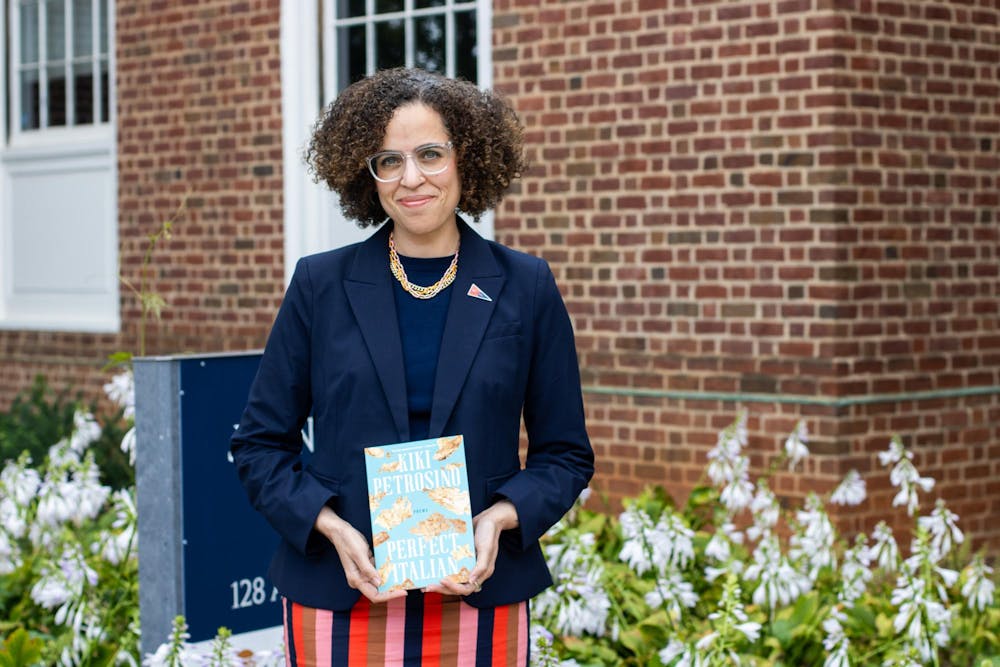
While University professors may seem fond of assigning lengthy writing assignments to their students, they themselves are often prolific published writers. In subjects ranging from politics to biology, professors often turn their expertise and knowledge into a piece of published writing and occasionally assign their own works in their courses for a unique, intimate academic experience. One of the newest such titles is “Perfect Italian,” a poetry collection by Poetry Prof. Kiki Petrosino.
In this work, Petrosino examines her own heritage and identity, using engaging yet deeply personal language, vivid imagery and carefully crafted syntax as ways to express her connection, and lack thereof, to her family’s history. She is holding a reading to officially launch “Perfect Italian” Sept. 25 at 7:00 p.m. at New Dominion Bookshop in downtown Charlottesville.
Petrosino works primarily in the University’s English department, specifically in the Creative Writing Program, teaching both undergraduates and master’s students. Her connection to the University also traces back to her time as an undergraduate at the University, receiving her bachelor’s degree in English in 2001 and participating in the creative writing community on Grounds.
In recent years, Petrosino has explored the relationship between her African-American and Italian-American heritages, ideas that ultimately inspired the creation of “Perfect Italian.” Petrosino studied Italian for the first time in her life as a student at the University in the late 1990s, with the desire to learn more about Italian culture and be able to speak the language with her paternal grandfather, who was born in Italy.
“The book is about being what you might call a heritage learner of a language, meaning you didn't maybe grow up as a mother-tongue speaker of that language, but you have, because of your own family heritage, a personal connection to it,” Petrosino said. “The book explores the idea of belonging and family from the lens of learning another language.”
Across dozens of different poems, Petrosino explores relationships between family members, both living and deceased, examining how the experiences, decisions and accomplishments of one’s ancestors affect modern generations.
“Perfect Italian” is the third installment in Petrosino’s trilogy about identity, heritage and belonging from a multiracial perspective — all extremely personal topics. In 2020, Petrosino released “White Blood: A Lyric of Virginia,” a poetry book written from the professor’s perspective as a descendant of African-American Virginians. This work discussed the complex legacies of Black identity in Virginia from Petrosino’s perspective. For the second installment in 2022, Petrosino wrote the memoir “Bright,” sharing stories about diasporic identity through prose vignettes. “Perfect Italian” acts as a closer to this series, where the author touches on the presence and absence of her Italian-American heritage throughout her life.
“I think that each book feels excruciating in its own way because I think that writing, especially from a personal place, makes you vulnerable,” Petrosino said. “You know, that's something that I help my students kind of put language around as well — is that you bring to the page something of your real self with every project.”
While Petrosino has imbued her knowledge of and experience with poetry through her teaching, her journey with the art form began when she herself was a student. The author said that she began writing when she was young, finding her love for poetry in high school. Petrosino said that her high school English teacher held weekly poetry writing workshops with some of her students and told the future University professor that she had a talent for poetry.
“There's usually like one amazing teacher that you have in your youth that kind of helps to set you on your path,” Petrosino said. “And I gained a lot of confidence from her, from her insight and from her belief in me.”
“Perfect Italian” is broken into multiple sections, with Petrosino choosing the order of the poems after they were written. When determining the placement of each work, the author said she was heavily influenced by music.
“I often think about my poetry as a musical consideration,” Petrosino said. “So I think about where we begin. What kinds of sounds do we start with in the book, or from poem to poem? And then where does the poem leave us by the end? And is there an echo? Is it a hum? Is it a vibration? And then what is the next sound that should go after that?”
In each of her works, along with the common thread of heritage and identity, Petrosino said that she experiments with different forms and styles of poetry. While creating this poetry book, Petrosino said that she challenged herself with writing in certain syllabic patterns, taking inspiration from both English language and poetic style and Italian music. For example, in “Perfect Italian,” many of the poems are short and condensed. The poems seen at the beginning and end of the collection are 10 lines long with 10 syllables per line, which Petrosino said many writers have used to convey meaning across the history of the English language.
“I wanted to use 10 syllables because it feels like a sentence,” Petrosino said. “It feels like a conversational kind of sentence, and I wanted to use 10 lines because 10 lines is just enough and not enough … It left things in a little bit more of an ambiguous place by the end of the poem, and that allowed me to have some momentum to jump into the next 10-line poem.”
In contrast, the poems in the middle of the book are written with seven- and four- syllable lines. Here, Petrosino said that she was inspired by the format of a stornello, a 19th-century Italian song with 11-syllable lines. Since the form of a stornello is made for the Italian language, Petrosino calls the version in her book “Stornello’s Bagliato,” which translates to “erroneous,” or “wrong stornello” since it is written in English.
Petrosino said that she found writing certain pieces to be especially emotional amidst the creation process. “Elegy,” one of the poems with 10 lines and syllables, is dedicated to Petrosino’s father, who passed away last July. Petrosino wrote this piece before her father passed and said it was eerie to realize she had written an elegy, a poem that reflects on the loss of someone who has passed, without knowing it in the moment.
The opening poem in the book also stands out to Petrosino, beginning with a line from the television series “The Sopranos” that the main character says — “I came in at the end.” In Petrosino’s context, which differs greatly from that of the show, she said that these words connect to belonging and family, two topics vital to the creation of this compilation of poetry.
“Each new generation comes in [at] a certain place within the trajectory of [their own] family,” Petrosino said. “I kind of wanted to think about what it meant to occupy the space that I occupy in my particular family line, and I also wanted to reference the whole universe of Italian Americana that's out there in the culture.”
Petrosino said that poetry facilitates self-expression and freedom, an art form enabling people to use language, writing and music as meaningful ways of communication to convey important messages.
“What I love about writing poetry right now is the capaciousness that poetry gives us as a genre to address different topics in a variety of forms,” Petrosino said. “I think about language as material. The way that a painter has paint, poets have language, and if we think about language that way, then suddenly poetry becomes this massive field that opens up.”
Read More

U.Va. Arts Welcome Picnic showcased the many ways to engage with art on Grounds
By Cece Sherman | 14 hours agoUniversity creatives, student-led Contracted Independent Organizations and local organizations were welcomed by U.Va. Arts to the Betsy and John Casteen Arts Grounds Sunday for the annual Arts Welcome Picnic.

How generative AI is — and is not — affecting arts education
By Alena Touve | 17 hours agoAs University arts professors begin teaching in the new semester, the industry-wide debate about AI’s role in art will frame how professors approach class discussions, assignments and preparing students for what awaits after graduation.

On Repeat: Songs for summer’s final sunsets
By Eloise Diffley | YesterdayThese songs are perfect for soaking up the last few drops of summer sunshine and serve as a great soundtrack for the first few weeks back in Charlottesville.