
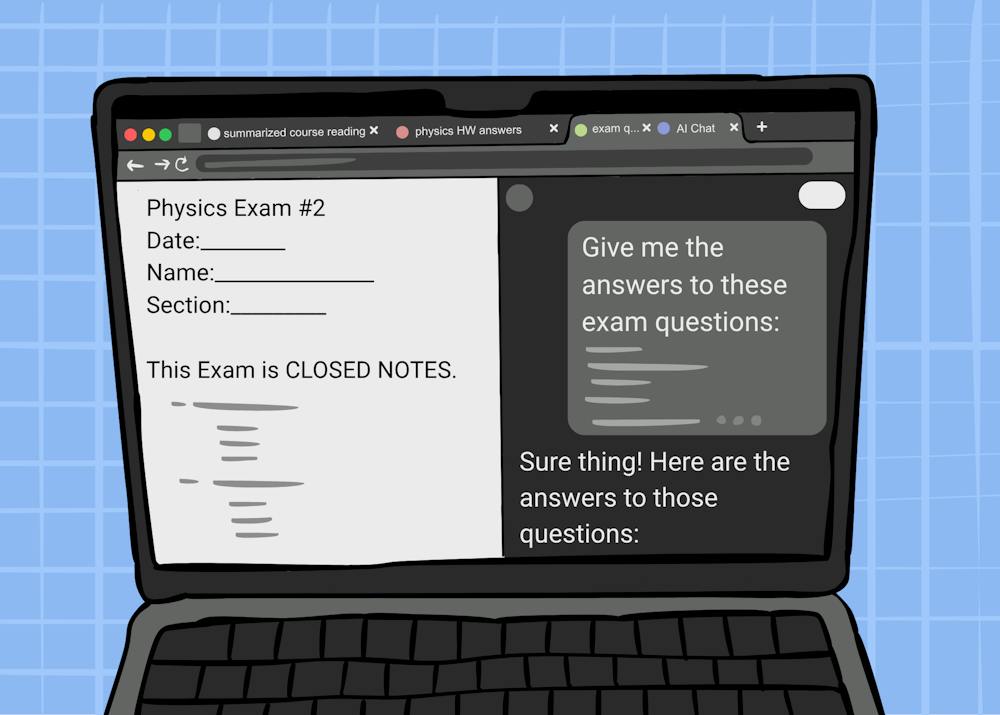
Rapid development of artificial intelligence has increased concern of academic dishonesty inside and outside of the classroom. Professors in three University departments described their experience with AI use in their own classrooms where large language models pushed them to rewrite assignments, restructure exams and in some cases, rebuild entire courses.
The University does not have a single policy governing student or faculty use of AI, leaving specific policies and permitted uses to the discretion of individual instructors and departments. In interviews, Asst. English Prof. Piers Gelly, Computer Science Prof. Sebastian Elbaum and Chemistry Prof. W. Dean Harman each described reaching different conclusions on AI use in their classrooms. Their conclusions are shaped less by concerns about dishonesty and more by what disciplines require students to accomplish without help, they said.
All three professors clarified that their insight on the matter of AI use in their classrooms is specific to them, and none of them are representative of their broader department’s policies or views on AI use.
Gelly, who teaches writing and rhetoric courses, has spent the past several years teaching a section of ENWR 1510 that he calls “You and AI.” He said he has taught two sections of the course every semester since the fall of 2022, and is now teaching it for the seventh and eighth time, revising it each term as the technology changes.
The University requires a majority of first-year students to fulfill a general writing requirement, which cannot be tested or opted out of, and Gelly’s course teaches college-level writing while making AI its subject matter. Gelly said he opens the first day by asking students to weigh whether the course they are required to take is still worth taking at all.
“This is a course that U.Va. requires you to take in some form, and do we still need it?” Gelly said. “Do we still need a course like this one in an age where ChatGPT can do a pretty good and increasingly better job of generating writing?”
Gelly said that an abstinence-only approach to AI would not work for teaching a writing class, because students were already using the tools. He further noted that there are some classes where it is useful to ban AI, but that his course is built around having students test what the tools can and cannot do.
In an earlier version of the course, Gelly said, students designed and taught a lesson on AI to the rest of the class as a final assignment. This semester, he said, students will write policy proposals for how University faculty should and should not use AI in their own teaching.
“[Whether using AI is cheating] would depend on the assignment,” Gelly said. “One thing I try to do in my class is to be very clear about when I do and don’t want them to use AI … Where I’m at now is I just say, ‘if I haven’t told you not to use it, you can use it, but you have to tell me exactly how you used it.’”
Gelly also teaches courses in which AI plays no part at all. He taught a 2026 summer session course called “Brain Rot (1854 to 2026)” entirely outdoors, using print copies of his texts that he purchased for students, and the students handwrote all of their essays. Next semester, he will teach a 3000-level creative writing course about technological refusal. In his ENWR sections, students place their phones on a table, out of reach, for the duration of the class.
Gelly said those choices are not enforcement mechanisms so much as they are used to disincentivize the use of AI. He explained his belief that technology as a whole is designed to be tempting, so the only way to ignore that temptation is to take a collective approach against technology in the classroom.
“The reason I’m doing it in print is to create some gentle barriers to avoid the temptation,” Gelly said. “I think that the notion that it’s an individual's moral failing that someone turns to ChatGPT is basically wrong.”
In the Department of Computer Science, Prof. Elbaum described a course on AI in a slightly different way than Gelly. Elbaum is teaching CS 4501, “Special Topics in Computer Science: LLMs and Software Engineering,” for the second time this semester, and he tells students on the first day that he wants them to use the AI tools as much as they can.
“From day one, I tell them AI use is not bad, it’s actually a good thing,” Elbaum said. “I want you to use these tools to the maximum power that you can. I want you to amplify what you can do.”
Elbaum said that sentiment stems from what he said he believes the computer science field is becoming, arguing that the skills the CS departments have taught for decades are becoming obsolete.
“Programming is going to be gone in two years,” Elbaum said. “The process of building software now is not about programming anymore, like we have been teaching for the last 20, 30 years. It’s really about how do you communicate to these models what you want to build … and then how do you check that what it built is what you intended in the first place?”
Though he is supportive of AI use in his courses, Elbaum said he still has to restructure his assessments to determine whether students are actually learning. He uses closed-book quizzes to check whether students have retained assigned readings, and structures assignments so that generic answers earn no credit — one assignment requires students to interview someone in a specific industry, and submissions without specific quotes receive no points.
He said that framing the conversation around AI use as cheating is a problem in itself.
“I think focusing on cheating and things like that is taking away from the focus that we should be having, which is how these tools are transforming what we do,” Elbaum said. “Not giving you these tools puts you at a disadvantage.”
Elbaum compared withholding the tools to training someone to be a carpenter without giving them a hammer, and said that failing to teach students to use them would be “almost unethical.” He said he expects AI to become a required and embedded part of the computer science curriculum rather than a single standalone course.
Harman, who has taught at the University since 1989, held a different perspective on AI where he said cheating rarely arises in his courses at all. He teaches CHEM 1810, “Principles of Chemical Structure (Accelerated)” — a roughly 100-student course that is built around problem sets that students work through in groups. Students are encouraged to attempt the problems without AI, and then go back and consult it to compare results and decide for themselves which to trust. The more substantial grades come instead from long-form paper exams where it is virtually impossible for students to use technology to cheat, Harman noted.
“It’s impossible [to cheat using AI in my course],” Harman said. “In the way I’ve got the course set up, they can use AI all they want. Just like they could use textbooks all they want … But in that process, they’re learning the concepts, and then they have to demonstrate that they learn the concepts in an environment where it’s impossible for them to use it.”
Harman said that he did not have to change his course at all to adapt to the rise of AI — he simply added permission to use it during practice problems, calling the arrangement “a happy circumstance.” He further added that he cannot ensure that students will leave the exam hall and consult their technology outside, but he said he does not think that has anything to do with the use of AI.
However, Harman explained that, though his courses make it difficult for students to cheat using AI, he still worries about its effect on students — students who use AI as a crutch may not learn as well, and students who refuse to use it may never take advantage of the help it can provide as an academic tool.
“I think that this generation of students … are extremely negative on AI right now,” Harman said. “That’s good that they are worried about it, but so worried that they’re not embracing it fully and using it as a tool in the way that they could.”
Where the three professors disagreed distinctly was the role of the University in creating faculty guidelines for AI use. Gelly, who this fall began serving as one of two Faculty AI Guides for the English department, said the issue is that many professors do not have enough time to think about how to redevelop assignments and courses in light of AI.
“There is not really any acknowledgement that I’ve seen on the part of the University that faculty are, in many cases, desperate for the time and resources to develop their teaching, change assignments that they’ve had for a long time, rethink the way that courses work,” Gelly said. “The move isn’t to say, ‘faculty, you should or shouldn’t do this.’ The move is to say, ‘faculty, what do you need right now, and how can we make it easier for you to adapt to this moment?’”
When asked how the University should support professors with AI implementation, Elbaum said he thinks that the University should provide guidelines and resources, but then leave professors to choose for themselves what they want to do with their courses. Elbaum said he would hate to see the University impose “harsh” requirements on course design.
What the University should do immediately, Elbaum said, is pay for access to leading AI tools. He said most faculty he knows pay out-of-pocket for leading AI models, and that in his own course, all of his students pay around $20 a month for their Claude subscriptions.
“Every student and every faculty at U.Va. should have free access to the latest models of Anthropic, for example,” Elbaum said. “I think that's the level of support I would like to see.”
Harman, on the other hand, said he had no criticism of how the University is handling AI use in classrooms, and that he did not consider himself well positioned to judge, given that AI has not posed the same problem in his courses that it has in others. He said he believes that professors need freedom to structure their own courses, and that he had no reason to think the University was overreaching in its policy or guidelines.
However, all three agreed that the pace of change is the biggest issue when it comes to the rise of generative AI. Elbaum, who described himself as an optimist, said his concern is not the technology, but the speed at which AI is changing and whether academic institutions and professors can adjust quickly enough.
“The speed of the change is, I think, the scary part,” Elbaum said. “The speed changes things in a way that it’s hard to even measure the effect before it happens.”
Komal Reddymachu is a second-year College student majoring in government and English. He is a staff writer on the news desk and has been writing for The Cavalier Daily since his first semester at the University. Komal enjoys writing about all topics, but he especially enjoys covering events around Charlottesville.
Read More

Honor Committee continues discussion of changing appeals process
By Isabela Delgado | 12 hours agoThe proposed change would allow the Committee to better determine whether a sanctioned student's appeal is legitimate and would establish new qualifications that an appeal would need to meet to be allowed to continue through the appeal process.

The Board will convene Sept. 16-18 — here is a preview of its meeting agendas
By Grace Little | YesterdayThe full University Board of Visitors will convene Wednesday through Friday to discuss artificial intelligence strategy, updates regarding the provost and dean searches as well as the buildings, finances and compliance of the University.

At first Council meeting since Free Bridge clearing, residents’ and City officials’ accounts differ
By Luca Bailey | YesterdayThe Charlottesville City Council convened for a regular meeting Sept. 8, where residents and City officials presented accounts of the clearing and subsequent early operations at the emergency shelter.


