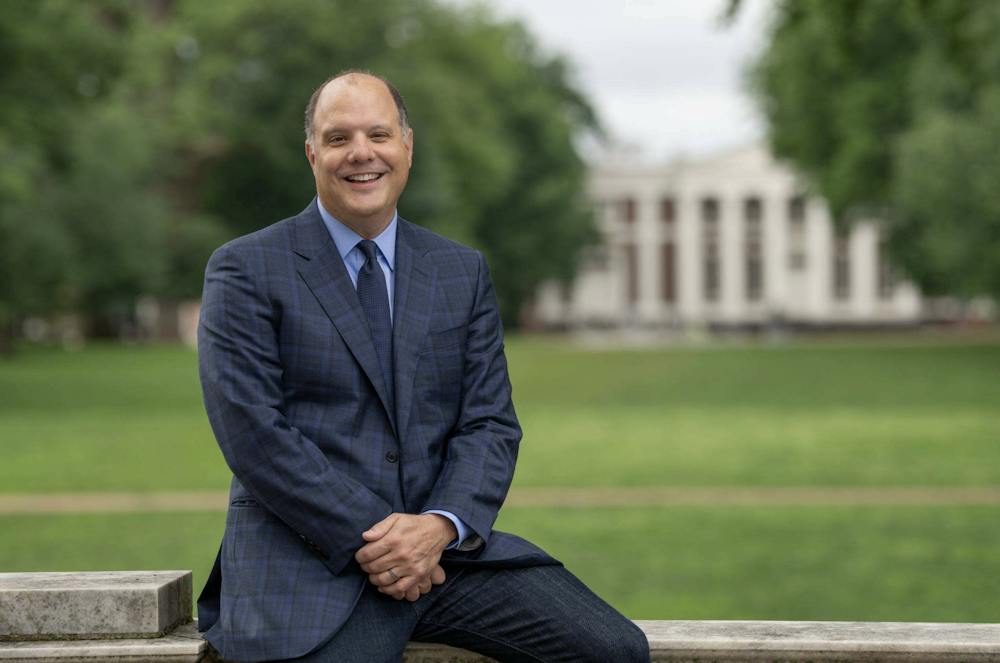
In March, Jeffrey Blume stepped into the role of interim dean of the School of Data Science in the wake of former Dean Philip Bourne’s passing. Previously serving as the quantitative associate dean for academic and faculty affairs, Blume worked closely with Bourne and other leadership to establish the University’s newest school. The University’s Faculty Senate voted unanimously in May 2019 to establish the school — which opened in 2024 — giving data science its own academic home at the University.
For undergraduate students, the school offers a three-year bachelor’s in Data Science — students can apply into the program during the spring of their first year — and a minor in Data Science. The major allows students to concentrate in analytics, systems, design or value, and has “optional collaborative concentrations from across the University,” which allows students to add collaborative concentrations in fields such as neuroscience, economics and astronomy.
Graduate students can enroll in the school’s residential master’s in Data Science which is a full-time, in-person program that can be completed in one year. The M.S. is also offered online and the school offers a Ph.D. in Data Science as well. Finally, the school has a combination degree program which allows graduate students to complete the master’s in Data Science alongside another graduate program at the University. There are also non-degree programs where students can enroll in online “bootcamps,” such as “Linear Algebra for Data Scientists,” and in-person week-long bootcamps designed for middle and high school students.
In 2019, the University received a $120 million donation from the Quantitative Foundation — a private foundation based in Charlottesville — to launch the School of Data Science. Blume said his skills fit with what the school needed to help establish it.
“The dean, then Phil Bourne, was wanting to do everything new and modern and fresh, which sort of fit with my philosophy,” Blume said. “That was the vision that I had when I came, ‘We're just going to build everything from the ground up,’ and we are pretty much the only school in the country that's done that.”
Blume came to the University in 2021, bringing years of experience in biostatistics, public health and data science in higher education. He was recruited to the Vanderbilt Department of Biostatistics in 2008 to help build out its graduate programs and later led Vanderbilt University’s effort to create graduate programs in data science.
According to Blume, having an entire school dedicated to data science is what sets the University’s School of Data Science apart. While data science programs at other universities build their curriculum from existing courses in other disciplines, the University’s school builds all of its own courses around the distinct study of data science, Blume said. While data science’s applicability to other areas of study as an interdisciplinary field is emphasized through the school’s curriculum, Blume said there is importance in separating what is uniquely valuable to data science itself.
Currently, Blume said there is a focus in the undergraduate curriculum on not just creating data scientists, but creating students who “are scientists at heart” and can use data to solve problems. According to Blume, the school trains undergraduate students to view data as their tool, and it hones in on this mission by encouraging its students to explore and apply their learning to other disciplines through the curriculum.
“Our undergraduate program is set up so that we teach you a lot of the data principles first, and then we encourage you to go do a concentration in an area … We're trying to push people … to be interdisciplinary … That I think is going to be a defining feature of what we want to do,” Blume said.
Blume said he was able to build his own curriculum for the data science graduate programs at Vanderbilt, but the classes were taught by professors from other schools, and there were restraints on how far the school wanted to expand the program. At the University, he said he faced none of these limits and felt impressed by the sense of community the School of Data Science was able to build, as well as at the University as a whole.
“U.Va. is unique like that. It's able to really create these cultures, and I think part of it is allowing the schools to have their own identity, and people rally around that identity … it allows them to do new and innovative things and see if those things work … That fosters this sort of intellectual freshness that U.Va. has,” Blume said.
Blume noted that when he became interim dean in March, he became able to foster innovation through the school. In making the transition from quantitative associate dean for academic and faculty affairs, he said he realized the importance of ensuring that the work at the school, such as research, is ever changing to address bigger problems and is broadcasted to a wider array of people.
“I think it's very easy to imagine that a school is comprised of all of its teaching and research, and that's it,” Blume said. “But it turns out that that's not how good schools successfully provide an environment in which teaching can be at its best and research can be at its best … I view the school now as a facilitator for exciting and novel and innovative things that the faculty want to do.”
Looking at current innovation in the school, Blume emphasized that he sees the relevance of data science in a variety of spheres, from health care to policy where decisions and initiatives rely on data. He explained that the school is currently working with radiologists to build artificial intelligence tools that will aid in identifying cancer more efficiently. Blume said he wants the school to play an active role in solving problems in areas of medicine while evaluating the impact of AI, whether that is through research or educating the next data scientists who will lead in this domain.
Finally, Blume reiterated the importance of data science, highlighting the need for students to study it and learn how to use the data science tools.
“We need to get back to some place where [data science tools are] accessible to everybody because these are important tools,” Blume said. “[It is] less about how to do all the little mathematical mechanics because the machines will do them for you now … The art now is understanding what to do with that, and for me, that's the fun part.”
Read More

Who is Gregory Fairchild, chair of the University’s third provost search committee?
By Ruby Budetti | 29 minutes agoThis is the University’s third search committee for the next permanent provost — Beardsley chaired the second committee until January, which paused its work in March.

Student Council discusses meeting procedures and increasing Student Activities Fee
By Lucia Gambacini | 32 minutes agoStudent Council met for a regular general body meeting to consider legislation that would change procedures for meetings during non-academic sessions and raise the Student Activities Fee.

From the Archives: Fraternity life
By Maisy Callahan and Emily Conway | 2 days agoMore fraternities decide to partner with the Historic Renovation Corporation, a University-affiliated agency that provides tax credits for the restoration of historic buildings.