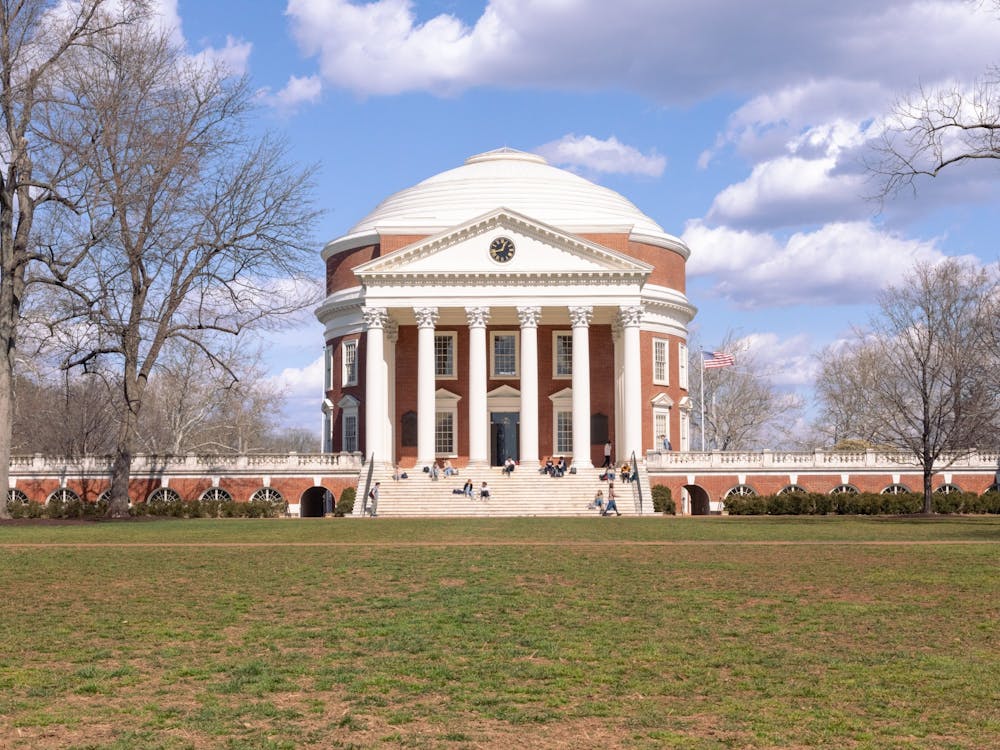
At a press conference Thursday the University confirmed that the Rotunda will be closed during Final Exercises for the Class of 2015.
Traditionally, Final Exercises take place on the Lawn. Graduating students gather on the Rotunda’s north side and walk around the building and down the steps.
Although the Lawn may play some role in graduation for the Class of 2015, the renovations to the Rotunda will be wide-ranging and intrusive. Because of the intensive nature of the $50 million Rotunda renovation project’s second phase, a traditional graduation ceremony will not occur on the Lawn in May 2015. The repairs will render the procession impossible, and the construction apparatus will make an already-packed Lawn squeezed for space. After four years at a school devoted to tradition, students in the Class of 2015 will have to leap into the unfamiliar — that is, life after college — at an unfamiliar place: perhaps Scott Stadium, possibly John Paul Jones Arena.
University officials hope the construction efforts will ensure the Rotunda’s structural health for the next half-century. Still, it’s no surprise that many members of the Class of 2015 are disappointed. Even a student who recognizes the necessity of Rotunda repairs is apt to think: why us?
In the Thursday press conference, the University focused on the construction project’s importance for the school. University officials released press statements comparing the Rotunda renovations to other stewardship projects: the Capitol Dome in Washington, D.C.; the State Capitol in Richmond; and Monticello, among others.
There’s a parallel story here, however, and one that the University did not address Thursday. That’s the story of accelerating (mostly undergraduate) enrollment. In 2010 University President Teresa Sullivan proposed the addition of 1,400 more undergraduate students, to be phased in over four or five years. Sullivan’s 2010 plan has not been executed completely: undergraduate enrollment has swollen from 14,445 in the 2010-2011 academic year to 14,898 students in the 2013-2014 academic year, an increase of 453 students.
Nonetheless, the trend is toward growth, thanks to pressure from the state and the ever-insatiable thirst for tuition dollars. The University has come a long way from being a small club for gentlemen living on the Lawn alongside their professors (a period that’s attained almost mythic status in the minds of many University students). The Lawn, we are told from the start, is the center of the school — and the Rotunda the centerpiece.
The Rotunda renovations not only will prevent the traditional student procession for the Class of 2015 (the stairs will be blocked), they will also impose space constraints on the Lawn. These same space constraints would not exist if the University had fewer students. We’ve got to wonder: was moving graduation off the Lawn simply a matter of time? The rethinking of graduation that the 2015 Class Council plans to undertake may be more than a temporary fix — it may point to how the University does Final Exercises in the future.
We thus come to a related problem. In the University’s early days, the Lawn and the Rotunda were more than just symbols. They were first and foremost physical environments that students walked by, in and on every day. They were centers of community, of learning, of social life. This is still true to a degree, but with each year of enrollment growth the percentage of each class that gets to live on the Lawn by definition decreases: the number of rooms is fixed; the number of students is growing. The size of the Lawn is also fixed. How much longer can this stretch of grass sustain a growing student body?
Read More

EDITORIAL: Reckon consistently with our history
By Editorial Board | November 19, 2024Until these bureaucracies have proven willing to commit to change outright, it is up to us, students and Charlottesville residents, to continue pushing for that change.

EDITORIAL: Scapegoating TikTok will not ensure data security
By Editorial Board | August 24, 2023It isn’t bad enough that Gov. Youngkin is crafting meaningless mandates, he is also forcing the University to act as the enforcement arm of his intrusive, big-government regime.
EDITORIAL: In defense of DEI
By Editorial Board | May 28, 2023Instead of mincing words, we should be taking action.