
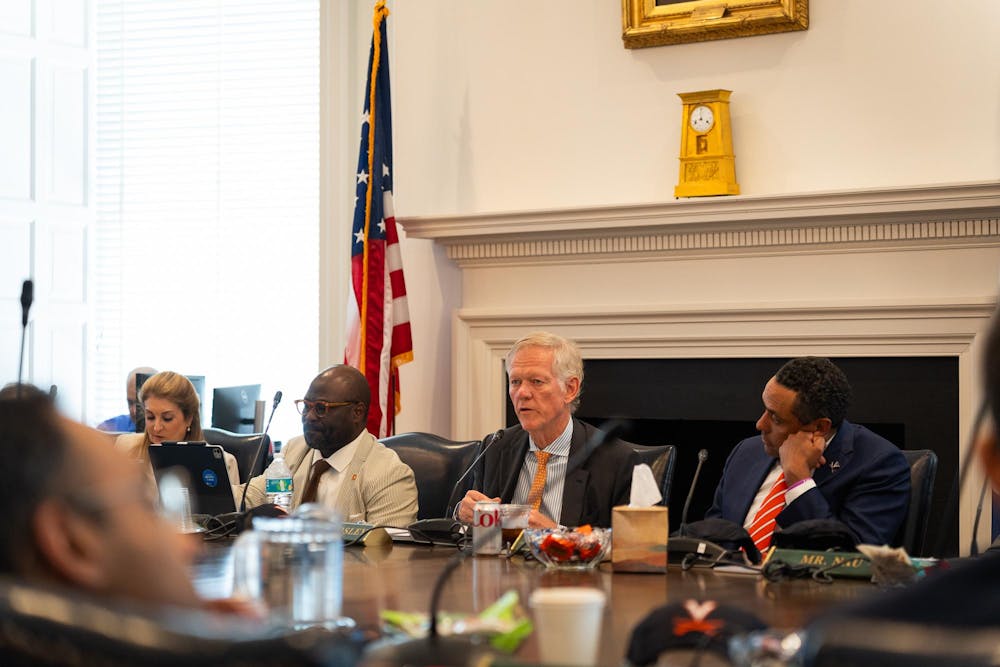
The Board of Visitors’ Academic and Student Life Committee convened Thursday afternoon to hear updates from Brie Gertler, interim executive vice president and provost, regarding ongoing dean searches and a decline in international applications to graduate programs. The Committee also heard a presentation from Maïté Brandt-Pearce, vice provost for Faculty Affairs and professor of Electrical and Computer Engineering, on the University’s faculty workforce and tenure process, approved three new endowed professorships and voted to retain the Master of Arts in Chemistry degree program.
The Academic and Student Life Committee oversees University operations related to student affairs, including athletics, safety, residential life and dining. The Committee also guides policies related to research and academics, including degree offerings and faculty recruitment and retention.
During Thursday’s meeting, Gertler began her remarks by highlighting the Public Service Pathways program, which graduated its first undergraduate cohort during Final Exercises May 15-17. The program allows students to complete coursework, internships and co-curricular experiences focused on public service while pursuing their primary degree programs.
Gertler also noted that the University received more than 82,000 undergraduate applications for the Class of 2030, while graduate program applications have declined significantly due to recent federal policy changes. According to Gertler, declines in international applications to master’s and doctoral programs come amid changes to immigration policies and proposed changes to the “duration of status” rule — which could limit the length of time international students may remain in the United States relative to the length of their academic programs.
Gertler added that changes to federal graduate loan programs have created additional barriers for domestic students pursuing advanced degrees.
“Federal policy changes are having an impact on graduate programs across the nation, and U.Va. is no exception,” Gertler said.
Despite these challenges, Gertler said the University has maintained strong graduate recruiting outcomes in many programs, with particularly successful domestic recruitment efforts in some schools. She pointed to the School of Engineering and Applied Science expanding four-plus-one master’s programs as one example.
Gertler also provided updates on several ongoing dean searches. She said that the search for the new dean of the Darden School of Business is nearing completion, while searches continue for the deans of the School of Architecture and School of Medicine. Candidates for the dean of the School of Medicine are expected to visit Grounds for interviews in September. According to Gertler, the University also plans to launch searches this fall for deans of the School of Data Science — following the passing of Founding Dean Philip Bourne — and the McIntire School of Commerce.
The Board then heard a presentation from Brandt-Pearce on the composition of the University’s faculty and the role faculty play in advancing the institution’s teaching, research and clinical missions. She described faculty as operating under a distinct academic employment model in which individuals are hired for their expertise and scholarly contributions rather than for narrowly defined job functions.
“When we hire faculty, we hire a person, and that person is the world's leader in their very specific thing,” Brandt-Pearce said. “Each has their own research agenda, their own national and international reputation … [and] their own funding so they're their own little enterprise … They compete on a global stage.”
To illustrate differences in faculty responsibilities across departments, Brandt-Pearce compared the work of historians, engineers and physicians at the University. She explained that faculty productivity varies considerably across disciplines, with each contributing to the University through different combinations of teaching, research, grants, clinical care and public service.
The presentation also outlined distinctions between tenure-track faculty and Academic General Faculty positions — which are tenure-ineligible but serve critical teaching, clinical and research functions. According to the presentation, excluding the School of Medicine, tenure-track and tenured faculty account for 65.6 percent of faculty positions, while Academic General Faculty make up 34.4 percent. In the School of Medicine, Academic General Faculty represent a majority of faculty appointments at 58.2 percent.
As part of Brandt-Pearce’s presentation, Board members also received a detailed overview of the University’s faculty promotion and tenure process, which Brandt-Pearce and Gertler described as multi-layered and highly structured. According to Gertler, the University reviewed 196 promotion and tenure cases this year, approving 191 and denying five.
Gertler further explained that candidates assemble extensive dossiers documenting their research, teaching and service. The candidate’s dossier is first evaluated by experts from around the world in the candidate’s academic discipline — who provide external assessments of the candidate’s contributions. The dossier then moves through departmental review committees, school-level review committees and the dean before a final decision is made by the provost.
Board members also discussed how the University evaluates teaching effectiveness.
Brandt-Pearce emphasized that faculty are evaluated across multiple categories, including excellence in research, teaching effectiveness and service to the University.
Drawing on his experience as former dean of Darden, University President Scott Beardsley noted that the University’s promotion and tenure system is designed to ensure faculty meet standards across research, teaching and service. However, he discussed the challenges of evaluating faculty across multiple dimensions, including cases with candidates who have made significant contributions but do not fully meet standards in every category.
“I will just say that the processes are very thorough,” Beardsley said. “Some of the hardest decisions you have to make as a dean … are these borderline cases of people that are extremely strong on one or two dimensions but struggle on one other dimension, and they've given their life to the University.”
Rector Carlos Brown questioned how the University distinguishes between student satisfaction and student learning, while Jackson Sleadd, newly appointed student representative to the Board and rising fourth-year College student, asked about the role of the Student Experiences of Teaching System — a mechanism used for gathering student feedback about their experiences with instructors and courses each semester.
In response to Brown and Sleadd’s questions, Brandt-Pearce said student evaluations are only one component of a broader review process that also includes peer faculty observations, syllabus review and assessment of student work and course materials. She added that reviewers often place greater emphasis on written qualitative comments than numerical ratings in the SET system.
Brandt-Pearce also discussed the University’s doctoral student population, describing Ph.D. students as “mission multipliers” because they contribute to both research and teaching while completing their degrees. The University currently enrolls 2,672 doctoral students across approximately 70 graduate programs. Brandt-Pearce noted that doctoral enrollment remains below that of the University’s peer institutions in the Association of American Universities, which she said carries “real consequences for rankings and institutional standing.”
According to Brandt-Pearce's presentation, graduate teaching assistants support undergraduate instruction through discussion sessions and course assistance, while graduate research assistants contribute to faculty-led research projects. Brandt-Pearce further noted that many research assistantships are funded through external grants secured by faculty members.
As part of the Committee’s agenda, Gertler presented several action items that were unanimously approved by the Board. The Board approved the creation of a second chairholder for Henry B. Mulholland Professorship in Internal Medicine after the endowment grew large enough to fund an additional position. The Board also rescinded its March 2025 decision to discontinue the Master of Arts in Chemistry degree program after the department of chemistry reconsidered its request and chose to retain the degree alongside the existing Master of Science program.
Board members also approved three endowed professorships, including the Fredson Bowers Professorship in Bibliographical Studies — which will be housed in the department of English. Named after English Prof. Fredson Bowers — who taught at the University from 1938 to 1975 — the position will support scholarship focused on manuscripts, books, digital texts and artificial intelligence.
The Board also established the John S. Lillard Jefferson Scholars Foundation Professorship in American Constitutionalism and Democracy. The professorship honors Class of 1952 alumnus John S. Lillard — a supporter of the Jefferson Scholars Foundation — and will focus on scholarship related to liberal democratic government, the American founding and constitutionalism.
Additionally, the LaCross University Professorship in Early Childhood Education and Development was approved by the Board to support research and teaching focused on early childhood education, child development and learning. According to Gertler, the professorship will span multiple disciplines — including collaboration with the School of Education and Human Development, the School of Data Science and the School of Medicine.
The Academic and Student Life Committee is scheduled to reconvene during the next Board meetings, which will take place Sept. 16-19.

Jaylynn Perez is a third-year College student from Chesapeake, Va., majoring in government and Public Policy and Leadership. She currently serves as a news senior writer and video staffer, after previously serving as senior associate editor for the news desk. She enjoys covering topics such as University governance and local politics.
Read More

U.Va. and United Way of Greater Charlottesville launch ‘Give Where You Live’ donation partnership
By Vrinda Vashisht | 42 minutes agoThe program is set to run through Dec. 18, and its start date coincided with United Way’s 35th annual Laurence E. Richardson Day of Caring.

Student Council passes bill to create ad hoc committee to review UBE proceedings
By Edward Christopher and Anna Ivanov | 50 minutes agoThe Commission will craft a report on the University Board of Elections’ current structure and governance practices, putting forth proposals for corrective action based on its findings.
Board of Visitors discusses the implementation of AI in research and academics
By Jaylynn Perez | 10 hours agoThe Board also received an orientation on changes to NCAA athletics, completed its annual Atlantic Coast Conference certification, heard a report from Aaron Bloomfield, Faculty Senate chair and engineering professor, and discussed the University’s ongoing searches for a provost and several deans.


