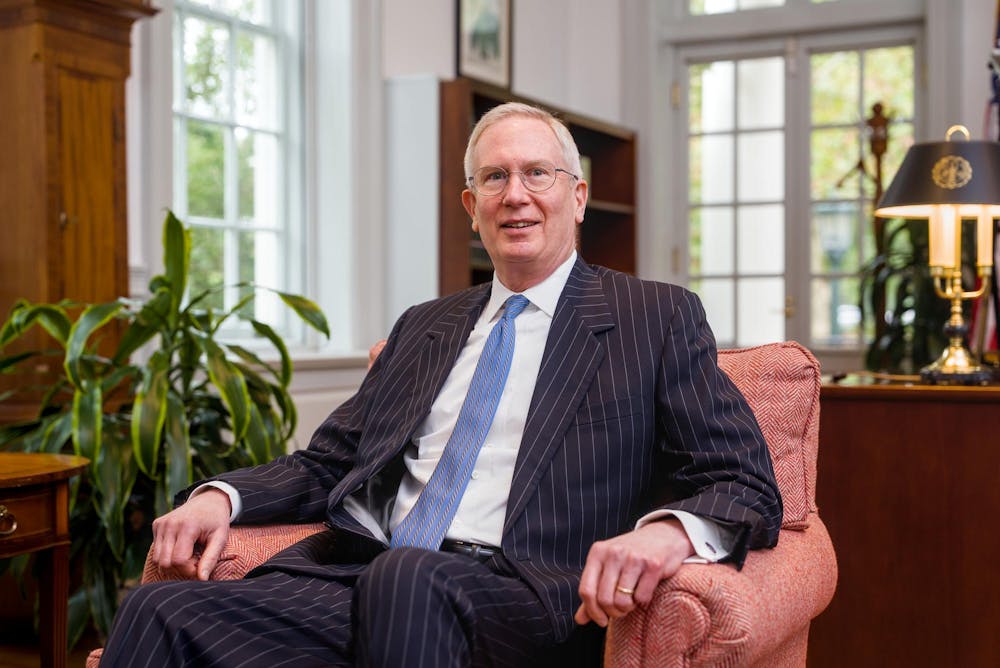
Interim University President Paul Mahoney testified before a Senate subcommittee Dec. 1 about the University’s Oct. 22 agreement with the Justice Department. Mahoney hailed the agreement as “a great win for the Commonwealth” and for the University despite multiple senators having expressed discontent with the agreement through letters sent to the University.
In the agreement, the University agreed to comply with the Justice Department’s interpretation of civil rights law in exchange for the suspension and eventual termination in 2028 of five remaining investigations into the University. The agreement additionally requires the University to submit quarterly reports to the assistant attorney general to share progress being made towards compliance with civil rights law, and the Justice Department has the sole discretion to determine whether that compliance is sufficient.
The nature of the agreement and an alleged lack of transparency in the process by which it was reached have drawn criticism from students, community members, faculty and representatives in the General Assembly. State Sen. Creigh Deeds, D-Charlottesville and State Sen. Louise Lucas, D-Portsmouth were both present at the hearing, and both sent separate letters to Mahoney’s office after the agreement was reached, voicing concern and encouraging him to reconsider or pursue legal action in partnership with other universities.
Mahoney described how he took office in the midst of the ongoing investigations and negotiated with the Justice Department to close two investigations, but that he was unable to negotiate with the Department to close the five remaining investigations by October.
”At that point, our options were to come to an agreement, or wait for the DOJ to impose sanctions on us and then litigate,” Mahoney said.
Invoking the letter sent by Lucas and Surovell and echoing language he used in his written response, Mahoney said he felt a lawsuit would have been costly for the University community and unlikely to succeed.
“Such a suit would be lengthy and uncertain and while the suit was pending we would be without the federal funds … funds that support life-saving research including clinical trials that may be the last hope for some patients,” Mahoney said.
Mahoney also said that while investigations continued, “seasoned investigators” would have had a direct incentive to find wrongdoing, which, along with allegations of noncompliance with the law, would have raised concerns about Mahoney allowing the investigations to continue.
Locke voiced disagreement with this characterization, noting many of those investigators have been fired or voluntarily resigned.
In response to a question by State Sen. Mark Obenshain, R-Rockingham — the only Republican senator present — about the level of similarity between the agreements the University and other universities had faced, Mahoney said that he felt the agreement was dissimilar from those reached by other universities in two ways. Mahoney first pointed out that while other Universities have had to pay the federal government millions in settlements and fines, the University has yet to be charged anything.
Columbia, Northwestern and Brown are three other universities that came to agreements with the Justice Department but all three had to pay financial settlements — these schools agreed to pay $221 million, $75 million and $50 million, respectively.
Secondly, Mahoney said that the University’s agreement has far less specific provisions than other universities’ agreement regarding what violates the SFFA v. Harvard case in employment or admission decision. He noted the terms other universities have agreed to include specific provisions ordering the elimination of the consideration of diversity narratives in admissions. Mahoney said the University has only agreed to comply with the Justice Department’s guidance document and argued those terms are “general” compared to the other agreements.
State Sen. Mamie Locke, D-Hampton, who chaired the hearing, expressed direct concern with the Justice Department’s recent agreements with universities during the questioning period of the hearing.
“I find it disappointing that institutions have been bullied into capitulating to the Department of Justice” Locke said. “I find the word justice oxymoronic in this day and age … [the Department has] is certainly rogue these days.”
Deeds then asked if it was true that unlike other schools, the University must provide quarterly reports to the Justice Department on its progress towards being in compliance with its guidance. Mahoney confirmed the existence of this requirement, but noted that Northwestern and Cornell have this provision as part of their agreements, both of which were reached after the University’s agreement.
Mahoney suggested that it is possible these schools saw this in the University’s agreement and sought a similar provision because providing quarterly reports may be more preferable to hiring an external monitor.
Citing a desire to “clear up” what Mahoney said he views as “misconceptions” that stakeholders have expressed about the agreement, he said that it does not bind the University to follow any and all Justice Department demands.
”It binds us to comply with DOJ’s July 29, 2025 ‘Guidance for Recipients of Federal Funding Regarding Unlawful Discrimination’ [document],” Mahoney said. “And … only to the extent that document is consistent with judicial precedent. Should we disagree about … a specific … situation, we could challenge the DOJ’s interpretation in court.”
The July 29 guidance document from the Department of Justice outlines a series of principles universities must meet in order to receive federal funding. These include keeping athletic competition teams and bathrooms separated by biological sex and prohibiting the use of race, sex or other characteristics in admissions decisions.
Brie Gertler, executive vice president and provost, said at a Faculty Senate meeting Oct. 24 that the University is bound by the Fourth Circuit Court — not the guidance document — and that the Fourth Circuit requires the University to allow individuals access to intimate spaces consistent with their gender identity.
Mahoney then expressed disagreement with the argument that the University should not have willingly agreed to follow the Justice Department’s non-binding guidance. He argued that this is not relevant, as the Justice Department has “formidable enforcement powers” that it could have exercised on universities that were not compliant, regardless.
Deeds went on to ask Mahoney, during questioning, if he accepts that the Justice Department’s guidance is not, in Deeds’ words, “declarative, existing law.”
Mahoney responded by saying Deeds had asked a “complicated question,” but that the only binding law the University is concerned with is the Students for Fair Admissions decision. That law states universities should not use an applicants’ essays or demographic information in a way intended to discriminate on the basis of race, and Mahoney said much of the Justice Department’s guidance aligns with that.
Mahoney also said that he does not believe this agreement violates the Code of Virginia, explaining that the code requires state agencies to “establish and maintain” a plan for Diversity, Equity and Inclusion, and that the plan should include equal opportunity and equal pay laws. — Mahoney said the University has done this. Mahoney said the University has already — and will continue — to follow these practices.
Mahoney added that even with the agreement, the University is working towards upholding a community of people from all diverse backgrounds. He noted the University’s 2030 plan as being a way to ensure this diversity. The 2030 plan includes an array of goals to make the University the best public university in the country by 2030 — one of these overarching goals is to cultivate the most “vibrant community” in higher education.
“We have a University-wide strategic plan — the 2030 plan — that talks specifically about our goal of having [both a diverse] student body and faculty,” Mahoney said. “We also instruct in that plan the various parts of the University to ensure that we will have a student body and faculty that are diverse along all dimensions.”
Locke noted the absence of University Rector Rachel Sheridan and Vice Rector Porter Wilkinson, who were also invited. According to Locke, Sheridan and Wilkinson did not attend the hearing because the two of them said they were not “notified appropriately in time.” Mahoney, Sheridan and Wilkinson received written invitations Nov. 24 to attend the hearing, which provided one week of advanced notice and were informally invited “a couple of week” prior, according to Mahoney.
CORRECTION: A previous version of this article incorrectly stated the date in which Mahoney, Sheridan and Wilkinson received a written invitation. The written invitation was received Nov. 24 and they were informally notified of the hearing prior to that date. The article has been updated to reflect this change.

Luca Bailey is a third-year College student majoring in politics from Free Union, Va. As a staffer on the news and video desks, he has covered topics ranging from the General Assembly and state elections to local politics and University governance. He is also The Cavalier Daily’s beat writer for the Charlottesville City Council.
Read More

U.Va. international students face suspension of non-required curricular practical training authorization
By Bryan Dean | 10 hours agoCPT is a type of university work authorization for students nationwide on F-1 visas to participate in employment or internships directly related to their field of study.

Student discourse organizations reflect on state of free expression at the University
By Nicolas Biernacki and Austin Stegerwald | 2 days agoThe Foundation for Individual Rights and Expression recently ranked the University No. 9 out of 261 colleges and universities in its 2027 College Free Speech Rankings.