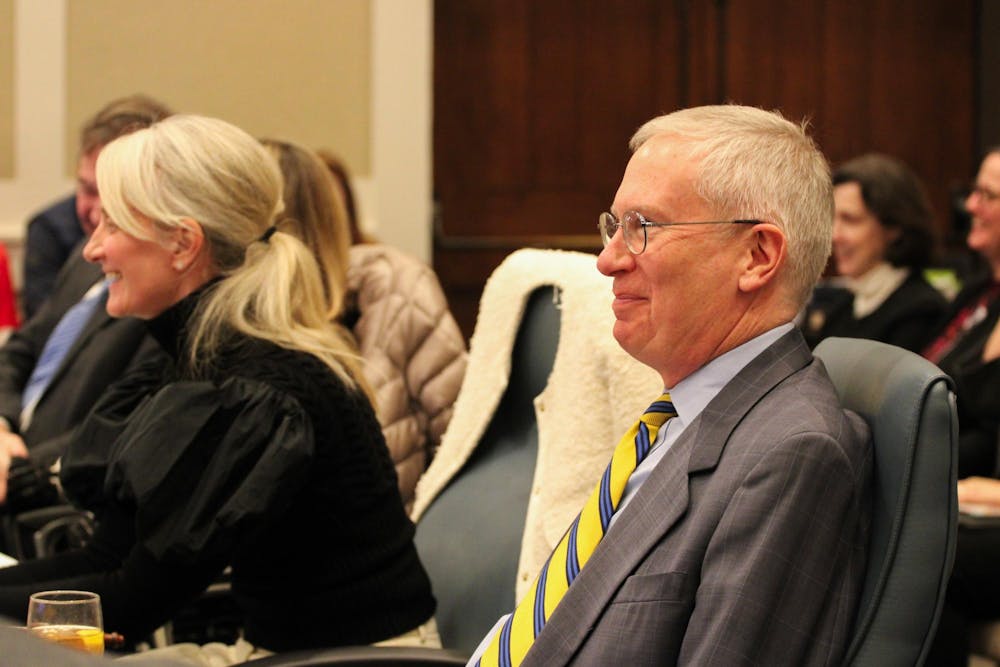
The full Board of Visitors met Friday to hear reports from Interim University President Paul Mahoney on the University’s agreement with the Justice Department, the state of research at the University and his vision for the University moving forward. The Board also met in closed session for almost three hours to discuss legal and security matters, employee appointments and updates on the search for the University’s 10th president.
At the meeting, protesters arrived and attempted to fill all available seats in the room, carrying signs that read “RESIGN,” and “NO CONFIDENCE, NO NEW PRESIDENT.” This came following resolutions of no confidence in the Board passed by Student Council and the Faculty Senate this summer, and a resolution passed recently by the Faculty Senate calling for Rector Rachel Sheridan and Vice Rector Porter Wilkinson’s resignations. These votes focused on the circumstances leading to and following former University President Jim Ryan’s resignation.
In Mahoney’s remarks on the Justice Department agreement — which he signed Oct. 22 and which suspended five remaining investigations into the University’s compliance with civil rights law — he explained that confidentiality had been essential to successful negotiations with the Justice Department.
Mahoney expressed that it was unfortunate that he had been unable to update stakeholders, including the Board, on the content of these negotiations at the time they were occurring.
“The DOJ investigations were a perfect storm, in the sense that there was both great community interest and anxiety and a need for confidentiality,” Mahoney said. “Conducting the negotiations confidentially was critical, both to preserving attorney-client privilege and avoiding giving the DOJ the impression that we were trying to use the press as a tool against them.”
The agreement suspended the five investigations and affirmed the University’s right to academic freedom. It requires the University to comply with the Justice Department’s July 29 “Guidance for Recipients of Federal Funding Regarding Unlawful Discrimination,” which outlines potential violations of the current Justice Department’s interpretation of civil rights law.
The agreement also requires the president to certify quarterly, under penalty of perjury, that the University is complying with the agreement, until the agreement ends Dec. 31, 2028. The Justice Department maintains sole discretion to determine whether the University is making adequate progress towards compliance with civil rights law.
Mahoney said that shortly after he became interim president in August, he requested that the Justice Department close its seven investigations because the University was in the process of conducting a comprehensive compliance review of its policies, procedures and activities. However, Mahoney said, the Justice Department only closed two of these investigations, which led him to pursue a voluntary resolution of the remaining five, culminating in the Oct. 22 agreement.
Mahoney also said that the agreement’s principal condition is adherence to the Justice Department’s guidance for recipients of federal funding. According to Mahoney, any university which receives federal funding could be investigated for taking actions inconsistent with that guidance. Therefore, he said, the University with the agreement is in a similar position to other institutions.
Agreements between the federal government and Northwestern University, Cornell University, Brown University and Columbia University have all included monetary fines. Northwestern’s agreement requires the university to provide annual admissions data including race, ethnicity, GPA and standardized testing performance to the federal government, among a series of other demands. Brown University’s agreement requires the institution to submit to visits, interviews and data requests from the federal government to ensure compliance with the agreement.
Mahoney said that had the University pursued litigation against the Justice Department, it could have been subjected to years of funding suspensions or terminations which would have remained in force pending a legal resolution.
“I recognize that many members of our community would have preferred that we not enter into any agreement with the Department of Justice,” Mahoney said. “As I've explained on several occasions, however, daring the Department of Justice to take action against us would have been a reckless act that our students, faculty researchers and health system patients would soon have come to regret.”
Board member David Webb said that although he had wanted to know more details of the negotiations, he understood the need for confidentiality and believed the agreement was the best possible outcome for the University.
“I do think that the lack of transparency, which was essential, is something that a lot of people don't understand, and therefore we get these allegations of no transparency, which I think are unfounded, and so I hope that everybody can sort of see that side of it,” Webb said.
Board member Doug Wetmore also asked how much total federal funding the University receives and how much would have been at risk. Mahoney said that the federal research grants total $450 million, which he believed the government could easily have terminated in its entirety.
Following Mahoney’s comments on the Justice Department agreement, Sheridan gave a series of remarks which shared highlights of Board committee meetings and University successes throughout the semester. She also addressed recent events which she called “less joyful and more concerning.” Sheridan said that since signing the Justice Department agreement, the University has seen a “dramatic rise in divisive politics” but did not specify what events she was referring to.
Sheridan noted that Board members are volunteers and said that these divisive politics hurt the University’s leaders and community.
“The people here have not been chosen to lead because they have an ideological position they have taken,” Sheridan said. “Our University has long relied on lay leaders to step up, just as this Board has, but it will be increasingly difficult to ask people to do so if they're signing up to be maligned, ridiculed and reduced to political fodder for others’ agendas.”
The Board also heard updates from its faculty representative Jim Lambert and student representative Gregory Perryman. Lambert encouraged Board members to focus on areas of development which exist between extreme poles of activity.
“As the University copes with external pressure, some of which we've heard about in this session, political, cultural, economic, regulatory and even our internal factions insisting that one pole must dominate another,” Lambert said. “The University must not be endangered by the existence of such poles.”
Perryman highlighted recent student accomplishments and events, including Lighting of the Lawn, the 34th fourth-year 5k run and the University Program Council’s annual CultureFest.
Mahoney also led a discussion of sponsored research — research that is funded by an external organization, such as a government agency or other grantmaking sources, under a formal agreement to meet the sponsor's specified objectives. He noted that at the University, there are fewer opportunities for sponsored research in social sciences and humanities compared to STEM or education fields.
In his statement, Mahoney noted that Sheridan had expressed interest in increased Board attention to research and recommended that time be set aside at the next Board meeting in March for members to hear an in-depth review of the research enterprise from University leadership.
“I do not see that [review] as an end point, but instead as a framework to give the Board a better knowledge base to help it determine how best to meet its oversight responsibilities,” Mahoney said.
Following a three-hour closed session, the Board reconvened in open session to unanimously approve the docket of resolutions previously passed by smaller committees and to approve faculty personnel actions and compensation for Mahoney’s work as interim president, which they had discussed in closed session.
A document containing approved personnel actions did not include Mahoney’s compensation, but did note appointments, including Barry Meek as interim University counsel until the position is filled by the attorney general.
The full Board will reconvene at its next meeting March 6.
Read More

U.Va. international students face suspension of non-required curricular practical training authorization
By Bryan Dean | 11 hours agoCPT is a type of university work authorization for students nationwide on F-1 visas to participate in employment or internships directly related to their field of study.

Student discourse organizations reflect on state of free expression at the University
By Nicolas Biernacki and Austin Stegerwald | 2 days agoThe Foundation for Individual Rights and Expression recently ranked the University No. 9 out of 261 colleges and universities in its 2027 College Free Speech Rankings.