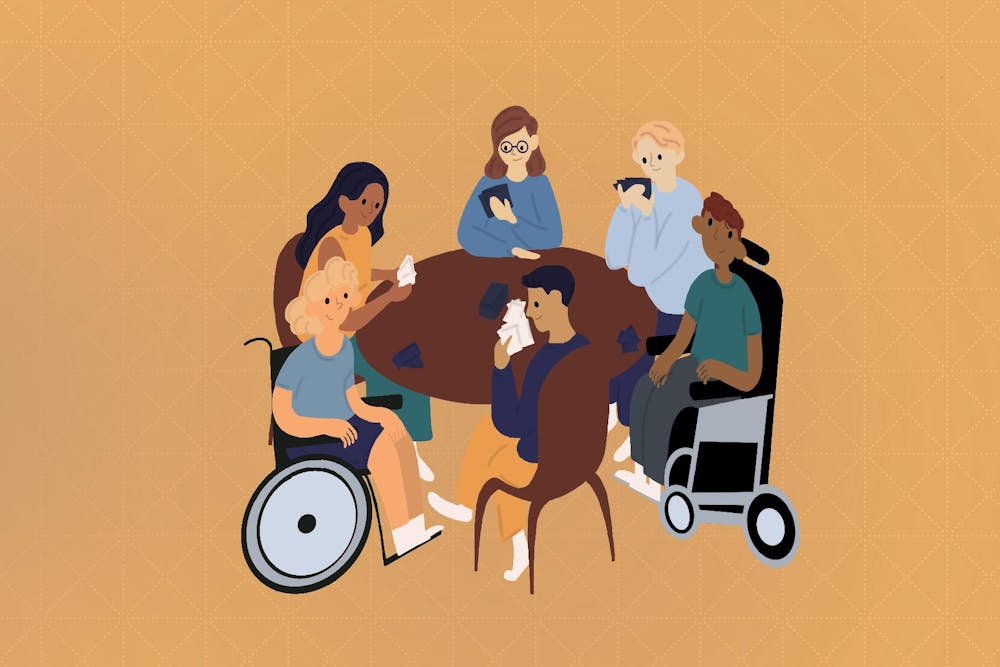
At the annual Valentine’s Dance last month, University students and adults alike gathered to play games, enjoy snacks, make crafts and hit the dance floor in style. For many participants, this dance is among the favorites of the many events run by Best Buddies, an international organization working to build meaningful relationships and opportunities for individuals with intellectual and developmental disabilities — often referred to as IDD.
The IDD community worldwide is disproportionately affected by social and emotional isolation, with nearly 40 percent of people with IDD reporting feelings of profound loneliness. Moreover, communities often lack adequate social networks that foster relationships between people with and without disabilities, often due to social stigma and a shortage of integrated community involvement opportunities. Best Buddies provides a support system for individuals who are often not given the support they need or deserve.
March is designated Best Buddies month, a global celebration dedicated to promoting their mission of fostering individualized friendship pairings, developing leadership skills and creating inclusive social and living environments for people with and without IDD.
In 1989, the same year the program’s first chapter was created at Georgetown University, Best Buddies was brought to Grounds and has since expanded its reach to include over 100 students. Best Buddies programs build genuine connections by pairing middle school, high-school and college students with a member of the local IDD community.
The University’s chapter of Best Buddies offers several opportunities for students to get involved in inclusivity. Students can become peer buddies, where they are placed into one-to-one friendships with an individual with IDD. Alternatively, depending on student and buddy needs, members can also become associate buddies, which are chapter members who attend social events and group activities but are not placed in an individualized friendship pairing.
To become a buddy — whether peer or associate — students are interviewed to gauge their individual interests, hobbies and values. Peer buddies are then matched with a buddy who shares similar interests.
Will Barlow, peer buddy and first-year College student, explained that he originally joined Best Buddies to make a positive impact on the community, but found that the genuine connections he made positively impacted him as well. He and his buddy, Greg, had an instant connection, and the two enjoy playing basketball at the YMCA and talking about University sports.
“Even though [IDD] does impair certain functions and it does limit them in certain ways, they still are capable of so much and doing so much in their community,” Barlow said. “The impact that they have on individual people like myself, and the impact that hanging out with Greg and the rest of them has is, regardless of what their [disabilities] are, extremely impactful.”
Echoing this sentiment, Catherine McClure, Buddy pair coordinator and second-year Education student, highlighted how formative the connection with her buddy, Noah, has been for the both of them. She reminisced on the fond memories they shared together, such as grabbing tacos at Brazos Tacos, playing basketball at the gym and going to the Kindness Cafe to talk about sports. She highlighted how each outing is a source of genuine joy and connection for herself and so many others.
“Maybe you're having a rough day before [the event], but I feel like you always come out with a smile on your face,” McClure said. “You just know that they've impacted your life just as much as you've impacted their life. It's that genuine connection that you [get] with these people … they want the best for you, [you] want the best for them.”
That sense of reciprocity — of impact flowing both ways — extends beyond individual friendships. For many members, such as Barlow, joining Best Buddies has reshaped how they go about their day-to-day lives. Barlow explained how consistently engaging with his buddy has prompted him to step back from the stressors of college life and reframe his perspective, recognizing the privileges and opportunities he might otherwise take for granted.
“[People with IDD] love to hang out and just feel included, like one of your friends. It's just a normal Saturday, and they're going and having fun with all their friends, that's how they see it,” Barlow said. “I found that as someone doing [Best Buddies], it puts life into perspective.”
At the University, Best Buddies hosts at least one club-wide event a month. Past events include the Holiday Party, the Winter Reunion and the Valentine’s Dance. Several of the organization’s events take place at the YMCA's Kindness Cafe, a local coffee shop that provides employment opportunities and a supportive environment for people with IDD.
Emi Flowers, a young adult buddy and a cashier at Kindness Cafe, said that buddy groups often come to the cafe to socialize. One of Flowers’ favorite memories from Best Buddies was playing a fiercely competitive game with a group of students.
“When the U.Va. was [at Kindness Cafe], we did Spot It,” Flowers said. “It was hard. I love memory games.”
Apart from club-wide events, students and their buddies hang out socially multiple times a month. Flowers said she enjoys grabbing a bite to eat at Chick-fil-A and stopping by the Dairy Market with her buddy. Other common activities for students and their buddies include getting coffee, playing games, going on walks and practicing sports. Additionally, many students regularly have text conversations with their buddies, maintaining contact during the week even when they cannot meet face-to-face.
Aside from its monthly events, Best Buddies also hosts several fundraisers, the most notable being their annual Friendship Walk. This event brings students, families, people with IDD and the broader Charlottesville community together for a brief walk alongside each other to raise awareness for and combat stigma against the IDD community.
In addition to its focus on friendship and inclusivity, Best Buddies at U.Va. also works to counteract harmful rhetoric and derogatory language towards people with intellectual and developmental disabilities. Their “Spread the Word” initiative started in 2009 to end the use of the derogatory r-slur towards people with IDD, encouraging awareness, empathy and person-first language when referring to the IDD community.
Beginning March 9 as part of Best Buddies Month, the University’s chapter of Best Buddies will bring this initiative to Grounds, campaigning against derogatory language and promoting inclusive speech and thinking.
Although there are about 200 million people worldwide with IDD, there are still very few support systems in place for this community, contributing to chronic isolation that permeates throughout the IDD population. At the University, Best Buddies breaks down traditional social barriers between young adults with and without IDD, creating a less isolating world through sincere, enduring friendships.
For Best Buddies chapters across the country, the month of March merely amplifies the ideals of inclusivity, friendship and support that each sector works to embody. Best Buddies Month on Grounds expands this mission of breaking barriers beyond the chapter to the wider Charlottesville community.
“I feel like bringing more awareness to having disabilities, making them be seen as humans, rather than a disability [is important],” McClure said. “I feel like that's like something that really is needing to change and continue to develop.”
Read More

One poke bowl, endless possibilities
By Astrid Cheng | YesterdayThough this version is my personal favorite, this recipe is meant as a starting point, not a rulebook.
Learning from the land at the University’s Morven Sustainability Lab
By Kendra Mickle | 2 days agoSpread across nearly 3,000 acres of rolling hills, luscious forests and farm lands, the property has become a hub for sustainability education and experiential learning for the University community.

Notes from a shared address
By Summer Hoffman | 3 days agoAfter one year of living with my partner, I can safely say that our living room is the best classroom I have ever sat in.