Three things are guaranteed in this world — death, taxes and the Board of Visitors’ overbearing influence. The most recent revelation of this heavy-handedness comes from Porter Wilkinson, vice rector of the Board. The recent Cavalier Daily report, detailing what numerous people familiar with the process saw as Wilkinson’s “unusual” conduct in last spring’s provost search, confirms this Board’s willingness to play fast and loose with established organizational structures. While they do indeed possess great influence, a Board member’s bully pulpit has no place in the search for a provost.
The events laid out in the report are deeply worrying as they seem to suggest the Board’s — or, at least, one member of the Board’s — willingness to hijack University operations to centralize its own authority. Normally, the University’s Executive Search Group conducts a nationwide search for these high-level positions and recommends potential nominees to the president with whom the provost has an extremely close working relationship. It is therefore up to the current president to decide who is the best candidate to nominate. While ultimately the Board votes to confirm the new provost, tradition and good sense do not dictate that the Board must have its hands on every part of the process leading up to that point. Yet, this Board has certainly not shown itself to be faithful adherents to tradition and good sense.
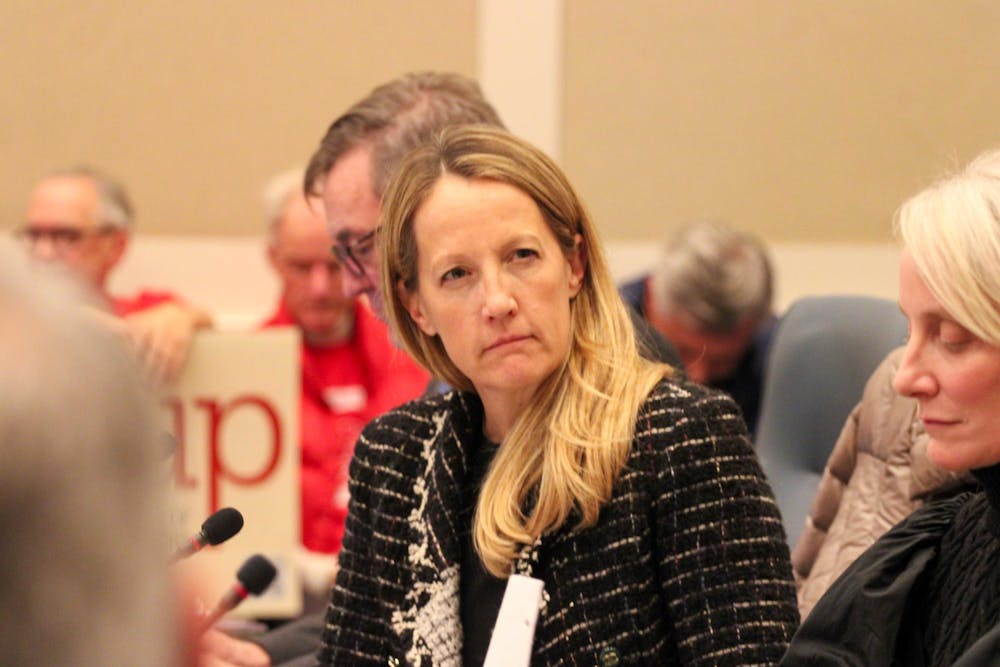
Wilkinson’s primary transgression was purporting to speak for the sentiments of the Board as she “implicitly vetoed” a well-qualified provost candidate in last spring’s search. This candidate, likely slated to be one of the three finalists presented to former University President Ryan, was not included in the final list after Wilkinson preemptively denied that the Board would approve if Ryan nominated them. As sources in the report note, Wilkinson’s actions caused the search committee to exclude the candidate from those presented to Ryan.
It is implausible that Wilkinson, one of only two Board representatives on the search committee, could faithfully claim to represent the sentiments of the entire Board. Despite this lack of authority, Wilkinson’s assertion pressured others to go along with her views. On search committees such as the one for a provost, it is imperative that all members feel equally qualified to debate the merits of candidates without undue influence, and it was this imperative that Wilkinson deliberately undermined.
To only consider candidates that the Board claims it would approve if nominated by Ryan effectively trumps the opinions of other non-Board stakeholders. The search committee is deliberately composed of professional executive recruiters who propose a candidate to the University President, not the Board. To claim some authority to have a large influence in the search for a position that does not report to the Board sharply cuts against the role of the provost as someone who works intimately with the University president. If the opinion of the rest of the committee can be short-circuited by Wilkinson’s domineering presence as a Board representative, then the role of the committee is of no practical substance.
In addition to rejecting one of the committee’s leading candidates, Wilkinson also pushed for a fourth candidate to be presented to Ryan, one brought in by Heidrick & Struggles, a firm outside the search committee. The fact that this candidate — described by three sources as “a waste of time” — was not originally considered by many to be among the three finalists shows that Wilkinson’s sway cuts both ways, forcing candidates to be both dropped and added to the final list. Furthermore, given Wilkinson’s rationale for vetoing a previous candidate, it is evident that this fourth candidate was presented as one upon whom the Board would look favorably. This episode shows once again how a single Board member can weaponize her status to pressure others into endorsing her preferred outcome.
Furthermore, this pressure was applied not by a leader of the Board, but by a rank-and-file member — Wilkinson was not vice rector at that point. In that sense, Wilkinson follows in the footsteps of the current Rector, Rachel Sheridan who negotiated with the federal government despite holding no official Board-wide leadership position. This concerning trend of any Board member claiming the ability to unilaterally speak for the University cannot continue. The distrust and confusion as to who has the authority to speak for the Board is self-undermining as the University continues to weather difficult political and administrative storms, and it undermines the very purpose of established leader positions.
This pattern of overreach is only magnified by Sheridan and Wilkinson’s elusion of calls for explanation. Their continued refusal to appear in person to discuss their roles in the University’s recent controversies bolsters the image of them as actors with something to hide. Indeed, they have both shirked appearances before the Faculty Senate and the General Assembly. Instead, the public has only reports such as these to learn about Board members’ actions behind closed doors. As the presidential search committee — of which Sheridan and Wilkinson are the chair and vice chair, respectively — continues its work in selecting a president, the University community must be assured that excessive influence by any one member of the committee does not dictate the outcome.
The University cannot continue to allow its future to be denigrated by the unbridled ambition of one person. It is high time Wilkinson recognized her place as but one member of a governing board that must be dedicated to serving the University community.
Michael King is a senior associate opinion editor who writes about politics for The Cavalier Daily. He can be reached at opinion@cavalierdaily.com.
The opinions expressed in this column are not necessarily those of The Cavalier Daily. Columns represent the views of the authors alone.
Read More

COHEN: The Honor Committee should rethink its approach to punishment
By Ryan Cohen | YesterdayIf accountability is to remain at the heart of honor, then consequences must do more than educate — they must also reflect the seriousness of the violations committed.

EDITORIAL: Access to graduate programs erodes without Grad PLUS loans
By Editorial Board | July 5, 2026From July 1 onward, the higher education bubble for graduate students will only worsen thanks to federal student loan policies.

HAWKINS: In defense of Spanberger’s collective bargaining veto
By Joshua Hawkins | July 3, 2026If passed, the bill would have sparked a budgetary train wreck.