

Student Council met Tuesday for their general body meeting to pass a resolution calling for the permanent establishment of an athletic dining option for student-athletes following the closure of the John Paul Jones athletic dining hall. Representatives also tabled three legislative pieces related to institutional stability during the University’s presidential transition, restructuring of the internal affairs committee and amending the bylaws to include the HoosConcerned website.
Student Council members unanimously passed a resolution calling on the University to create a permanent student-athlete dining alternative. The JPJ athletic dining hall permanently closed at the end of the Fall semester, which has impacted meal accessibility for student-athletes. The meal plan provided student-athletes with one dinner swipe per day Sunday through Thursday.
Kyle Montaperto, president of Student-Athlete Advisory Committee and third-year Education student, explained during public comment that the closure stemmed from financial pressures tied to the House v. National Collegiate Athletic Association settlement. The settlement requires participating universities to allocate millions of dollars annually toward direct compensation for student-athletes.
According to Montaperto, the Atlantic Coast Conference opted into the settlement, requiring member institutions to contribute approximately $20 million annually toward direct compensation for student-athletes — a cost that has strained the University’s athletic department. As a result, the department eliminated the athletic dining hall, which Montaperto said costs approximately $1.2 million per year to operate. The athletic department also cut approximately 70 student-athletes from the University’s NCAA programs — including the diving program which was suspended March 1, 2025.
While the athletic department has currently introduced a temporary solution — providing student-athletes with one catered meal per week — Noah Dyer, student-athlete representative and third-year Commerce student, said the temporary measure fails to replace the consistent access previously offered by the JPJ athletic dining hall. Dyer emphasized the importance of passing the resolution to create a student-athlete dining alternative to show formal support for student-athletes at the University.
“I think this legislation … really shows that we are invested in our athletes, not only the basketball and football players, but everyone here because we are a really well-rounded university,” Dyer said. “I think it’s really important that we know our support for them.”
The resolution proposed establishing a permanent athletic dining option within an existing dining hall such as Newcomb Dining Hall to accommodate a dedicated student-athlete dining station. The proposal also suggests exploring a swipe-based system to restrict access to student-athletes while coordinating with U.Va Dine and the athletics nutrition department.
Dyer plans to meet with Nicole Hall, senior associate vice president for student affairs and dean of students, to discuss permanent solutions on dining alternatives for student-athletes Jan. 28.
Student Council also discussed a resolution calling for institutional stability amid the University’s presidential transition, which focused on maintaining continuity in leadership and governance following the appointment of President Scott Beardsley and the addition of 10 new members to the Board of Visitors. Representatives tabled the proposal to be voted on at the next general body meeting Tuesday, citing the need for additional information ahead of a scheduled meeting Friday between Clay Dickerson, Student Council president and fourth-year College student, and Beardsley to discuss their shared priorities.
“I find it valuable to give Beardsley a chance this Friday to earn student trust,” Dickerson said. "Right now, I think that shared governance is in a grey position, and it’s important to tread mindfully and lightly to ensure that we don’t break the ice here.”
A proposal to restructure the internal affairs committee was also tabled. The Student Council’s internal affairs committee is currently responsible for overseeing internal Student Council operations such as managing meetings, legislative documentation and representative training. According to Imane Akhanous, chair of the representative body and fourth-year College student, her role is also responsible for managing and numbering the proper legislative documents.
The resolution would amend the Student Council bylaws to reduce overlap between the internal affairs committee’s duties already assigned to the chair of the representative body. The resolution is written so that the committee would function as an internal advisory support by reviewing internal procedures, coordinating support for legislation and evaluating Student Council operations. The resolution received support from representatives but was delayed to allow additional revisions regarding the legislation’s format.
Representatives similarly tabled a bylaw amendment that would formally incorporate the HoosConcerned website — an online forum where students can report and discuss University issues — into the duties of the community concerns committee. The committee is responsible for addressing issues affecting the University community by documenting concerns and assigning issues to committee members for resolution.
During leadership reports, Suraj Gangar, director of Cavalier Health and fourth-year College student, highlighted several wellness initiatives — including updates on the dental insurance pilot program since its launch Dec. 2. Gangar said Cavalier Health funded dental care for more than 55 students at a cost of approximately $10,000 — which will be added eventually as a budget amendment to the Accommodation Access Fund.
Currently, students can apply to the AAF to receive funding for equipment related to disability, therapy or psychiatric visits. Students may receive up to $2,000 per year through AAF. Gangar also noted that Cavalier Health is planning an additional week of free STI testing in partnership with Student Health and Wellness.
Second-year College Rep. Lucas Addison described a recent visit to Richmond where he met with Del. Lily Franklin. Addison said Franklin highlighted legislation in the General Assembly that would grant the student representative on the Board voting power. Fourth-year College student Gregory Perryman currently serves as the student representative on the Board as a non-voting member after beginning his one-year term June 1.
Addison said he had several conversations with state officials regarding a shared consensus that depoliticization and strengthening the University’s governance remain key priorities.
“Having a voting member on the Board of Visitors … [is] going to be good for us,” Addison said. “Everyone has an opinion, but the vast majority do believe that the best route is depoliticization, and that we need to focus on structural integrity of our institution.”
Dickerson also confirmed that the Student Government Association at the College at Wise is visiting Jan. 27. The visit follows a previous trip Nov. 14 by Student Council representatives to the College at Wise as part of an expanding effort to strengthen ties.
Representatives are expected to revisit the tabled legislation at their next general body meeting Jan. 27, which will take place as regularly scheduled at 6:30 p.m.

Jaylynn Perez is a third-year College student from Chesapeake, Va., majoring in government and Public Policy and Leadership. She currently serves as a news senior writer and video staffer, after previously serving as senior associate editor for the news desk. She enjoys covering topics such as University governance and local politics.
Read More

Buildings and Grounds Committee approves a U.Va. Health hospital renovation
By Grace Little | 6 hours agoThe Board of Visitors’ Buildings and Grounds Committee convened Thursday afternoon to approve the U.Va. Health Transitional Care Hospital renovation and the namings of 13 exterior spaces at Aggarwall Hall.
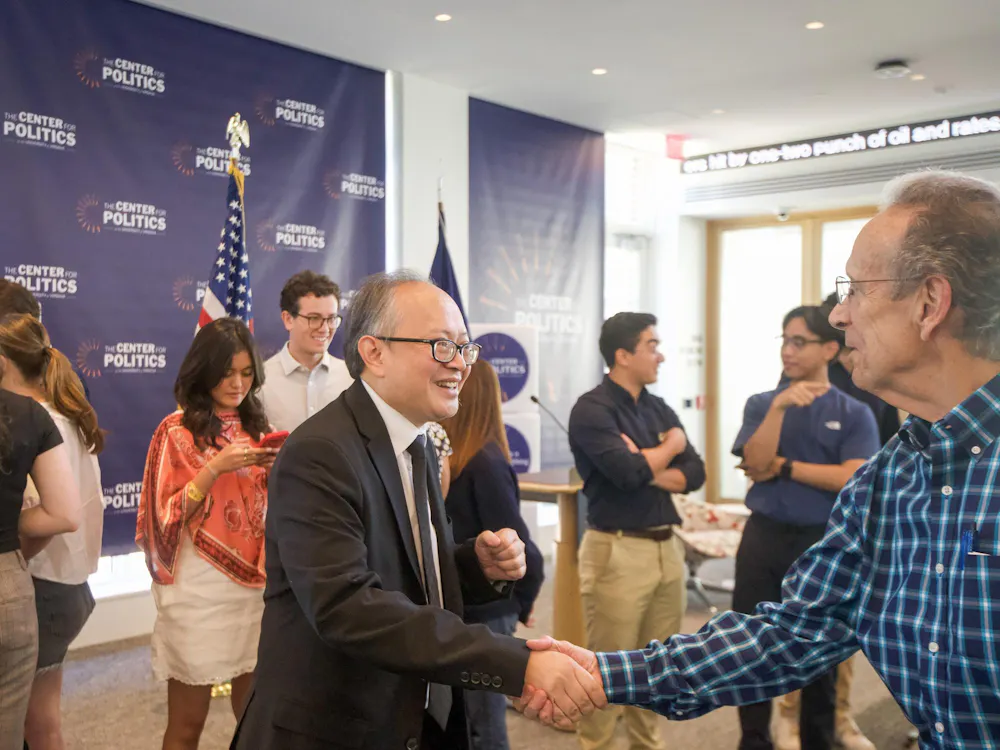
Ambassador of Thailand to the US speaks on Thai economy, conflict with Cambodia
By Edward Christopher | 6 hours agoChindawongse spoke about his home country’s history with the U.S., relations with other nations in Southeast Asia and Thailand’s economy and social progress.

Supreme Court Justice Amy Coney Barrett discusses legal doctrines, emergency docket
By Edward Christopher | 6 hours agoShe reflected on how the role of the Supreme Court Justice has evolved since she clerked for former Supreme Court Justice Antonin Scalia and how she approaches legal issues.


