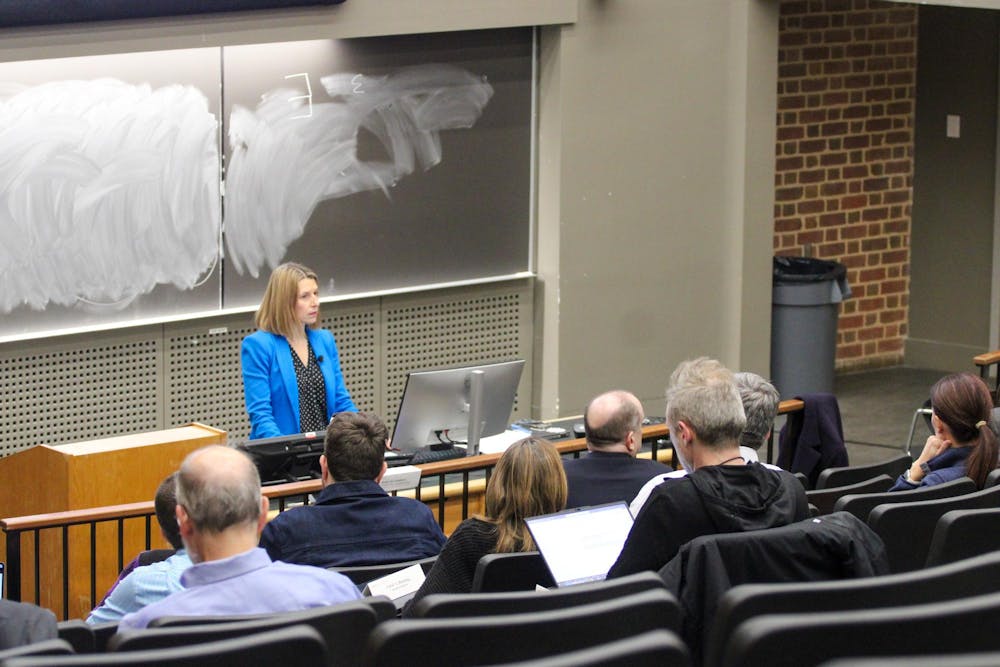
The full Faculty Senate met Friday afternoon to hear updates from University leadership, including recently-appointed University President Scott Beardsley, and to hear speeches from five candidates for faculty representative to the Board of Visitors. Senators also held a question and answer session with the chair of the Honor Committee and discussed recent policy changes within the honor system.
In his first meeting with the Faculty Senate as president, Beardsley introduced himself and provided an update on his work during the first several weeks of his term. He shared that he has begun a “listening tour” to meet with University stakeholders — including faculty, alumni and students — and gather their input. Beardsley also said he met with Gov. Abigail Spanberger one-on-one, selected a new chair for the executive vice president and provost search committee and spoke with incoming Board members following their appointment by Spanberger.
Assoc. Psychology Prof. Hudson Golino asked Beardsley to explain why he had accepted an offer for the presidency in December, despite nine deans and the Faculty Senate requesting that the search process be paused. Beardsley said that although he had been aware of calls to pause, he felt they had been primarily directed at the search committee rather than at candidates.
“[The Board] decided to continue with the search process and make an offer. I was not in control of the fact that they did that. I didn't know the date that they would [make an offer],” Beardsley said. “... I decided that I had two choices. I could either heed the call to serve or to say I don't want to serve the University. And in the end, I feel called to serve the mission.”
A Dec. 12 Faculty Senate resolution called on candidates themselves to ask for a pause in the search, but Beardsley said he had not seen this resolution when he received his offer Dec. 16.
Beardsley also said he plans to continue the standstill agreement with the Justice Department, which requires the University to certify quarterly that it is making progress towards full compliance with the Justice Department’s interpretation of civil rights law. McGuireWoods law firm is conducting an ongoing compliance review, he said, as part of these efforts.
The search for the University’s next executive vice president and provost, Beardsley said, is still ongoing, although he has stepped down from his position as chair of the provost search committee. Stephanie Rowley, dean of the School of Education and Human Development, will assume the position as chair. Former Vice Rector to the Board Porter Wilkinson, who resigned Jan. 16 ahead of Spanberger’s inauguration, will also step down from the search committee and will be replaced by newly appointed Board member Evans Poston. Beardsley also shared that Faculty Representative to the Board Jim Lambert will be added to the committee.
Assoc. Spanish Prof. Anne Garland Mahler asked Beardsley about his strategic vision for the University, to which he responded that he hoped to keep the University as a highly-ranked public institution, with input from the community on the best specific strategies for achieving this goal.
“I think it's premature, and it would be incredibly arrogant for me to articulate a detailed strategy without involving the community in the development of it,” Beardsley said. “It's less important for me to say what it is, and more important to have something that we all [buy] into.”
The Faculty Senate also heard from five candidates for the next faculty representative to the Board, a year-long position selected by the Board. Senators will vote on these five candidates in the coming weeks, and the top three candidates, their written statements and the vote counts will be presented to the Board’s Executive Committee for selection in March.
This selection process changed three years ago, from a process in which the Senate would elect a single faculty member to be Faculty Representative to the Board. Now, the Faculty Senate elects the top three candidates for the Board to ultimately select one of those members. Former Faculty Representative Michael Kennedy told The Cavalier Daily that since the appointment process was changed, the Board has continuously selected the candidate with the most votes each year.
Golino, Assoc. Education Prof. Walter Heineke, Politics and Public Policy Prof. David Leblang, Assoc. Engineering Prof. Peter Norton and Jeri Seidman, Faculty Senate chair and Assoc. Commerce Prof., each delivered short oral statements to the Senate ahead of online voting. They spoke about the importance of shared governance and academic freedom and their plans to elevate faculty voices if elected to the role in March.
Later, senators heard updates from Brie Gertler, interim executive vice president and provost, who spoke about the onboarding process for new Board members. Gertler said that she will meet with all new members, who will receive information about sponsored research and academic programs at the University.
The Faculty Senate also heard from Thomas Ackleson, Honor Committee Chair and fourth-year College student, who answered questions from senators about the Committee’s process and how professors can discourage students’ use of artificial intelligence on coursework. He said that since shifting to a multi-sanction system, the Committee has seen a “significant” increase in cases, although most of these are resolved quickly.
“I think really it stems from an increase in the number of reports that we receive,” Ackleson said. “Faculty, and I think students as well, are more willing to report each other … just because they know that the process is restorative and the intent is that the student who has offended will come back into that community having grown and learned something from that process.”
Ackleson also estimated that approximately 50 percent of all cheating cases involve the use of AI, and he recommended that faculty note in their syllabi that the honor code applies to all assignments regardless of whether students are required to sign it.
The Policy Committee of the Faculty Senate, which reviews and advises on potential University policy changes received from both the office of the executive vice president and provost and the University Policy Review Committee, shared updates on two recent policies. The first was “RES-004: Research Misconduct” which was revised Jan. 1 to provide a “clearer” framework for the review of an allegation of research misconduct. Committee Co-Chair Lisa Colosi Peterson spoke about PROV-035, the second policy, which she said is a more expansive policy focused on academic misconduct and discipline which was finalized in December.
The next full Faculty Senate meeting will take place Feb. 27.
Read More
Parking on Grounds — what has changed this semester?
By Charlotte Gabriel | 16 hours agoAccording to University students interviewed by The Cavalier Daily, several expressed frustration with high parking prices on Grounds, as well as the difficulty in finding available parking in general.

Student Council connects with University’s Strategic Planning Committee
By Lucia Gambacini and Reilly Auld | 16 hours agoThe Council also heard updates from Executive Board members regarding the upcoming Fall 2026 elections and new investments in free Sexually Transmitted Infection testing kits for students.

Virginia colleges workshop three-year bachelor’s degrees
By Luca Bailey | 16 hours agoIf the effort is successful, participating schools in Virginia and Ohio will join at least 70 higher education institutions across more than 26 states that have already adopted three-year programs in some capacity.