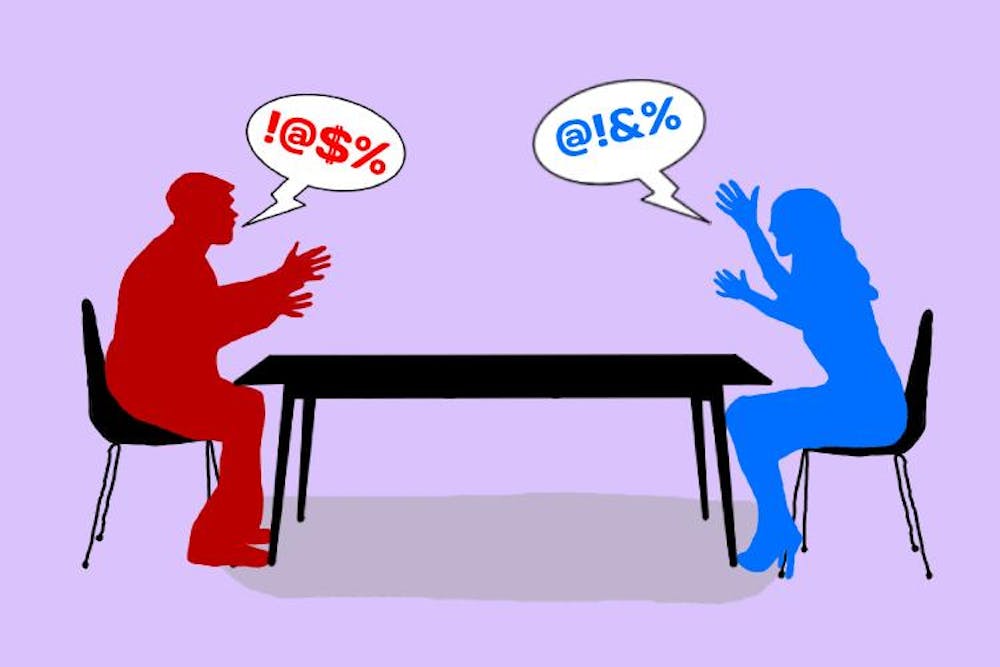
As soon as Thanksgiving and winter breaks roll around each year, students slam their laptops shut, eager to trade late-night study sessions for home-cooked meals and long-awaited rest. But for some, holiday breaks are anything but restful. After a semester of engaging in classroom discourse, many students return to households where similar conversations — especially about politics — spark conflict rather than curiosity.
Third-year College student Molly Russell said she often finds herself politically at odds with her family. She explained how walking into her home over break can feel like walking on eggshells.
“I tend to spend a lot of time alone in my room in order to regulate, because there definitely is a lot of tension in my family,” Russell said. “[So] I kind of just suppress it.”
In recent years — as Americans have felt more politically divided than at any point since the Civil War — conversations with ideologically-distant family members can feel not just uncomfortable, but demoralizing. So if they have not already, many students will likely experience stress about political conversations this season, whether at Christmas dinner or over a New Year’s toast.
In an email statement to The Cavalier Daily, Nikki Kain, assistant director of programming for the Karsh Institute of Democracy, explained that during the holidays, students spend more concentrated time with extended family members that they do not regularly see. This, she said, can make the holidays feel particularly politically charged.
“That dynamic alone can heighten tension around political topics, and that stress doesn’t lend itself well to productive conversations, especially with those who hold different political views,” Kain said. “People tend to be more reactive in times of stress.”
From debates about social issues to arguments over divisive politicians, tension can pervade any family, even within those that typically see eye-to-eye. Beckett Smith, member of College Republicans and fourth-year College student, explained that there are political discrepancies within his own family, even though they largely identify as conservative.
“My dad's side of the family is very populist Republican, and I am very socially right, but very economically left. So I disagree with them a lot on that kind of stuff,” Smith said. “My grandmother is actually the one that I talk about with politics all the time. She's very left, but she gives me all kinds of hell for my positions.”
Similarly, Russell has opposing political beliefs from the majority of her family. She leans “quite far left,” she said, while her parents frequently vote Republican. She noted how this difference in opinion can lead to self-censorship as she tries not to rock the boat.
“I used to be very outspoken, and it would just constantly lead to a pattern of rejection … they're clearly not willing to listen and learn from me or have an open discussion,” Russell said.
This extended, concentrated time with relatives often makes one issue, or even one politician, the crux of every heated disagreement. Like many others, third-year Engineering student Will Kittrell identified a core source of conflict for many families — the president of the United States.
“Bottom line, just Trump … If [my uncle] is at Thanksgiving, there's a fight at the table. And because of that, I have not had Thanksgiving with him since pre-COVID,” Kittrell said. “There's definitely a wedge between me and my immediate family and my cousins and aunts and uncles who [are] kind of crazy about Trump.”
In accordance with this idea, Smith agreed that, even among his more conservative family members, President Trump has caused further division between populist relatives, traditional conservatives and even centrists who often lean right.
“[Trump] is not something that I feel like we would have really talked about before Trump era politics,” Smith said. “My grandmother … was sort of center-right before and has been pushed very far to the left just because she really, really dislikes him.”
Russell said these shifts have deepened feelings of frustration and alienation for her. In particular, she said that as a member of the LGBTQ+ community, the stakes of a conversation about Trump feel quite personal. From reversing Biden-era protections for LGBTQ+ folks to barring transgender people from military service, the current administration has attacked a “central” part of her identity, and arguing with her parents about Trump’s policies can feel hurtful, she said.
“It's extremely frustrating to have people that you love and deep down, [who] know [you], love you and care for you deeply, vote in immediate opposition to that,” Russell said.
Aside from differences in ideology, these students also noted that generational differences can spark disagreements. Over the holidays, many students see older relatives who have vastly different takes on contemporary politics — takes that are rooted in their mid-20th century upbringings.
Beyond the typical “Baby Boomer versus Generation Z” discourse, some students said that they feel frustrated growing up in a very different world than that of their older family members. Smith noted that the current state of the economy is a contentious issue he feels strongly about — and one he struggles to help his grandmother understand.
“A lot of my generation feels a little stuck,” Smith said. “I've had this conversation with my grandmother a million times [where she’s said], ‘You guys complain about housing prices too much, you just have to work a little harder,’ [even though her] house was $20,000 and [she] lived in a massive house on the top of a hill.”
Russell said that to reconcile the generational gap — which can sometimes make connection feel impossible — she reminds herself that her family members were influenced by their life experiences, not by anything necessarily in their control.
“Your own personal experiences shape who you are and how you end up acting, and that shapes how you vote,” Russell said. “If you grew up in a homogenous community of people that just looked like you and had the exact same opinions as you, you would never be able to understand another person's point of view.”
Like Russell, Smith acknowledged that such political convictions have been instilled in his family members over time, and there is not much he can do to shift their positions on certain issues. Now, he seeks to promote engaging, thoughtful discourse, rather than simply trying to convince others of the merits of his beliefs.
“They have their ideas, and they're not particularly interested in changing their minds, which is okay,” Smith said. “I still have fun talking to them … maybe because I just enjoy arguing with people.”
Several programs at the University help students develop these conversational skills, including the Karsh Institute's Civic Cornerstone Fellowship. Kain said the program equips fellows to navigate heated conversations about politics with curiosity and respect, rather than by getting defensive.
“One of the most effective strategies we’re seeing [fellows] employ when navigating politically charged family environments centers around curiosity,” Kain said. “When students are able to put what they’ve learned to practice, they lead from a place of seeking to understand rather than to persuade.”
Kain said that students can lead with curiosity by asking reflective, open-ended questions, like, “How … has your environment shaped your political views?” or “Why do you feel so strongly about this [issue]?” She said these questions spark discussion rather than dispute, which leads to insightful discourse — unlike just coming in and saying, “Here’s why I’m right.”
Russell said that in the few times she has these kinds of intentional, curiosity-driven conversations across the aisle, she and her conversation partner have walked away with open minds and a greater understanding of another perspective.
“Everyone is in their echo chambers [on] their side [and] they don't want to have these conversations,” Russell said. “And I will say, I do like having those conversations with people who think differently than me — if they're willing to have a calm conversation about it … If [they’re’ willing to say, ‘Oh, I haven't thought about it that way.’”
In a political landscape where polarization can relegate people into silos, finding common ground can seem out of reach. Yet, Kain said connecting with others through deliberative dialogue is a “cornerstone of democratic participation.” She encouraged students, in the midst of their tense holiday political discussions, to treat moments of friction as opportunities to learn and grow, instead of resigning themselves to talking past their relatives.
Along the same vein, Russell encouraged anyone who is willing to have an open-minded conversation to do so this holiday season. In the midst of a volatile political landscape, she emphasized how important it is to communicate respectfully across differences — and what better time to try than at a family gathering?
“Having those conversations is important,” Russell said. “And being able to communicate with people who think differently than you is really important — especially now.”

Adair Reid is the newsletter editor for the 137th term of The Cavalier Daily, former humor editor for the 136th term and staff writer on the sports desk. She is a fourth-year College student, majoring in English and Media Studies. She is from Richmond and enjoys writing about the University’s Olympic sports teams and the changing landscape of college athletics.
Read More

Students, professors weigh in on the importance of letter grades
By Ruby Budetti | 22 hours agoWhen thinking about letter grades for themselves, many University students and faculty said they prefer letter grading throughout all four years of college.
The ‘AI and Future of Work’ Series — How the University is preparing students for what is next
By Lidia Zur Muhlen | YesterdayIn a recent Gallup Inc poll, 79 percent of Americans believe that artificial intelligence will reduce the number of jobs over the next 10 years.

U.Va. Health cuts scribe hours as AI documentation tools expand across Health System
By Vrinda Vashisht | YesterdayScribes in the undergraduate medical scribe program said in interviews with The Cavalier Daily that a new emergency department schedule that began Sept. 15 has reduced or eliminated certain scribe shifts and has decreased scribe availability to clinicians in the Emergency Department.