“Highly unusual.” “Unethical.” “Unprofessional.”
“Hard to understand how that could possibly be appropriate.”
These are a few of the adjectives and phrases that several anonymous sources used to describe the failed provost search which was conducted this spring.
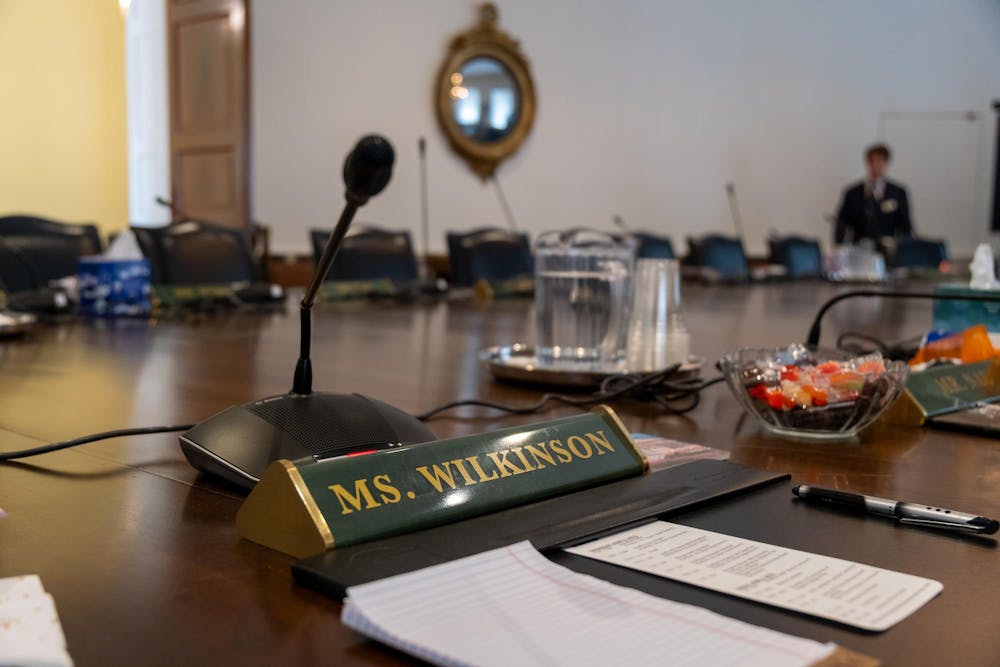
The search — which began when Ian Baucom, former executive vice president and provost, announced in January that he was leaving for Middlebury College — was ultimately unsuccessful. Although it is still unclear why it failed, several sources qualified the search or elements of the search as “highly unusual,” in large part because of the actions of Porter Wilkinson, who was at the time a member of the search committee and of the Board of Visitors, and is now vice rector to the Board.
To better understand why these sources characterized the initial search as so unusual, The Cavalier Daily spoke with six people familiar with the search, who asked to not be named due to the confidential nature of academic searches. The Cavalier Daily did not ask any of these people to identify any of the candidates involved in the search, in order to protect these candidates’ privacy. The Cavalier Daily also corresponded with Wilkinson.
“Given the Board’s role in electing a provost, it is typical that representatives of the Board participate as members of the search committee,” Wilkinson said. “It was a democratic process where each member of the committee had an equal vote in selecting the finalists.”
Below is an overview of the search and how these “unusual” events unfolded.
What happened?
Although the six sources disputed the specifics of certain events, there was a clear consensus on several key moments. Unless otherwise noted, The Cavalier Daily confirmed all information within this section with all six sources, or obtained information from already publicly available statements.
The University launched a nationwide search for Baucom’s successor Feb. 6, announcing a search committee which would be tasked with finding the University’s next executive vice president and provost. In the committee’s first meeting this spring, Ryan charged members with producing three final candidates for his consideration and described the relationship between the president and provost as the closest working relationship at the University.
The search, which was being led by the University’s Executive Search Group — which conducts searches for academic officers at the University — was well underway in March when the committee was notified that an external search firm would be added to assist with the search.
One source, however, did not characterize the search as “well underway,” and said that although the committee had held listening sessions and created a candidate profile, they had not yet seen candidate packets or made any decisions regarding specific applications.
The new firm, Heidrick & Struggles, appeared to sources to have been selected by the Board or members of the Board with the aim of diversifying or broadening the candidate pool. Although this firm brought in one or two qualified candidates, it also brought the committee “a number of” candidates who sources did not see as qualified.
The addition of Heidrick & Struggles caused a three- to four-week delay in the search, but the search continued to progress in late spring.
At the search committee’s final meeting in May, Wilkinson “implicitly vetoed” one of the leading candidates from being presented to Ryan, and said that the Board would not approve this candidate if they were to be selected by Ryan for the position. It was not clear why she did so, but four sources agreed that Wilkinson’s actions caused search committee members not to include this leading candidate in the top three presented to Ryan.
Four agreed that it was “highly unusual” for one member of a search committee to veto a candidate who was widely viewed as a leading candidate, and two sources went further to call her actions “unethical.”
The committee also presented an additional, fourth candidate to Ryan, who was brought in by Heidrick & Struggles and who was not among the initial leading candidates. One person said that Wilkinson forced this candidate, although another person said it is not unusual for individual members of a search committee to push for their favored candidate to be a finalist even if that means increasing the number of candidates presented.
It was not until Sept. 9 that the University community was notified that the initial search had been unsuccessful and that a new search would be conducted during the fall semester. The University did not provide an explanation of why the search had failed.
Why did Wilkinson veto the candidate?
While all six sources said that Wilkinson did not directly explain why she was implicitly vetoing this candidate as a finalist, several had different understandings of what could have caused Wilkinson’s statements.
“Wilkinson decided that she would preempt the process, and I think that's the key word here. She was preemptive and declared a highly qualified candidate, one among several highly qualified candidates, unacceptable and preemptively said this person is not acceptable and would be vetoed by the Board,” one source said.
Three additional sources confirmed that Wilkinson had made clear that the Board would veto this candidate, although there was not a consensus on whether she said the candidate was “unacceptable” for the position of provost.
This source went on to note that Wilkinson was not vice rector at the time and therefore, in their opinion, did not have the right to speak for the Board. The source also said that regardless of whether Wilkinson could represent the Board in the way she did, her actions circumvented a typical search process.
Wilkinson said in a statement to The Cavalier Daily that the Board had hoped for a candidate whose skills would be “complementary” to Ryan’s. She also noted that the Board had agreed with the results of listening sessions, which she said had expressed a need for candidates who had experience with sponsored research or running an academic medical center. Wilkinson said that she did not feel her actions had been inappropriate.
“My role on the committee was to represent the views of the Board, and I do not think it was inappropriate for me to do so,” Wilkinson said.
Two sources said they had inferred that this veto was on the basis of the candidate’s political views. However, another person said they believed that it was instead based on the candidate’s experience — this candidate did not have experience in sponsored research, a qualification Ryan had emphasized at the beginning of the search, according to this source.
“[Wilkinson] reminded the committee of this charge and then said this person's background is too similar to President Ryan's,” the person said. “She did not explicitly say [the candidate has] no background in sponsored research, but those two sentences were said within three or four sentences of each other.”
Wilkinson also explained that she had been focused on finding a candidate with experience in sponsored research, although The Cavalier Daily had not mentioned this topic in questions sent to her.
“Given the significant problems in the health system and desire to elevate the University’s research profile, voices throughout the community spoke in our listening sessions to the need for a candidate who brought experience with sponsored research and/or running an academic medical center,” Wilkinson said.
Another source confirmed that Wilkinson had said this candidate’s background was too similar to Ryan’s, but that Wilkinson had not specifically stated that she was rejecting this candidate on the basis of sponsored research experience.
Four other sources also noted that Wilkinson had said this candidate would be a strong fit for the presidency, although that position was filled at the time by Ryan. It was not clear to these four sources why Wilkinson had thought this.
The fourth candidate
Although Ryan had initially asked the committee to present three candidates, Wilkinson pushed for a specific candidate to be included as a fourth option, according to three sources. Five sources confirmed that this fourth candidate had been brought in by the external search firm, and three said that this candidate was not originally a leading candidate.
“I think it was unusual. I think if this person had been in the top three, I don't think [Wilkinson] would have pushed for four candidates,” one source said. “I think that this was her preferred candidate, or the Board's preferred candidate, and that's why she pushed for four [to present to Ryan].”
Another source said that in a normal search process, it is typical to have disagreements over which candidates should be finalists, and that at times, the finalist group might be expanded to include an additional person who could have been overlooked. This source disagreed that Wilkinson had “forced” a fourth candidate and said that advocating for one candidate was not out of the ordinary. However, three sources agreed that this fourth candidate was “a waste of time,” including the source who felt it was not unusual to add a fourth.
The Board
Wilkinson and Board member Amanda Pillion were the Board’s representatives on the 14-member search committee, although it was not clear to sources who selected Wilkinson and Pillion for this search. There was no clear consensus on whether Ryan had selected the rest of the committee members or whether other colleagues had put together the committee.
According to section 2.4 of the Board manual, the powers of the Board include the election of the provost — the chief academic officers of the University — among other positions such as the president and chief operating officer. Section 4.4 of the manual adds that the provost is elected by the Board upon nomination by the president and reports to the president rather than to the Board.
One source said that certain Board members had expressed interest in selecting the provost themselves, although in a typical search a president would select one candidate from the three presented to them and bring that candidate to the Board for approval. The Cavalier Daily independently verified that at least one member of the Board had instead hoped to select the provost from the slate of finalists.
It is unclear whether the Board knew about any of the candidates before Ryan selected a finalist. On the website of Executive Search Group, potential candidates are promised confidentiality and discretion. Recently, members of the search committee for the University’s tenth president have also emphasized the need for strict confidentiality in academic searches to protect candidates who may hold leadership positions at other universities.
What was unusual about this?
Every source confirmed that they found Wilkinson to be “unusually involved” in the search process, but what this meant to each of them differed. One source said that Wilkinson’s veto had preempted the process of the search.
“This was peremptory, and … took this person entirely out of the process, … saying, ‘I represent the Board of Visitors, and this isn't going to happen’ in a bullying way,” the source said. “I remember at the time, being shocked that a member of a committee that had worked together for months and months would behave in this way, which seemed to me to be inappropriate, unprofessional and certainly unprecedented.”
Wilkinson said, however, that the process of selecting finalists requires committee members to be “candid” about whether candidates will be approved of by the full University community.
“The process of narrowing a pool of highly qualified and competitive candidates to a short list of finalists requires members of the search committee to express their candid views about whether any particular candidate will enjoy support across the various constituencies of the University,” Wilkinson said.
An additional source said that the implicit veto could not have been based on qualifications, as the candidate had strong credentials for the position. They noted that while one person on a committee does not have the sole authority to veto a candidate themselves, Wilkinson had made clear that the candidate could never receive approval from the Board.
“The problem I see is you cannot, before a vote happens, say whether someone will be confirmed or not. That's irrelevant to [the] process. That's an overreach,” the person said. “The bottom line is this person was highly qualified ... [Wilkinson’s actions] were unacceptable. You cannot do that when you are voting on people. That's not part of our process."
Another source said that what was more unusual was the addition of the external search firm, which to all sources appeared to have been selected by the Board, specific Board members or Wilkinson herself. The source said that the search had already begun and was being led by the University’s Executive Search Group, which they felt was capable of conducting the search.
“The Board could have given [ESG] specific suggestions about what types of candidates to reach out to, rather than bringing in another search group,” the source said. “It not only implies that [ESG] is incapable of doing that job, but also that even if given direction from the Board, they would not [listen], which I think is an unfair thing to assume about the ESG.”
Wilkinson said in her statement that it is typical to bring in an external search firm to assist with national searches, and, with the exception of Baucom’s selection, every previous presidential and provost’s search at the University had engaged an external firm.
“There are many benefits to that approach, including that an external search firm in collaboration with ESG can solicit a broad candidate pool and lend external objectivity and credibility to the search process,” Wilkinson said.
Who is Heidrick & Struggles?
Although the reason for bringing in Heidrick & Struggles, the external search firm, was unclear, two sources said that they had heard the Board wanted to “diversify” the candidate pool. The other four sources said that this was not said explicitly, but all four confirmed that they had inferred this was the reason for bringing in Heidrick & Struggles.
Four sources said that they inferred that “diversify” meant bringing in more conservative candidates who aligned more with the Board’s political views, although they noted that there may have been other reasons. One person said that it was implied the candidates they had prior to the external search firm were not satisfactory, and three sources added it may have been based on bringing in candidates with nontraditional backgrounds.
Ron Brown, a partner at Heidrick & Struggles, was the lead collaborator with the search committee, although one source said that he did not appear to have experience with academic searches.
“There seemed to be a lack of expertise … I'm not sure people found this firm helpful,” the source said. “Was the slate of candidates broadened? Yes. Did that broadening surface particularly attractive and particularly qualified candidates? I have real doubts.”
Neither Heidrick & Struggles nor Brown responded to requests for comment.
Five sources agreed that the external firm brought in one or two highly qualified candidates, but also a number of candidates who were not qualified.
In her statement, Wilkinson did not comment on the quality of candidates brought by Heidrick & Struggles, but said that the firm has more than 70 years of experience in searches for executive leadership and claimed that this experience includes education and research.
As the search continued and finalists were narrowed down and ranked, no candidates from Heidrick & Struggles were among the top three leading candidates, according to all six sources, until Wilkinson advocated for the addition of a fourth candidate.
Moving forward
Ultimately, four candidates were presented to Ryan, according to all six sources, and visited Grounds for in-person interviews with Ryan, according to two sources. It was unclear to sources whether Ryan ever made a selection or presented a selection to the Board, though two sources said Ryan had expressed that there was only one viable candidate of the four, and three confirmed that one candidate had dropped out at the last minute.
Wilkinson said that the slate of candidates presented to Ryan were highly qualified and all had STEM or academic medical center experience. She confirmed that Ryan had selected a candidate, but that this candidate had then withdrawn from the search process.
“The candidate the president ultimately selected was my favorite candidate and had strong support across a broad range of stakeholders,” Wilkinson said. “When you are vying for the best and most-competitive candidates — whether as faculty, researchers, physicians, or administrators — this sometimes is how the process plays out, despite the best efforts of everyone involved.”
Wilkinson was elected to serve two years as vice rector to the Board in June, although the Faculty Senate recently called for her resignation and the resignation of Rector Rachel Sheridan for reasons related to Ryan’s resignation in June.
The committee for the renewed provost’s search also contains 14 members, although only three of those members — Economics Prof. Ken Elzinga, John Kosky, vice president and chief human resources officer, and Wilkinson — also served on the initial committee this spring. Wilkinson is currently serving as a member of the fall provost’s search committee, which was formed by Interim University President Paul Mahoney, and as vice chair for the presidential search committee.
In her statement, Wilkinson said that narrowing down finalists was a challenging process, and that the entire committee had to navigate disagreements and difficult decisions which took place.
“I have a high degree of confidence in the ongoing search for a Provost and am optimistic that the process will produce another slate of highly qualified candidates,” Wilkinson said.
The University has not yet provided records from a FOIA request for records pertaining to the provost’s search submitted by The Cavalier Daily Oct. 30.
Ford McCracken contributed reporting.
Read More

Tao Tan discusses financial future of U.Va., rising college tuition trend nationwide
By Lily Kostro | 24 minutes agoTan explained how tuition costs will shape the future of academic institutions such as the University.

U.Va. Health cuts scribe hours as AI documentation tools expand across Health System
By Vrinda Vashisht | 34 minutes agoScribes in the undergraduate medical scribe program said in interviews with The Cavalier Daily that a new emergency department schedule that began Sept. 15 has reduced or eliminated certain scribe shifts and has decreased scribe availability to clinicians in the Emergency Department.

How does the Honor Committee manage its endowment?
By Isabela Delgado | YesterdayThe Honor Committee manages an endowment upwards of $200,000, and for its 2026-27 academic term, it has budgeted $204,500 — just over its available endowment.