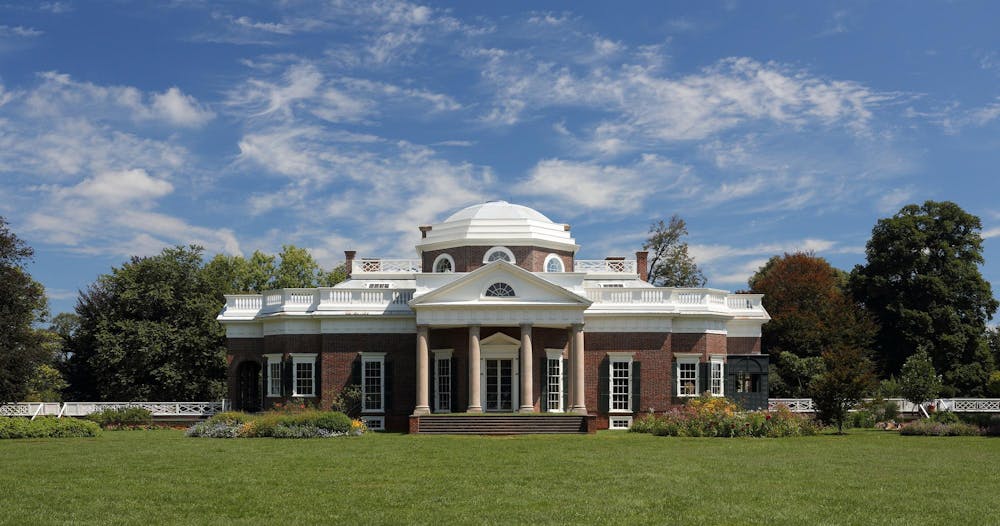
July 4 will mark the 250th anniversary of the signing of the Declaration of Independence. The University’s founder, Thomas Jefferson, served as a primary author for the Declaration of Independence. In light of this anniversary, both University and Charlottesville groups will hold celebrations throughout the year. Activities and projects — including the reenactment of the declaration and the introduction of digital platforms for curated historical information — will be held by organizations such as Thomas Jefferson’s Monticello, the Center for Digital Editing and several student groups on Grounds.
At Monticello, a series of “Pursuits of Knowledge” events will be hosted beginning Jan. 23. These events will feature authors of books written about the American Revolution, and attendees will have the opportunity to meet the authors. Jefferson scholar and biographer Andrew Burstein is one of the featured authors, and he will discuss his book “Being Thomas Jefferson.” Individuals can buy tickets on the “Pursuits of Knowledge” page on the Monticello website.
Other events hosted by Monticello include the Declaration Book Club and daily guided theatrical tours starting March 18. The book club is free and available online with readings and guided questions. Participants are provided with a guide to organize their own book clubs or may enjoy the materials on their own, but Monticello is not hosting its own in-person sessions. The guided questions ask participants to think critically about the history of the United States, and some of the reading materials include “Jefferson, Adams, and the Crucible of the Revolution,” by Dr. Jane Kamensky, and a rough draft of the Declaration of Independence.
The theatrical tours will take place once daily, Wednesdays through Saturdays, between March 18 and July 31. Guests can sign up by purchasing a $150 ticket online, and the tours will feature veteran historical actor-interpretor Bill Barker giving visitors a tour of Monticello as Thomas Jefferson.
Finally, Monticello will be hosting an Independence Day event July 4 commemorating the 250th anniversary of the nation’s independence. This celebration will be free for attendees with a reservation and includes music, concessions and children’s activities. Additionally, the West Lawn of Monticello will be transformed into an outdoor courtroom, and individuals can take part in the annual Naturalization Ceremony to officially become naturalized American citizens.
Student organizations on Grounds are also celebrating in their own ways. Matthew Foley, president of the History Club and third-year Batten student, discussed the club’s plans for the 250th anniversary of the United States, saying that the History Club will host speaker events and field trips to provide club members with different perspectives on the American Revolution.
“We’ll have opportunities to tell the stories that we know about Thomas Jefferson, George Washington and the founders of this era,” Foley said. “[We are] also highlighting some of the stories of the role of women, the role of African Americans and the role of Native Americans during the Revolution.”
The first speaker event of the series hosted by the History Club will occur March 12 with Dr. Jane Kamensky, chief executive officer and president of Monticello. Dr. Kamensky will speak to the club on the role of women and gender during the Revolutionary period. Foley also discussed plans for organizing an event in February on the role of African Americans during the Revolution for Black History Month.
Similarly to the History Club, Ryan Shoztic, president of the Jefferson Literary and Debating Society and third-year College student, explained that similarly to the History Club, students in the Jefferson Literary and Debating Society will be commemorating the 250th anniversary of independence. Shoztic said that though they have no concrete plans for the beginning of the year, the Jefferson Society will be hosting an event for their alumni and regular members July 4.
“We will be doing a reenactment and reading of the Declaration on Fourth of July in Jefferson Hall or Hotel C West Range,” Shoztic said. “This is kind of like an old tradition of the society.”
Afterwards, Shoztic explained that the Jefferson Society will have a summer meeting July 14 on Grounds in Jefferson Hall. He noted that this summer meeting has taken place every year for the past 21 years, and members orate on varying topics each year. This year, the content will be related to America’s 250th anniversary of freedom. Shoztic described the event as a rhetoric or oratory contest with a prize being given to the best presenter.
Stories about the Revolutionary period will also be highlighted by the Center for Digital Editing, a specialized center at the University focused on creating and publishing digital editions of historical documents. The CDE received a $10 million, five-year grant in October from the National Endowment for the Humanities to digitize various historical documents for the general public who may not have access to historical primary sources otherwise.
CDE Director Jennifer Stertzer discussed the grant and how that connects to the goals they have for the 250th anniversary, including a digitization project. Stertzer highlighted that the CDE will be curating content related to the revolutionary era and making it accessible through an online platform they are developing called forgingUS.
“The 250th project is something that the NEH was really interested in,” Stertzer said. “[Digitizing historical documents] make[s] all of the work that editorial projects do more accessible in an online environment.”
Stertzer noted that the CDE plans to collaborate with the University’s own scholarly publishing division, The University of Virginia Press, to create forgingUS. U.Va. Press’s extensive collection of scholarly material and their digital imprint, Rotunda — which is a collection of historical documents — allows for the CDE to access digitized scholarly works and primary sources to integrate them into forgingUS.
“We’re going to be curating content from projects and from the publishers, and making it more accessible through [forgingUS],” Stertzer said. “We’re imagining our audience to be … high school on up to lifetime learners”
CDE’s plan, alongside Monticello and on-Grounds organizations like the Jefferson Society and the History Club, provide University and Charlottesville community members with opportunities to recognize their country’s history and Jefferson’s prominent role.
Komal Reddymachu is a second-year College student majoring in government and English. He is a staff writer on the news desk and has been writing for The Cavalier Daily since his first semester at the University. Komal enjoys writing about all topics, but he especially enjoys covering events around Charlottesville.
Read More

Students, professors weigh in on the importance of letter grades
By Ruby Budetti | 13 hours agoWhen thinking about letter grades for themselves, many University students and faculty said they prefer letter grading throughout all four years of college.
What services does the Student Health Fee provide for students?
By Melody Yuan | 13 hours agoThe University Board of Visitors approved tuition and fees for the 2026-27 academic year in April, and the Student Health fee rose from $1,147 to $1,184 per student.
The ‘AI and Future of Work’ Series — How the University is preparing students for what is next
By Lidia Zur Muhlen | 15 hours agoIn a recent Gallup Inc poll, 79 percent of Americans believe that artificial intelligence will reduce the number of jobs over the next 10 years.