
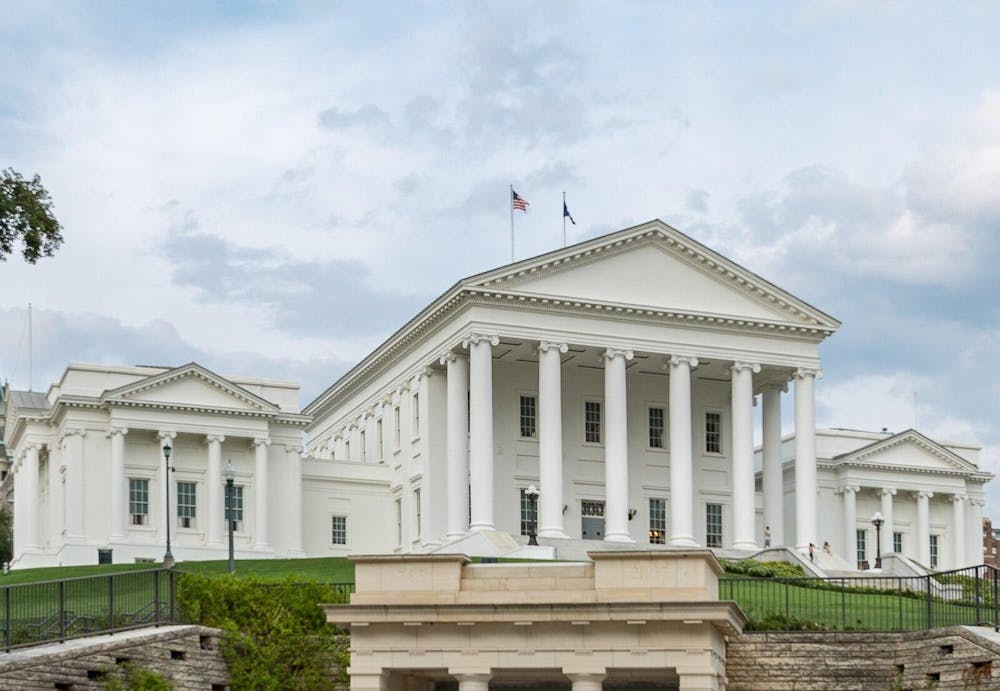
The new General Assembly convened Wednesday in Richmond after resounding Democratic victories in November’s elections. The start of the legislative session and Saturday’s inauguration of Gov.-Elect Abigail Spanberger marks just the second time this century that Democrats have held a trifecta in Virginia state government — a majority in both legislative chambers, plus control of the Governor’s office. From Spanberger’s affordability plan to major amendments which could end up on the ballot this year, there are a number of key priorities for the new legislature that could affect members of the University community.
Wednesday also officially marked the end of the prefiling period during which members and members-elect proposed their bills. Legislators will consider the bills over the course of a 60-day session. Spanberger, who will set much of the agenda for her party in the General Assembly, will also sign, veto or attempt to amend any legislation that makes it to her desk, once session concludes. Legislation signed into law will go into effect July 1.
Among some of the major legislation introduced includes House Bill 1, sponsored by Del. Jeion Ward (D-Hampton) which would amend existing law to slowly raise the minimum wage in Virginia to $15 per hour by 2028. The Department of Labor and Industry would then raise the minimum wage further in proportion to any increases in the Consumer Price Index — which measures how the typical cost for standard products like food, housing and healthcare change over time for the urban American household.
Cecelia Parks, member of the Political Coalition and Policy Committee for the University’s United Campus Workers of Virginia chapter, told The Cavalier Daily that the UCWVA welcomes this legislation despite thinking that the minimum wage should be higher.
“We’re really excited about [the bill],” Parks said. “I know there are folks at U.Va. who make minimum wage…[though] 15 dollars [an hour] working at U.Va. doesn't go but so far [and] we’re…advocating for a living wage at a higher level … it’s a really good step in the right direction.”
Parks said that the UCWVA’s primary focus this session is legislation which would allow all public sector workers to collectively bargain in Virginia. Currently, localities can choose to give bargaining rights to local public-sector workers such as teachers and police officers, while state public-sector workers — such as University faculty and staff — cannot collectively bargain at all.
Parks further added that the UCWVA supports a bill by Delegate Amy Laufer (D-55th), which would require that a staff and faculty member serve as elected, voting members of Virginia’s Boards of Visitors. Currently, the University’s Board has a non-voting faculty representative appointed by the Board and no staff representative.
Other major legislation introduced this session is Spanberger’s legislative package to make the Commonwealth more affordable. The 17-bill plan, announced by Spanberger and Democratic legislative leaders in December, is designed to lower the cost of living for Virginians with bills targeting housing, healthcare and energy.
A key component of the package is that it aims to strengthen tenants’ rights. House Bill 15, introduced by Delegate Marcia Price (D-85th), would increase the length of time before landlords could evict their tenants for missing rent from five days to 14. Spanberger’s team says this would allow more renters to get their paycheck during that period and avoid eviction. Another bill would expand the Virginia Eviction Reduction Program — a pilot program signed into law in 2020. Its role includes providing temporary financial assistance to certain Virginians at risk of being evicted, helping them to make rent and remain in their homes.
Other Democrats in Richmond have proposed similar bills which would strengthen tenants’ rights. House Bill 14, also introduced by Price, would allow localities to sue landlords on behalf of tenants who have been directly harmed by living in unsafe conditions. House Bill 95, introduced by Del. Elizabeth Bennett-Parker (D-5th), would require landlords with more than four properties to offer payment plans to tenants who owe up to a month’s rent.
Given the University’s large population of off-Grounds students — most of whom rent in Charlottesville — there are a number of University organizations that advocate for stronger tenant protections. In October 2021, the Student Council Executive Board released a statement, co-signed by 19 organizations, advocating for codifying the “essential tenants’ rights” found in the Charlottesville Affordable Housing Plan. Furthermore, Student Council’s statement argued that the city’s limited housing supply contributes to a power imbalance between student renters and landlords.
Clay Dickerson, Student Council President and fourth-year College Student, confirmed in a statement to The Cavalier Daily that Student Council stands by the sentiments expressed in their 2021 statement. Furthermore, Dickerson said he believes Spanberger’s affordability agenda will be crucial in achieving a more livable Charlottesville for both locals and students.
Sen. Creigh Deeds (D-11th) said he broadly supports many priorities in Spanberger’s agenda. As someone who used to represent one of the state’s most rural counties — Highland County in Western Virginia — Deeds said he believes the needs of every locality differ drastically depending on size. Spanberger’s 17-bill package avoids imposing a “one-size-fits-all” housing plan across the Commonwealth, and Deeds said this will account for differing needs.
”Whatever [bills] we make in Virginia have to work for Fairfax County with a million and a half people and Highland County with 2,200 people,” Deeds said.
Noteworthy proposals by Republican legislators include Senate Bill 46, introduced by Sen. Christie New Craig (R-19th), which would shorten the window to vote early and in-person from 45 days before an election to 15. House Bill 51, introduced by Del. Rob Bloxom (R-100th), would eliminate the requirement for local elections to occur in November. When this requirement was passed in 2021, opponents of the measure expressed concern that it would inject national political tensions into local contests.
There are also four proposed Constitutional amendments in Virginia which, pending legislative action, could make it onto voters’ ballots in April and November. In order to amend Virginia’s Constitution, the General Assembly must first pass an amendment by a simple majority vote in each chamber. The next elected General Assembly must then vote to re-pass that amendment for “second reference.” Finally, the amendment is sent to the voters for a statewide referendum vote on its adoption. Democrats are expected to re-pass the four major proposed amendments from the 2025 session during this session, which will then go to a statewide vote. Notably, the governor does not have veto power over these proposals.
The first proposal would allow for mid-decade redistricting of the Commonwealth’s congressional districts by the General Assembly — this amendment would not eliminate Virginia’s Independent Redistricting Commission. The General Assembly would be granted the temporary power to redraw congressional district lines until October 2030 in response to other states doing the same.
Deeds noted that, as the language requires, other state legislatures have engaged in mid-decade redistricting. With President Donald Trump encouraging states like Texas, Missouri and Ohio to redraw their congressional lines, Deeds says he believes Virginia must act now to counteract Republican gains from these efforts by first passing the amendment and then a new, heavily Democratic congressional map.
“Never before [has] a president [gone] from state to state, encouraging states to … redraw [congressional] lines for partisan advantage,” Deeds said. “We cannot sit idle while that happens. We have to be able to fight back.”
The next proposed amendment would eliminate null and void language about marriage from Virginia’s Constitution and replace it with protections for all married couples, regardless of “sex, gender or race.” The current language, added to the Constitution in 2006 but subsequently nullified by the courts, recognizes marriage as “only a union between one man and one woman.”
Another proposed amendment would guarantee Virginians the right to reproductive freedom. This would mean the freedom of individuals to make choices about their medical care for childbirth, abortion, fertility and miscarriages.
A final proposed amendment would automatically re-invest all Virginians convicted of felonies with the “fundamental right to vote” after release from incarceration. Currently, the governor must restore the voting rights of those who committed felonies on an individual basis.
Deeds said that Virginians can expect to vote on most of these amendments in the November general election, but that the General Assembly will likely schedule a vote on the redistricting amendment to take place in April. If it passes, he says the General Assembly will go back into session and redraw the lines.
Political organizations on campus are already gearing up for a potential spring vote. Semony Shah, University Democrats president and third-year Commerce student, shared a statement with The Cavalier Daily, indicating UDems would strongly support the redistricting amendment and work to convince the student body to vote for adoption.
“UDems supports legislation that prevents and challenges bad-faith partisan gerrymandering in other states,” the statement reads. “As we approach the spring, UDems plans to educate and engage the student body through voter education and outreach.”
The statement also expressed support for the three amendments which would be on the ballot in November.
The session will conclude March 14. The General Assembly is expected to reconvene April 22 to override any vetoes by Spanberger, as well as to consider her suggestions for amendments on particular bills.

Luca Bailey is a third-year Politics student from Free Union, Va. As a staffer on the news and video desks, he has covered topics ranging from the General Assembly and state elections to local politics and University governance. He is also The Cavalier Daily’s beat writer for the Charlottesville City Council.
Read More

University launches new Program in Digital Humanities and AI
By Naren Senthilkumar | 21 hours agoAccording to the University’s website, the program is intended to function as a coordinating hub for the College's digital, computational and AI-based approaches to humanistic inquiry.

U.Va. Health Emergency Department among most expensive trauma centers in Virginia
By Michael Racz | 21 hours agoIn comparison to other nonprofit level 1 trauma centers in Virginia, the University Medical Center had the highest self-pay rate — the amount charged to patients who pay out-of-pocket rather than through insurance — for Emergency Department facility fees and was among the most expensive for other treatment services, including CT scans and various blood tests, based on published pricing data.

Mona Sloane joins U.Va. Law for a discussion of her book on AI and sociology
By Edward Christopher | 21 hours agoSloane runs the Sloane Lab at the University, an interdisciplinary research group focusing on the intersection of artificial intelligence and cultural, economic, material and political conditions.


