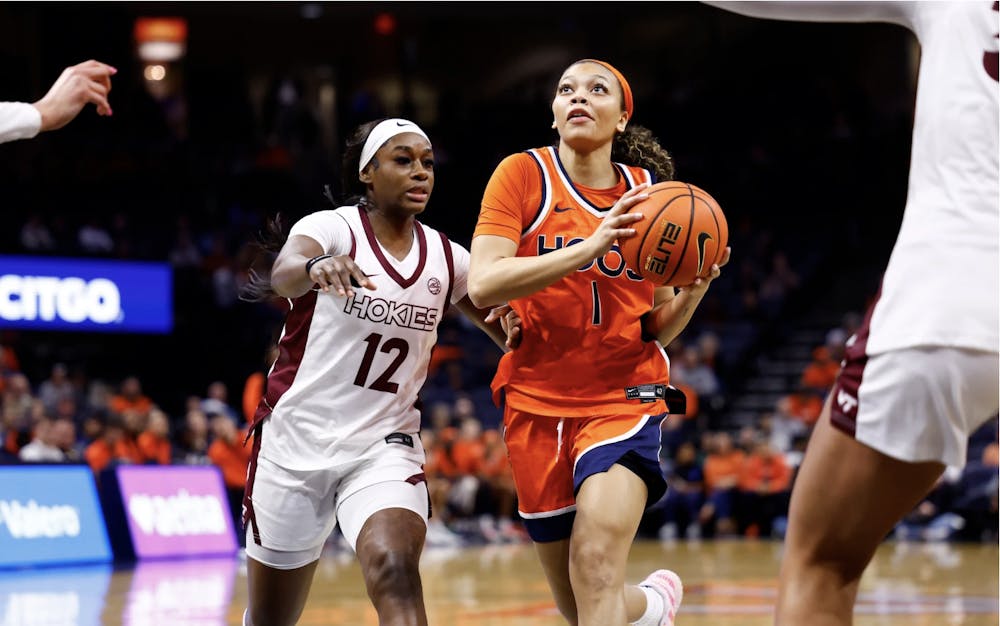
For Virginia, Sunday’s one-point defeat to Virginia Tech felt painfully familiar.
All season long, the Cavaliers' inconsistency has undermined their potential. Whether it was climbing back from behind before flaming out in the overtime loss to NC State or allowing Syracuse a 15-2 run in the final frame, Virginia has lived off the false hope that second-half surges would erase first-half deficits and tip momentum in its favor, only to come up short in the final moments.
But against Virginia Tech Sunday, falling short punctured a wound far deeper than any other matchup has posed this season. The Cavaliers had already missed an opportunity for a statement win at Cassell Coliseum Feb. 1, where, once again, Virginia’s rally stalled despite trailing by just five points heading into the final quarter.
At the surface level, the rematch’s outcome was only a distinction between a six-seed and an eight-seed in the ACC Tournament. However, beyond seedings, a win could have made all the difference for a team in desperate need of morale amidst the Cavaliers' eight-year NCAA Tournament drought.
Even though Virginia pulled off an impressive rally in the second half that pushed Coach Amaka Agugua-Hamilton’s squad in front by one point after cutting back a deficit as large as 23 points, the team’s attention to detail was sorely lacking in the final two minutes.
The matchup devolved into the kind of scramble that has haunted Virginia all season — it featured rushed shot selections down the stretch, panicked defensive possessions that the Hokies capitalized on and a botched inbounds play with one second left. One possession bled into another, and momentum slipped away before Virginia could steady itself.
Time and time again, the Cavaliers have struggled to maintain any sort of consistency this season, often finding rhythm only until the deficit is large enough to force freer, more synergistic basketball. No matter how commendable the second-half comeback was against Virginia Tech, the first-half hole was self-inflicted and entirely avoidable. Sure, Virginia fights. It did so on the road at Louisville, not solely because of clutch shotmaking, but because of late-clock execution, minimized turnovers and crisp ball movement.
But replicating that kind of consistency down the stretch has been rare. When games demand careful execution rather than reactive urgency in the final quarter, the Cavaliers have not delivered — making matchups like Louisville feel more like anomalies than the standard.
Even on their home floor on Senior Day, the Cavaliers could not maintain the discipline necessary to avoid unforced errors and fully regain momentum, highlighting a longstanding pattern in a cruelly up-and-down season.
“I apologized in the locker room that we didn't get it done for the seniors,” Agugua-Hamilton said. “I think everybody feels that way. You never want to send your seniors off in their last game in this arena with a loss.”
As much as the final minutes dictate the results of a game, the Cavaliers were backtracking the second the opening whistle was blown. Another characteristic of Virginia's season, even recently in its matchup March 1 against No. 21 North Carolina, has been its scoring droughts. Virginia’s shot selection and overall offensive inconsistency have plagued the Cavaliers from the slightest ounce of staying within striking distance in the second half.
Sunday followed the same script.
Junior guard Kymora Johnson scored only one point in the first half, which was dominated by poor perimeter defense that Virginia Tech easily exploited. The Hokies drained six three-point shots in transition, as Virginia’s pace lagged behind.
Virginia’s man-to-man scheme never found its footing because the Cavaliers lacked urgency. Closeouts came late, and Virginia’s rotations were consistently outhustled. The Hokies punished Virginia on both fronts, a pattern NC State and Syracuse also followed.
“[The Hokies] were scoring at will on us in [five-out],” Agugua-Hamilton said.
Without Virginia’s primary facilitator in Johnson, its offense stalled entirely, settling for rushed shots as the shot clock wound down, forcing tough drives with hopes to be sold out on whistles and opting for sloppy ball movement, which added nothing more than an increased turnover margin. But, if anything, this performance was more a confirmation than a collapse. The bout against Virginia Tech exemplified how Virginia’s inconsistency has forced unnecessary deficits that resilience alone cannot escape.
With the regular season over, a team that once appeared primed to maximize its tournament hopes after a statement victory on the road to then-No. 8 Louisville is back on the outside looking in.
For months, Virginia has waited for proof that slow starts and late-game lapses were temporary and fixable. But now with that signature win under the Cavaliers’ belt, Sunday proved something different for Virginia. Virginia lost to the Hokies because this has represented its identity all year long — a team that fights back, but cannot sustain control when the lights shine the brightest.

Sofie Keppler is a senior writer on the sports desk. She is a second-year Commerce student. Originally from Evansville, Ind., Sofie enjoys covering women’s basketball, soccer and golf.
Read More
Five takeaways from the first two Virginia men’s basketball exhibition showcases
By Jordan Zimm | 14 hours agoWith one more exhibition remaining at Villanova Thursday, here are five takeaways from Virginia’s first two preseason tests.

Virginia volleyball looks to extend historic winning streak to 10 against Virginia Tech
By Jonathan Altshuler | 15 hours agoWhile both teams have struggled recently, Wednesday’s result further strengthened the Cavaliers' advantage in the rivalry — which remains one-sided.

Virginia volleyball extends winning streak against Virginia Tech with four-set victory
By Jonathan Altshuler | YesterdayThe Cavaliers defeated the Hokies in four sets Wednesday night at Memorial Gymnasium with scores of 25-19, 25-19, 22-25 and 25-23. This was the Cavaliers’ first win since Sept. 25, extending a five-year winning streak against the Hokies since 2022.