Correction: A previous version of this article incorrectly stated that the search for University President Scott Beardsley lasted seven months. The search lasted for approximately five months. The article has been updated to reflect this change.
In their recent letter to the Board of Visitors, University President Scott Beardsley and the University community, 191 faculty members demanded a restart of the presidential selection process under new Board of Visitors leadership — a demand as futile as banging one’s head against a brick wall. Even as someone who previously wrote against the hurried and opaque nature of the appointment process, I believe it is irrational to request a reset two months later when the foundation of this administrative brick wall has already been poured, set and built upon. To tear it down would not be an act of protest, but rather, one of institutional sabotage.
The faculty’s letter raises broader concerns about the legitimacy of Beardsley’s appointment, questioning whether the previous Board gave adequate consideration to applicants or was even lawfully meeting in the first place. They highlight the role of the external search firm, Isaacson, Miller, and urged the newly reconstituted Board to address lingering questions — even suggesting that Beardsley himself quit his position. While all of these concerns are well-founded and logical, the nature of the situation is paradoxical in that any attempt to retroactively “correct” the process risks amplifying the political tensions it seeks to resolve.
A truly unbiased presidential appointment process is something of a catch-22 in that there will always be political values in play from one side or another. As a public institution, the composition of our Board of Visitors is at the discretion of the governor, a position always occupied by a political actor beholden to one set of partisan ideals or another. For this reason, if the process were to be restarted, the end result would likely appease a different group of people, but leave others feeling left out of the equation, taking the University community back to square one and making the position even more expressively political. At a certain point, the University needs to take a defiant step forward, rather than ending up in a cycle of re-litigation.
The impracticality of restarting the search is further compounded by the sheer time it would take to conduct a comprehensive search for a new president. The previous search, which has been criticized for being abbreviated, lasted approximately five months. Consequently, a search thorough enough to escape the “hasty” criticism leveled at Beardsley’s would likely require significantly more time.
This process delay is especially alarming because, as we have seen in the recent past, time is not at a premium. Just last semester, under interim leadership, the University was unscrupulously investigated multiple times by the Department of Justice. Interim officials were filling many major roles, such as the president, executive vice president and provost, health CEO and three academic deans, and the University received criticism for its lack of prolonged leadership. It is abundantly clear that as an institution under scrutiny, we can not afford ambiguity at the top. No matter how effective the interim leader, strategic planning stalls and long-term commitments waver during their stints — a weakness which can be avoided by standing behind Beardsley's presidency.
Moreover, the demand to restart the search entirely ignores the sunk-cost fallacy staring the University in the face. The faculty letter supposes Beardsley’s employment agreement features a "poison pill" contract. With a base salary of $1.3 million and a clause guaranteeing a full year of severance plus paid sabbatical leave if terminated without cause, the financial reality is undeniable. Contracts of this nature exist to provide stability and are common for such a position. Thus, firing Beardsley would not only trigger millions in severance and paid leave, but also require the University to hire a top search firm to assist with the ensuing process. Considering both the contract and the associated costs involved with a new search, it is clear that the University must move forward, rather than dwell on a restart that achieves little but financial and political upheaval.
Although it could be argued that the contract limits the Board’s ability to truly hold Beardsley accountable, it is worth noting that the new Board of Visitors, like many of the critics calling for a restart, now leans liberal after Gov. Abigail Spanberger’s 10 Board appointments. This means that those who are ideologically concerned about the accountability of the process already are in possession of the mechanisms to hold Beardsley responsible if he fails to meet their expectations. In fact, it is hypocritical to bring the partisan nature of Beardsley’s appointment process back to light when similar partisan motivations were behind the current composition of the Board.
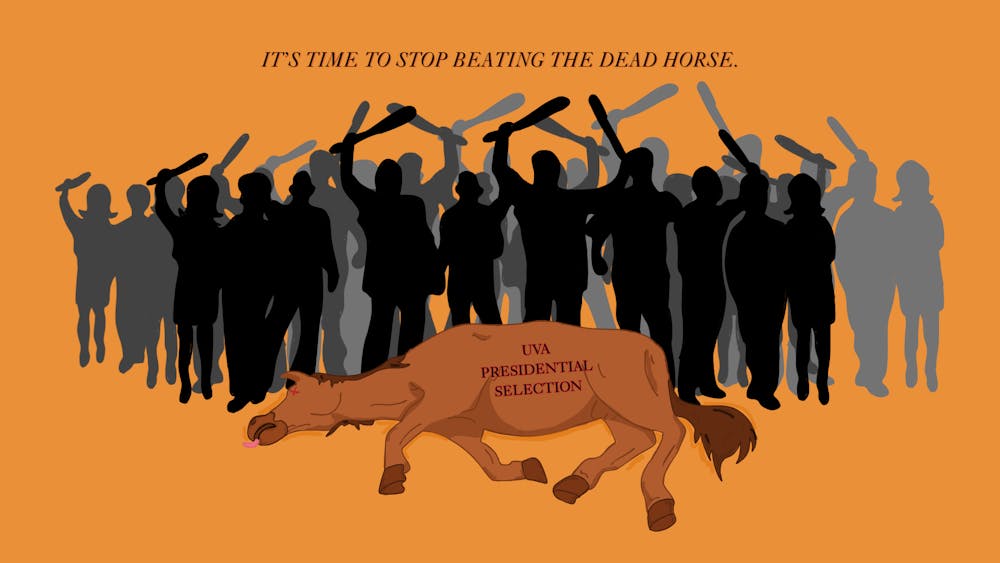
In short, the horse is dead. If we continue to beat it, we only delay the essential work that needs to be done and the stability that needs to be established right now through long-term planning. This approach does not preclude criticism or scrutiny — faculty and stakeholders still retain the ability to hold the administration accountable. What it does do is prioritize the University’s stability and effectiveness over partisan posturing or procedural theatrics. In this moment, the responsible path is forward, not backward.
Ryan Cohen is a senior opinion columnist for The Cavalier Daily. He can be reached at opinion@cavalierdaily.com.
The opinions expressed in this column are not necessarily those of The Cavalier Daily. Columns represent the views of the authors alone.
Read More

DUTTENHOFER: There is no ‘networking’ your way into belonging
By Lucy Duttenhofer | 21 hours agoThere is no need to optimize every second, schedule every plan to the last minute or know every single person within a 15-foot radius.

ANDERSON: Be lazy
By Beckett Anderson | 6 days agoTrue laziness means trusting yourself to lead your own life.

HAWKINS: Virginia’s budget ‘compromise’ tries and fails
By Joshua Hawkins | July 31, 2026As families across our Commonwealth struggle to make ends meet, Virginians are yet again saddled with a state legislature with no concept of what the public actually wants.