
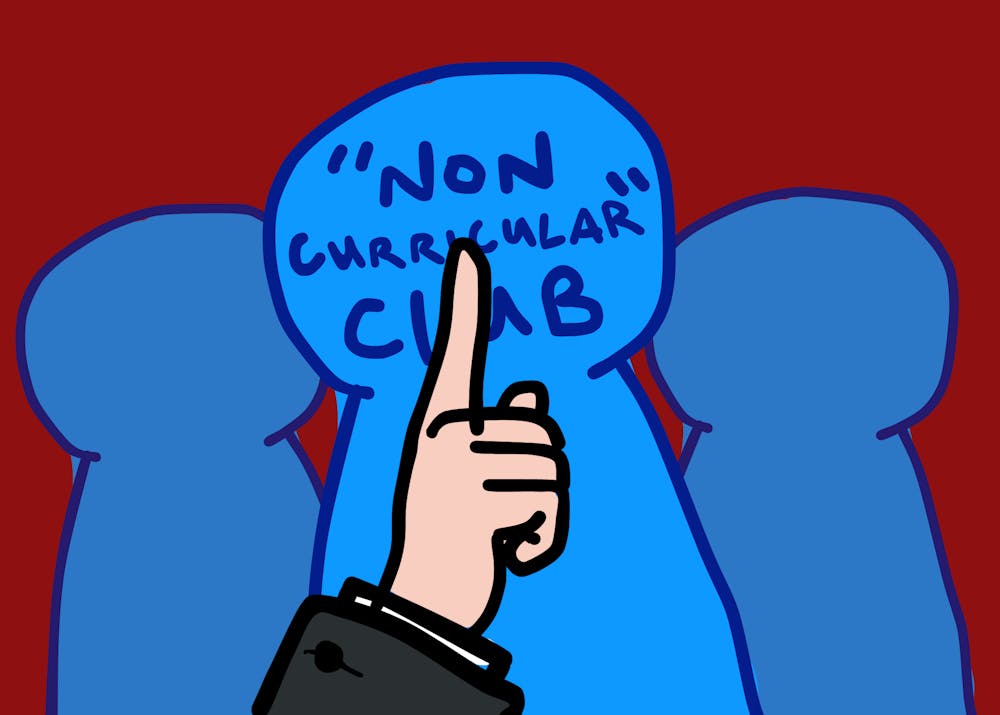
Recently, the Albemarle County School Board voted to pass a policy that instructs middle school and high school administrators to classify clubs into “co-curricular” and “non-curricular” clubs. By their definition, non-curricular clubs are ones that the board determines are affiliated with a political, religious or special interest motive. Co-curricular organizations are clubs that are deemed by the board to extend school curriculum and supplement course material — the board highlighted performing arts groups, language clubs and art activities as examples of this. This classification comes with new stipulations for “non-curricular” clubs, consisting of limited teacher involvement, guest speaker appearances only after school hours and potential restrictions on access to funding. At a surface level, this policy can be seen as a valid attempt to address legitimate concerns about hateful speech and student safety, but the problem lies in its execution. The new distinction between “co-curricular” and “non-curricular” clubs creates vague and deleterious gray areas that risk undermining student expression.
As national politics become more focused around issues like race, gender and the role of public education, K-12 schools have become key battlegrounds for disputes over free expression — prompting outside groups to push for greater influence over what can be discussed in the classroom. K-12 schools sit promptly in the middle of partisan crossfire, and because of this, there have been increasingly more attempts to impose content and expression restrictions across all educational activities. Controversial speakers and political organizations remain present figures at universities, but more recently are starting to move into high schools to expand their scope of outreach and influence.
Albemarle County’s school district experienced this firsthand, as Erika Kirk was recently scheduled to speak to the Turning Point USA chapter of Western Albemarle High School during school lunch. The news of Kirk attending Western Albemarle High School prompted the board to quickly act on its policy proposal of club classification, voting to pass it and impact the operations of the TPUSA chapter before her appearance. The newly adopted policy meant Kirk, and any other speaker in the political sphere, would no longer be allowed to speak during school hours, as it violates the guidelines that a “non-curricular” — such as the school’s chapter of TPUSA — must follow. Grounded in facilitating safety for students, this policy goes beyond such a realm to limit student expression.
With the new policy, “non-curricular” clubs are stripped of their ability to host speaker events during lunch. Unfortunately, the reality for many high school students is that lunch events are one of the few accessible times they can attend such opportunities. A student may have finally found a topic they care deeply about, a group they feel connected to or even something they want to learn more about, but with the new policy, their access to it may simply be denied if they do not have the luxury of attending after school hours. In this way, the blanket club policy risks limiting students’ educational experience — the exact opposite of the effect that school policies for students should have.
Despite the policy being initiated surrounding the circumstances of TPUSA, its language clarifies an inherent and broad problem of the distinction mechanism — this distinction could be politically weaponized by the Albemarle County School Board for other clubs. Perhaps TPUSA is an obvious example of a “non-curricular” club, as it is entirely politically motivated in contrast to other student organizations. However, there is plenty of gray area around where other organizations lie in this distinction. Cultural and LGBTQ+ organizations, for example, are impactful clubs that help students find their community, but they could be at risk of falling under this “non-curricular” label if, say, the club writes a statement in support of legislation or protests in favor of their identity. Under these circumstances, these clubs would then be restricted from meeting during school hours and may have their funding cut. In effect, this policy’s arbitrary classifications of clubs may lead to long-standing consequences for clubs beyond those that are often controversial and political.
It is absurd that such a sweeping decision, with ambiguous consequences for numerous clubs, did not come with protections against partisanship or favoritism which may appear in its own governing board. At the end of the day, the decisions on how to classify clubs will be made by middle school and high school administrators — who, inevitably, have their own ulterior political drivers just like anyone else. Perhaps one administrator would select certain “non-curricular” organizations to support, based more on their personal preferences rather than treating all organizations with impartiality regardless of their beliefs. In this way, the policy change risks eroding the power of and support for certain “non-curricular” organizations. Further, by creating this policy, the board risks disincentivizing civic engagement and viewpoint diversity on various issues — key formative experiences for high school students.
To get at the heart of the board’s stated mission of removing clubs that “promote or endorse violence, harassment or hatred toward an identifiable person or group,” they must first create a policy that clearly distinguishes between hateful conduct and merely controversial ideas. Groups promoting harassment or violence towards any group of people should absolutely be banned, but placing restrictions on clubs with political or religious views sets a dangerous precedent that these clubs are inherently hateful or deserving of administrative ostracization. Instead of limiting this form of dialogue, schools should encourage teaching students how to have healthy conversations about difficult and tense worldly topics. Protecting students from harassment should never become a justification for suppressing debate itself.
Ironically, the Foundation for Individual Rights and Expression proclaimed in their letter to the Albemarle County School Board that, while school officials should protect their students from any club promoting hatred, the broadness of their policy risks prohibiting far more speech than what is truly unconscionable. There is a way for the board to balance safety and protection while also remaining advocates for free and open discourse amongst their students — but this new policy is not the answer. Albemarle County high school administrators must remember that their schools pave the way for children to figure out who they are, what they believe in and what they care about.
Mason Segarnick is an opinion columnist who writes about politics for The Cavalier Daily. He can be reached at opinion@cavalierdaily.com.
The opinions expressed in this column are not necessarily those of The Cavalier Daily. Columns represent the views of the authors alone.
Read More

U.Va. MEDICAL STUDENTS: Why e-bikes and e-scooters need real rules
By U.Va. Medical Students | 11 hours agoAs medical students who will soon be treating the consequences of these injuries firsthand, we believe e-bike and e-scooter safety is a public health issue the University and the Commonwealth can no longer afford to overlook.

OPINIONS: What to watch for this November election in Virginia
By Wylie Brunman , Scarlett Sullivan , Michael King and Joshua Hawkins | YesterdayFour opinion columnists write on upcoming ballot measures and key races for Virginia’s Nov. 3 general election.

YOUNIS: The false promise of neutrality at U.Va.
By Ayat Younis | 3 days agoAcademic excellence and diversity have never been competing ideals.


