
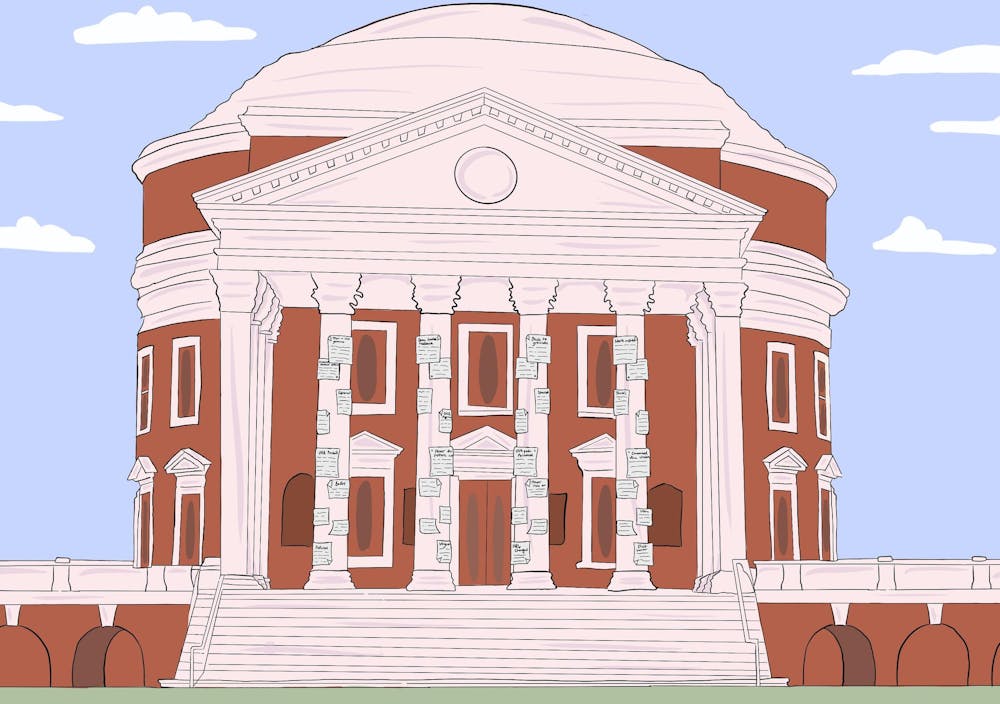
It has been an eventful year to be the Editorial Board for a student newspaper at the University — this summer, our University became national news. The forced resignation of former University President Jim Ryan raised fundamental questions about institutional autonomy, academic freedom and shared governance, each of which seemed to be compromised with Ryan’s resignation and the ensuing months of controversy. And while we now have a permanent president in Scott Beardsley, the questions and challenges which have defined this semester will continue to resonate.
The sections below chart the paths of Editorial Board members over this semester, with each member of the 136th fall Editorial Board sharing an editorial which they found to be particularly meaningful during the tumult of the past year. Our articles are typically published under the monolithic title of “EDITORIAL.” This article, however, intends to capture the parts of the whole — the seven students behind the sign-off.
June 27: Federal overreach will not end with President Ryan
Whenever someone asks me what it is like to lead the Editorial Board, I am brought to one image — a four-time-zone-spanning Zoom call with the members June 27, the night of Ryan’s resignation. The subsequent article, “EDITORIAL: Federal overreach will not end with President Ryan,” sped past those four time zones with a publishing turnaround under 24 hours.
Organizing this quick production, I spent the night of the resignation half-heartedly hoping that the news was an overdue April Fools prank. Surely, it could not be our University that found its institutional autonomy under direct siege from the Trump administration. It could not be our University president who was pressured and forced by the Justice Department to resign.
This piece signaled the beginning of a transformative semester. With the announcement that the University as we knew it was effectively gone, we mourned the loss of a University president who inspired thoughtful change for the community and jointly asserted that this moment in University history was also a moment for action. This editorial set the tone for a semester in which we had to quickly react and thoroughly analyze events that continued to impact Grounds. — Scarlett Sullivan, Executive Editor
July 21: U.Va.’s path forward begins in the shadows of administrative silence
The resignation of Ryan sent shockwaves through the community — our Editorial Board included. As a result, many looked to The Cavalier Daily for answers. And yet, the seven members of this Editorial Board soon realized that we did not have all of the answers, leading us to write an article entitled, “EDITORIAL: U.Va.’s path forward begins in the shadows of administrative silence.”
We were uniquely placed in a position that made us reevaluate the two identities we held — we were students who lacked access to complete truths and journalists writing for a professional publication that aspired to publish the truth.
So when trying to make sense of the swift resignation, we asked four questions. Who negotiated on behalf of the University with the DOJ? Where were the guarantees the DOJ promised? When would these guarantees take shape? What comes next? However, even now, many of our questions remain unanswered. In this way, the July 21 editorial was the precursor for an ongoing conversation that reflects dissent, confusion and disdain, all of which continues to pervade the University community. — Farah Eljazzar, Opinion Editor
Oct. 9: Some “limited” feedback on the Compact
Compiling unique editorials each Monday in our Editorial Board meetings is never easy, but every so often, someone seems to throw us a bone. This was the case for our Oct. 9 article, “EDITORIAL: Some 'limited' feedback on the Compact,” which came after the University was included in the Trump administration’s “Compact for Academic Excellence in Higher Education.”
Aside from a name that reminded me of the First Annual Montgomery Burns Award for Outstanding Achievement in the Field of Excellence, this document was an ostensibly well-intentioned proposal, replete with sweeping mandates and performative language, yet riddled with ambiguity and latent coercion. For instance, it limited the amount of international students allowed to attend and mandated the University share all relevant international student data with federal agencies.
The Editorial Board identified the language in the Compact as subtly intrusive, and deftly acted, using our high school DBQ skillsets to dissect it clause by clause. The resulting piece noted constraints on university autonomy, and advocated for its rejection, which the University effected a week later. — Ryan Cohen, Senior Associate Opinion Editor
Oct. 25: On the ballot this November, keep U.Va. in mind
Being on the Editorial Board this semester has given us the unprecedented opportunity to voice our opinions on the ongoing tumult which engulfs our University — problems created and enhanced both internally and from the government at large. At the time of Virginia’s statewide elections, we needed our Board of Visitors to be depoliticized and leaders who would defend our University.
In our Oct. 25 article “EDITORIAL: On the ballot this November, keep U.Va. in mind”, our goal was to inform students of the ballot’s local impact on their future education. While there are many issues factored in by each voter, for the well-being of our University, I felt there was only one true option for governor.
Foreseeably, I was elated when the results came in. However, just taking Spanberger at her word presents its own risk. In a later article, “EDITORIAL: Spanberger, do not follow in the pattern of our last governor,” we provided our next leaders with a few suggestions as to whose footsteps they should follow in, and we are hoping they choose the right path. — Adeline Garvie, Opinion Columnist on the Editorial Board
Oct. 31: DOJ agreement signed and institutional instability guaranteed
It is hard to describe the utter bewilderment I felt when the University chose to sign an agreement with the federal government that incorporated most of the Compact's unpleasantness. After the Compact’s rejection was announced, I personally championed Interim University President Mahoney for his necessary act. To that end, I felt especially betrayed by his subsequent decision to engage with a government that has continually disrespected our University.
The truth is, we attend a unique institution — one founded shortly after our nation was founded and built on many of the same ideals, including the rule of law and governance for the sake of the governed. As such, we students have a crucial responsibility to ensure that our leaders respect the fervent dedication of all who have and will pass through the University. As our Oct. 31 editorial, “DOJ agreement signed and institutional instability guaranteed,” argued, the agreement’s sanction of continuous federal investigation and uncertain legal guidance does much to denigrate that dedication.
Yet, the intensity and passion of community engagement, from protests on the Lawn to collaborations with other targeted universities, make me hopeful for the future of this school. As we move into a spring semester marred by uncertainty, I know that the zeal that has moved our University to action will live on. — Michael King, Senior Associate Opinion Editor
Dec. 4: Trust in U.Va.’s governance begins with candor
Since June, we have all been asking versions of the same question — what happened behind closed doors in the beforemath and aftermath of Ryan’s resignation? When Sheridan and Ryan released their multi-page accounts, we all hoped there would be clarity. This was not the case — the letters simply raised more questions.
Instead of trying to answer each question, the Editorial Board litigated a different debate — the role of transparency in an institution of higher education. What this Dec. 4 editorial points to is that transparency is an aspirational project that requires consistent and principled commitment. It is not built or sustained through grand reveals, but rather through daily practices. It is not an unreasonable demand but rather the foundation of community trust.
For four years, I have been a part of an organization committed to upholding and seeking transparency. What this editorial reminded me of was the power of being able and willing to ask questions, demand transparency and expect our leaders to invest in the pursuit of truth. — Naima Sawaya, Editor-in-Chief
Dec. 21: An eleventh-hour presidential appointment and a community left in the dark
Growing up, I engaged with speeches by national leaders — the promise of “malice towards none” to rebuild a ruptured nation, and the demand that walls be torn down with the hope of ending global division. Oddly, this interest in institutional leadership followed me to our discussions this semester.
On May 1 last year, we published an editorial on University presidents, commending Ryan’s signature on a letter that criticized political interference in higher education. We recognized that, whilst action must follow, rhetoric is a necessary step to upholding community values. Much has changed since then — most notably, our University appointed a new president, something that we wrote epitomized the Board’s dedication to sidelining community stakeholders.
In moments like this, those speeches resurface in my mind. The promises contained within these declarations were not immediately realized, but their rhetoric ensured that unity would be ever-present. As a new University president starts, I hope for a future where we need not reread aged speeches about communal optimism, but rather see this value in action. In other words, President Beardsley, we have heard your pledge that we will all work “together,” and we hope this is not yet another broken promise. — Wylie Brunman, Opinion Editor
The Cavalier Daily Editorial Board is composed of the Executive Editor, the Editor-in-Chief, the two Opinion Editors, two Senior Associates and an Opinion Columnist. The board can be reached at eb@cavalierdaily.com.
Read More

U.Va. Health Emergency Department among most expensive trauma centers in Virginia
By Michael Racz | 4 hours agoIn comparison to other nonprofit level 1 trauma centers in Virginia, the University Medical Center had the highest self-pay rate — the amount charged to patients who pay out-of-pocket rather than through insurance — for Emergency Department facility fees and was among the most expensive for other treatment services, including CT scans and various blood tests, based on published pricing data.

ELJAZZAR: Do not be fooled by the Vanderbilt Report
By Farah Eljazzar | 4 hours agoA report chaired by a philosopher that aims to invoke objective inquiry is hypocritically holding itself to a lower evidentiary standard than it criticizes.

U.Va. climbs in FIRE free speech rankings, but fails to regain top spot
By Nicolas Biernacki | YesterdayThe Foundation for Individual Rights and Expression released its 2027 college free speech rankings Wednesday.


