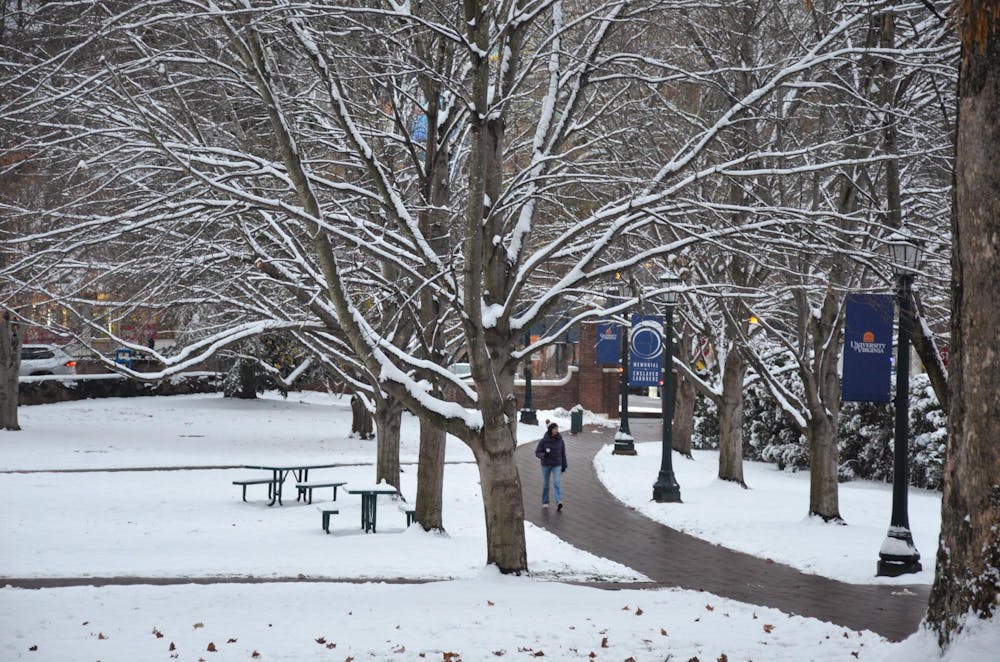
January Term courses, the majority of which occur on Grounds or online, will begin Friday and end Jan. 10. Across the eight days, students are able to earn three course credits by studying a wide-range of subjects, with this year’s offerings spanning from public speaking to Slavic literature. Some J-Term abroad courses are also currently underway, taking place across the world including in India, Argentina and Australia.
Students interested in taking a J-Term class had the opportunity to enroll in no more than one course when J-Term enrollment opened the week of Nov. 10. Students meet for five and a half hours each day — on Grounds or online — for eight days, Friday through Saturday. Due to the short timeframe in which students receive three credits, some courses are reduced versions of a semester-long course, while other courses are unique to the J-Term, and are not offered during the semester.
Four schools within the University are offering courses this J-Term — the College of Arts and Sciences, the Frank Batten School of Leadership and Public Policy, the School of Data Science and the School of Engineering and Applied Science. The courses range from the 1130 to 4830 level.
Assoc. Engineering and Society Prof. Benjamin Laugelli is teaching an in-person J-Term course centered around the LEGO company — STS 2500, “The LEGO Course: Engineering and Design Values.” He said students spend the morning in a seminar-style discussion, and after a lunch break, spend the rest of the day working with physical and digital LEGO bricks to make their own models.
Laugelli noted the benefits of J-Term class sizes, which are typically smaller than during the semester. He said enrollment for his class normally ranges from 15 to 20 students, with a cap at 50.
“Class sizes in January Term are typically smaller, so it’s a nice, intimate experience,” Laugelli said. “Students can get more individual attention and have the opportunity to build a stronger relationship with a fewer number of their peers in the class and with the instructor.”
Another course offered in-person, ENGL 1910, “Public Speaking,” strives to develop student skills in speech delivery. According to English Lecturer Meg Gardiner, the course has been taught during nearly every J-Term since 2006, with the exception of the two most recent J-Terms.
Since J-Term students are in class for several hours per day, some professors incorporate interactive activities to maintain high engagement and interest levels throughout the day. Gardiner said she strives to do so in her public speaking course.
“We start every class with physical warm-ups. We do vocal warm-ups, stretches, breathing exercises … then everyday the student[s] will give an impromptu speech,” Gardiner said. “Students bond really quickly in the course … We become like a little community.”
Other courses embrace the long hours of J-Term courses with unique assignments and field trips that may not occur when the class is taught during the semester. One example of this strategy is used in SLAV 2360, “Dracula,” taught by Assoc. Slavic Languages and Literature Prof. Stanley Stepanic, who started teaching the course in 2007. Stepanic said that he is able to differentiate his J-Term course from the semester-long version of the course due to a smaller enrollment size, which he said has ranged from 30 to 100 students over the years he has taught the J-Term.
“[During the] J-Term, what I do differently is try to do things that students in [the] regular semester can’t experience,” Stepanic said. “We’ve taken field trips to [the] local comic bookstore … I usually have guest speakers come in. I’ve had some directors of films and some other people talk about different things.”
According to Stepanic, the “Dracula” semester-long course analyzes the evolution of vampires throughout Slavic culture and history, and the course concludes with a final exam. He said he is able to teach more through the J-Term version of the course due to the guest speakers and long hours of the class. Additionally, rather than having a final exam, the J-Term course culminates with a three-hour vampire live-action role-playing game, in which students act as vampires. He said this impacts students because vampires are a symbol of the human race, and through the course and role-playing game, students are able to learn about anthropology, disease and literature.
Following the same schedule as on-Grounds J-Term courses, online courses give students the option to complete a three-credit course from home. One of the online courses offered this J-Term is AAS 2224 “Black Femininities and Masculinities in the U.S. Media,” a seminar exploring the concept of “Blackness” in America and where it converges with ideologies about gender.
The learning experiences that come with J-Term courses do not only occur on Grounds or online — this year, the University is offering 20 J-Term courses abroad that allow students to learn in places such as Dubai, Australia and Argentina. In these programs, students take one three-credit course just as they would online or on Grounds. A few J-Term abroad courses began Dec. 26, and the rest are set to begin this week. All J-Term abroad programs will conclude Jan. 10.
Fourth-year College student Ava Kowalski is taking a “Threshold of European Art and Culture” class in Prague. Taught by Eric Ramírez-Weaver, Associate Art History Professor and Director of Undergraduate Programs in Art History, the students will be arriving in Prague prior to New Year’s Eve to begin their course.
“I’ve always kind of had my eye on [J-Term abroad], because I’ve always considered [studying] abroad, but I chose not to pursue a full semester,” Kowalski said. “Also, the credits are a huge help, because we’re getting three credits in such a short amount of time.”
During her time in Prague, Kowalski said she will be spending time visiting the city’s historical sites as well as learning more about the Czech language at local schools.
Another course taking place abroad, “U.Va. in India: Commerce, Creativity and Culture,” is being taught by Assoc. Commerce Prof. Chiraag Mittal. Mittal said the course is built around industry tours and cultural visits to places like Bangalore, known as the Silicon Valley of India, the Taj Mahal and trips around the city to investigate how traditional markets operate.
“I really designed the course to have a balance between innovation and tradition,” Mittal said. “We’re going to study how the old India is still alive and well, while having this really high tech presence.”
In addition to partaking in immersive cultural experiences abroad and obtaining academic credit through the University, some students are taking advantage of the J-Term to obtain short-term, paid work experience. Second-year College student Spoorthi Nadkarni said she will be participating in an online externship she applied to through Handshake with a global nonprofit organization, The Nature Conservancy. The Conservancy has a stated mission to protect endangered parks and indigenous lands in developing countries, and externships grant the opportunity for students to gain short-term exposure to a given career field.
Though Nadkarni is not receiving academic credit for her externship, her program at the Conservancy is hosted through the University’s Environmental Institute’s environmental externship program. According to the website, this program grants students a job-shadowing opportunity to expose students to career options.
According to Nadkarni, the externship involves looking over bills and legislation and helping the nonprofit with fundraising efforts. Nadkarni’s externship begins Sunday and concludes when J-Term ends, Jan. 10.
“It’s not only a chance to get real world experience and also a nice gig over the J-Term … but I’ve always wanted to look at conservation through the global scale, as somebody in environmental science,” Nadkarni said.
Tuition for the various J-Term programs depends on student residence and whether they are undergraduate or graduate students, with some financial aid options available.
This year, the J-Term tuition per credit for undergraduate in-state and out-of-state students participating in on-Grounds or online courses was $484 and $1,787, respectively. All courses taught are three credits, making the total for undergraduate in-state and out-of-state students $1,452 and $5,361, respectively.
In-state and out-of-state graduate students are charged $551 and $1,117, respectively, per credit for J-Term courses. For a traditional three-credit course, the total cost is $1,653 for in-state students and $3,351 for out-of-state students.
For University J-Term abroad programs, the tuition still varies between in-state and out-of-state students, but there is a much smaller discrepancy. Out-of-state J-Term abroad tuition is, on average, approximately $300 to $500 more than in-state tuition. The majority of the abroad programs range in cost from $3,000 to $6,000, but that only includes tuition, fees and housing, not meals or airfare.
J-Term courses will conclude Jan. 10, just in time for University courses for the Spring 2026 semester to begin Jan. 12.
Melody Yuan is a staff writer on the news desk. She is a second-year College student studying economics and statistics from Richmond.
Read More

Students, professors weigh in on the importance of letter grades
By Ruby Budetti | 13 hours agoWhen thinking about letter grades for themselves, many University students and faculty said they prefer letter grading throughout all four years of college.
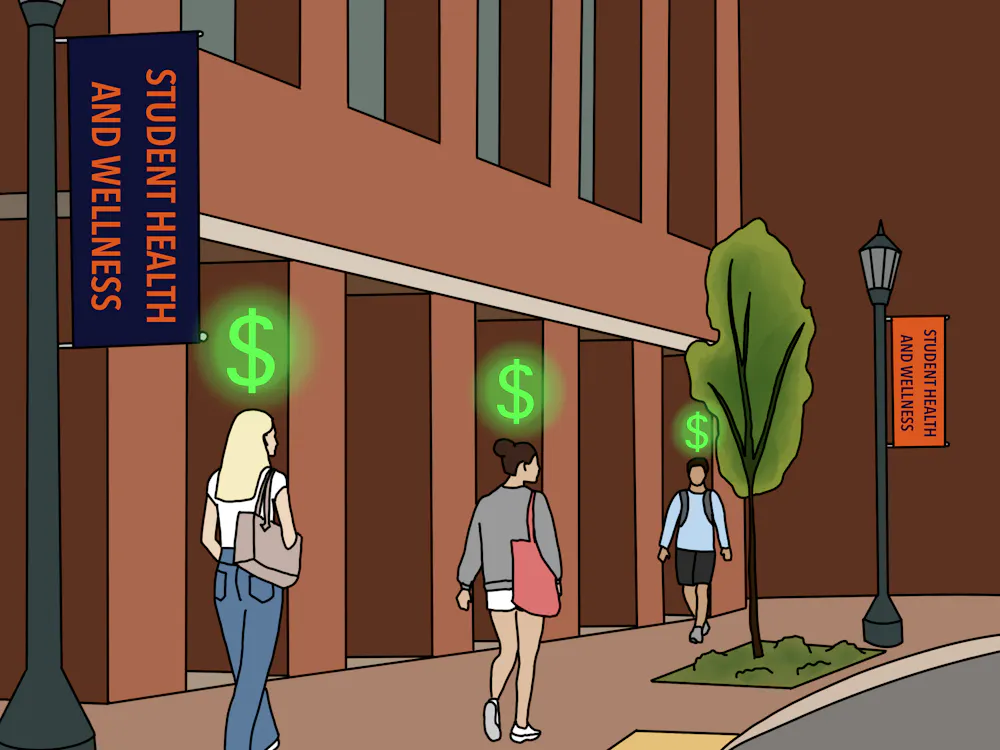
What services does the Student Health Fee provide for students?
By Melody Yuan | 13 hours agoThe University Board of Visitors approved tuition and fees for the 2026-27 academic year in April, and the Student Health fee rose from $1,147 to $1,184 per student.

The ‘AI and Future of Work’ Series — How the University is preparing students for what is next
By Lidia Zur Muhlen | 15 hours agoIn a recent Gallup Inc poll, 79 percent of Americans believe that artificial intelligence will reduce the number of jobs over the next 10 years.