
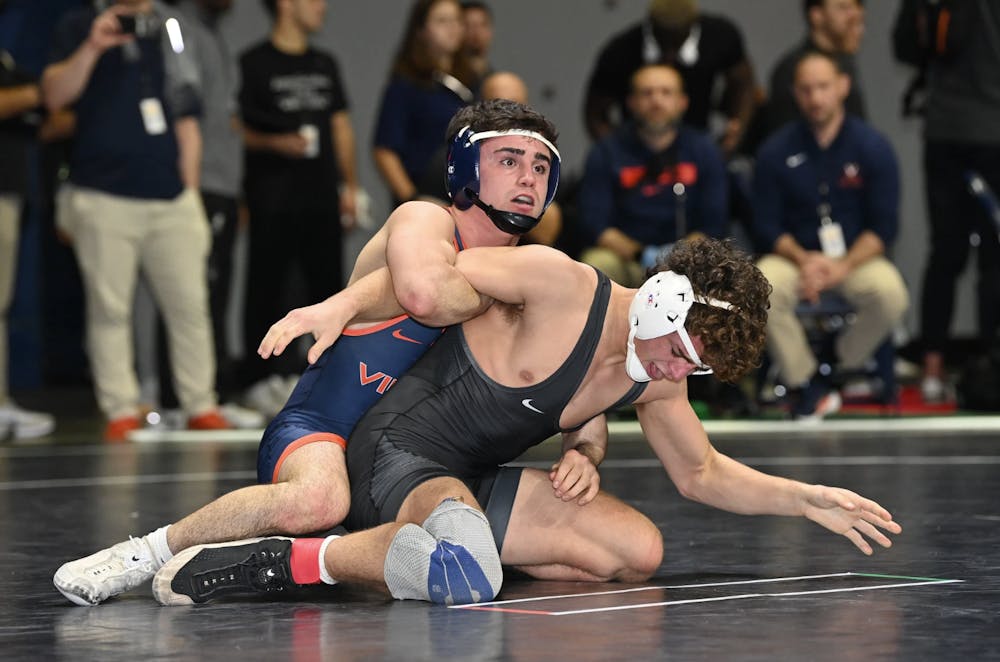
The bus, its tires worn thin from nonstop hours of motion. The bus, previously basking in the natural rays of sunshine, now catches fleeting glances of moonlight, dimmed by drifting clouds in the sky. The bus, crammed with a mass of bodies at full capacity, slows and groans to a halt at John Paul Jones Arena. And from it lumbers the Virginia wrestling team.
A 41–0 shutout over Bloomsburg should constitute celebration, but it is 1 a.m. and the Cavaliers have logged over 18 hours on the road. A full night of sleep sounds nice — and it would be — but they are back at it again the very next day at 8:30 a.m.. Coach Steve Garland is already back in his office, planning for their next dual as they embark on yet another laborious drive outside their home state.
This is not an abnormal weekend for the squad — if anything, it has become the norm, as they have done this for 12 straight matches.
Virginia, now 8-4 overall and 0-1 in the ACC, has faced more consecutive road matches than any other winter sports team, a grueling reality caused by the Memorial Gymnasium renovations. The challenge was known before the season began, and Garland addressed it with cautious optimism in an interview with The Cavalier Daily following the team’s first intrasquad match of the year.
“It’s going to suck, like, no question about it,” Garland said. “But if they get through that, God willing, they’re going to be pretty battle-tested by the time January comes.”
Indeed, battle-tested they are — Virginia has constantly endured challenges throughout the first half of the season. A standout stretch came at the Bucknell Quad meet, where the majority of their time was not spent on the mat, but on the road. Four matches in two days is an exhausting stretch — to make matters worse, illness became a factor along the way, impacting the final results. Garland expanded on this after the fact.
“If we didn’t have to forfeit at 125 because one of our guys got sick, that’s one of the casualties being on the road like that … he got some sort of virus while we were there and was puking in the locker room right before weigh-in,” Garland said. “If he wrestled, it’s probably a nine-point swing — and we lost by eight.”
Even amid the struggles and unpredictability, the Cavaliers pushed through, navigating injuries, fatigue and the challenges of travel while maintaining cohesion as a team. They continued to do some of their best wrestling despite the circumstances.
“I would say that one of our better matches of the year was Penn, if not the best we wrestled collectively,” Garland said.
But at the tail end of the first half of the season, the byproducts of such intense scheduling surfaced again at the Southern Scuffle Jan. 3.
The competition began on a sluggish note. None of the four Cavaliers who advanced to the quarterfinals secured a win and seven wrestlers fell into the consolation bracket in the opening round of the tournament.
“I gotta believe that some of the rough results we saw was the accumulation of week after week after week after week after week,” Garland said. “That first couple rounds was rough as we’ve looked the entire season, I have to think that there was, at least in part… some sort of effect of the constant grind we’ve had to do all season.”
If constant travel were not taxing enough, proper rest is even harder to come by in the culture of wrestling. Athletes must always hit weight, meaning a full day off is rarely an option. The strain of being perpetually on the road, coupled with the precise curation of rare off days, makes the toll of 12 consecutive away matches that much heavier.
“So if you give them a full off day, then they may hurt their weight cut for that weekend,” Garland said.
But with the intensity and battle scars comes understanding and determination. Garland expects a Virginia team shaped by hardship, one that has learned how to compete through fatigue, adapt to adversity and remain composed in hostile environments. The constant travel, narrow losses and physical toll have forged a group that is more seasoned than its record alone might suggest.
“What I’m hopefully anticipating is that the second half of the year is going to feel pretty easy,” Garland said. “Especially during the stretch where we have Stanford, Chapel Hill and Virginia Tech at home.”
For the first time all season, the Cavaliers will be able to slow down. Instead of hotel beds, they can sleep in their own homes. Instead of hours on the road, their opponents will travel to them. And instead of wrestling before a sea of away fans, Virginia will finally hear a home crowd behind them.
Virginia’s first home match, against the University of North Carolina at Chapel Hill, comes Friday, followed by Stanford the next weekend and Virginia Tech Feb. 6.
Those matches will not only be held in Charlottesville, but they will also be ACC duals, carrying heightened importance for the Cavaliers’ record as the season enters a decisive stretch and the playoff push begins.
Read More

Late drama denies Virginia men’s soccer’s ferocious comeback against Wake Forest
By Mofeoluwa Akande | 8 hours agoAll four of Virginia’s losses have been the result of 80th minute or later breakthroughs by their opponents.

Country roads lead to Charlotte blues as Mountaineers reclaim long dormant rivalry
By Joe Schwiesow | 10 hours agoThe Queen City claims another Virginia football victim, as the Cavaliers fail to overome a powerful West Virginia offense in a 38-27 loss.

Taking stock as Virginia men’s soccer finally leaves Charlottesville
By Michael Liebermann , Mofeoluwa Akande and Noah Cinel | YesterdayAfter a lengthy homestand to kick off the season, Virginia men's soccer finds itself in a shaky position with a 3-3-1 record. Three writers assess where the team is now and what is of note in the future.


