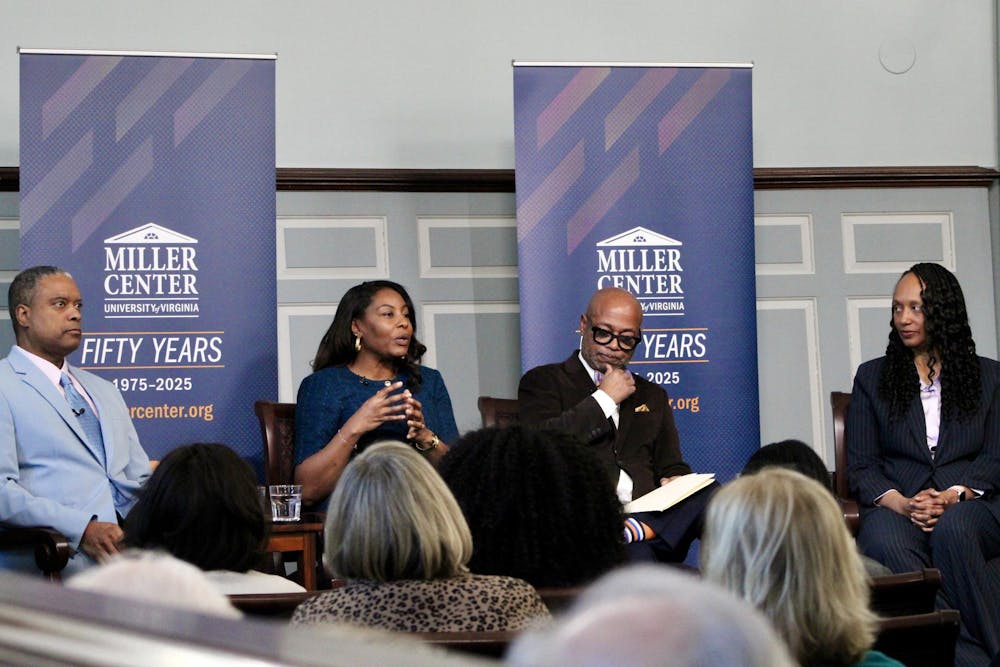
A Miller Center panel hosted Wednesday titled “Education: The view from Martin Luther King's 'mountaintop'” discussed the current state of education and Martin Luther King Jr.’s lasting impact on K-12 and higher education. The three participating panelists also considered the role of politics in education and attitudes towards diversity, equity and inclusion initiatives in education and the workforce.
The panel, moderated by Miller Center Senior Fellow Gerard Robinson, was hosted as part of the University’s 2026 Martin Luther King Celebration following Martin Luther King Jr. Day Monday. Education Prof. Derrick Alridge, Law Prof. Kimberly Jenkins Robinson and Emily Dickens, chief administrative officer for HR firm SHRM — an HR firm which works on improving workplaces and empowering workers — spoke on how educational institutions can continue King’s focus on economic mobility and equal opportunity.
Alridge — who founded and directs a “Teachers in the Movement” project at the University through which he and his students have conducted more than 500 interviews with national civil rights-era teachers to understand how they worked as activists at the time — spoke about how he aims to advance King’s concept of a “beloved community” in higher education. With this community, King imagined a society where regardless of differences, all people could live together peacefully, Alridge said.
“Dr. King said [the beloved community] … was going to happen by the work of foot soldiers, such as … community workers and teachers,” Alridge said. “So I see the work that I'm doing here at U.Va. with the Teachers in the Movement project … as contributing to this larger global vision of the role that teachers can play in bringing about the beloved community.”
Jenkins Robinson, founder and director at the Education Rights Institute at the School of Law, also emphasized King’s focus on education as a necessity for democracy. She noted that while King advocated for desegregation of schools, he also called for school resources to be distributed equally and for all students to have access to high quality education. The ERI issues reports on opportunity gaps for students across geographic locations, race and socioeconomic status, and Jenkins Robinson said that this year the institute will begin partnering with school districts to help them close these gaps by advocating for policy change and securing funding.
“King very much understood the importance of education for preparing engaged civic participants. He tied education to democracy,” Jenkins Robinson said. “There is no democracy without educated individuals to hold officials accountable, to understand the issues that they're voting on, to participate in … elections at all levels, to be engaged with officials about what needs to happen.”
Dickens added that both K-12 schools and universities should, in her view, be attuned to local economies and industries so that those institutions can shape curriculum and degrees around the needs of their communities. Doing so, Dickens said, would help encourage students of state-funded institutions to stay in those communities after graduation and contribute to their economies.
In response to an audience question about the state of DEI in education and the workforce, Dickens said that SHRM has refocused on diversity and inclusion. Although she said that equity is still important, she said she feels that the term has become misunderstood in a way which prevents different groups from finding common ground.
“Diversity is the metric, right? That's what's in the chart. We were saying, I got to check these boxes,” Dickens said. “Inclusion is the goal of making the workplace someplace where everyone feels included and their [point of view] is included.”
Jenkins Robinson focused on equal opportunity in her response to the same question, noting that some groups of students still receive inferior education and opportunities. She said that despite debates over the role of DEI in education, there are opportunities for emphasizing common interests in education rather than divides.
“[DEI] is not about benefiting one group over the other, it is not a zero sum game,” Jenkins Robinson said. “K-12 education, and I would say higher education also, is not a zero sum game. And so I think that's part of what we have to understand about these. The need for reform today is that we have to address these systemic inequalities to move us toward the democracy and economy and society that we all need.”
On supporting teachers currently in the workforce, Alridge said that training programs and universities could provide better education on how to best serve students from diverse backgrounds. He emphasized the need for teachers to connect with their students’ parents, history and culture.
Jenkins Robinson echoed that in the future, providing teachers with an education in “cultural competency” would provide educators with the ability to engage and support a wide range of students.
Graduate Education student Taylor Whirley said she attended the event because she was interested in the intersection of King’s legacy and education, and how that has impacted the current legal and policy landscapes.
“I enjoyed … the different perspectives coming from three different experiences as it relates to education,” Whirley said. “... Hearing [from] somebody in the legal field, hearing from somebody in HR and an educator themselves, it's all very interesting to hear those perspectives.”
The Miller Center will host its next event Jan. 29, with a focus on President Trump’s past year in office.
Read More

10 years since Trump’s first election, professors reflect on a decade that reshaped U.Va.
By Komal Reddymachu | 22 hours agoSince President Donald Trump’s first election in 2016, Charlottesville has seen a white supremacist rally, the removal of its Confederate statues and federal pressure influence the University’s governing body.

Student Technology Council aims to represent students on technological issues
By Solomon Ross-Milligan | YesterdaySTC is currently a 20-member council and includes students from across schools and organizations within the University.

Woodruff and Bouie discuss freedom of the press, emphasize need for nonpartisan news
By Robert Head | YesterdayAfter an introduction by Jane Kamensky, president and chief executive officer of Monticello, Woodruff answered Bouie’s prompts on topics such as modern threats to the press, the objectivity of the press and Americans’ declining trust in news outlets.