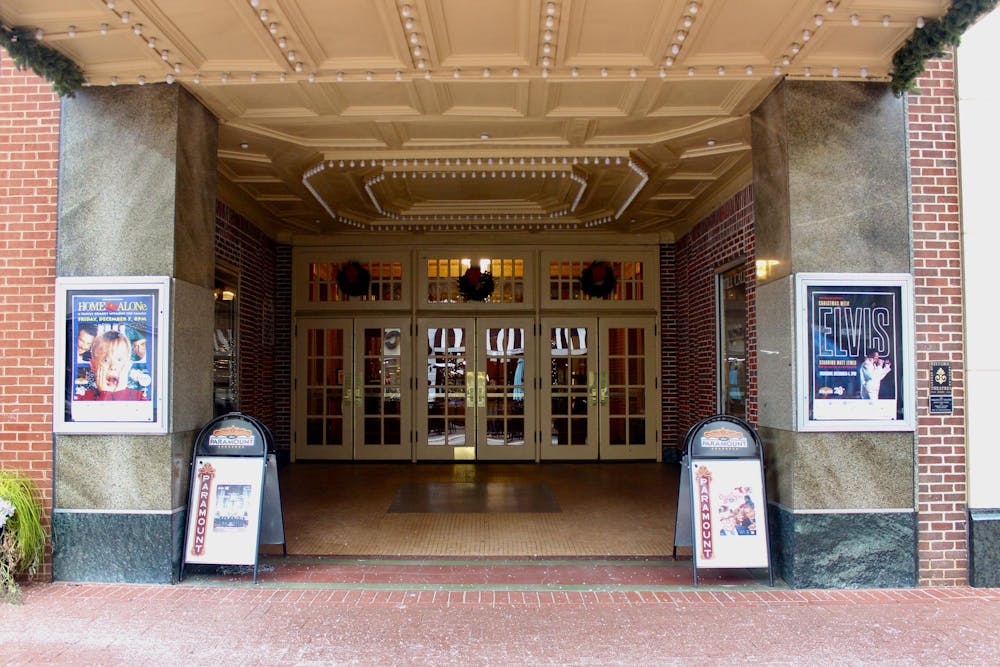
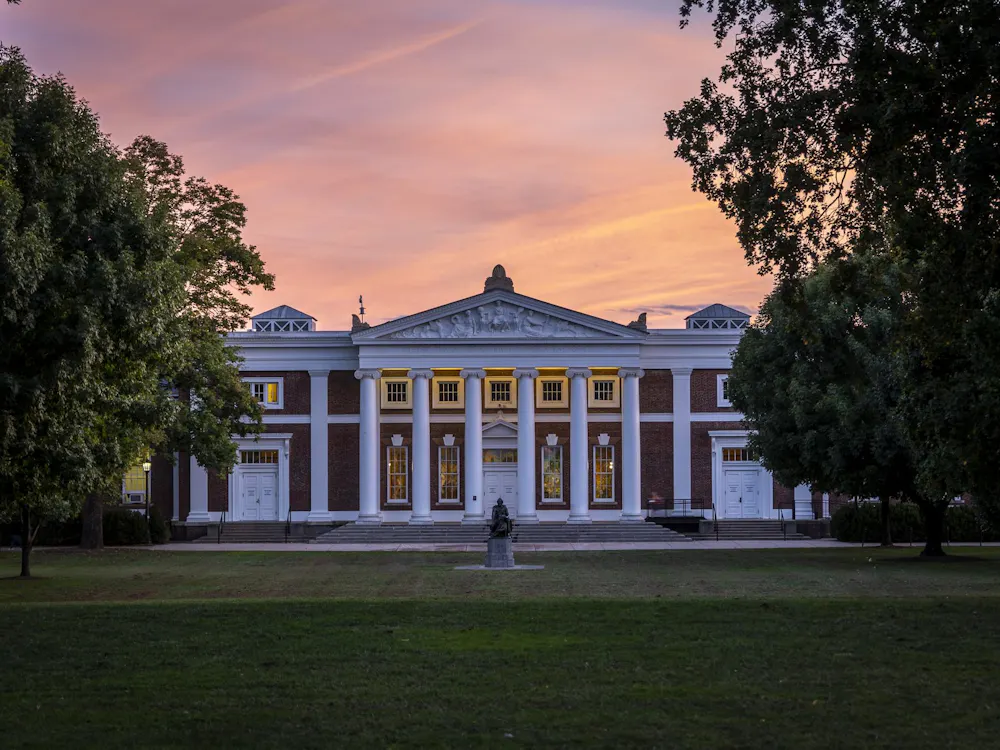
Love took center stage last weekend as the Charlottesville Symphony Orchestra commemorated Valentine’s Day with their program titled “Romance.” The concerts took audiences on a journey through what the Symphony describes as “some of the most romantic music ever written.” Performances took place Saturday at 7:30 p.m. in Old Cabell Hall and Sunday at 3:30 p.m. at The Paramount Theater.
The Charlottesville Symphony is deeply intertwined with the University’s music department, combining the talents of professional musicians, University students and community members to perform masterworks and holiday concerts. Assoc. Music Prof. Benjamin Rous is the orchestra’s music director, a role he has held since 2017. His dynamic conducting style delightfully matched the passion of the music, immersing the audience in the emotions of the concert.
Whether concertgoers were celebrating romantic love or appreciating love in its other forms, the performances had something everyone could enjoy. Rous provided his musings on love and the music as he introduced each song, both entertaining the audience and educating listeners on the context of each piece’s creation.
“This program is a love letter to our community on this Valentine’s weekend,” Rous said. “To folks celebrating love and the folks celebrating not having the downsides of being in a couple, we dedicate this to you.”
The orchestra’s selections included songs that captured the essence of love and romance, spanning intimate expressions of devotion to an overture inspired by Shakespeare’s “Romeo and Juliet.” From gentle, lyrical melodies to sweeping, dramatic passages, the program offered a rich emotional journey. Together, these works explored love in its many forms and highlighted how composers across time have used music to embody the universal language of love.
Opening the concert was “Salut d’Amour,” or “Love’s Greeting,” a heartfelt work composed in 1888 by Edward Elgar that set the emotional tone for the rest of the performance. Written as an engagement gift for his wife, the piece’s bright refrain captures his affection and passion. Its elegance and simplicity immersed the audience in an atmosphere of tenderness and sincerity.
“Adagio, Symphony No. 2” by Sergei Rachmaninoff was performed next, featuring two dominant motifs — a long, meandering melody and a repeated hook. Senior Clarinet Lecturer Jiyeon Choi played the clarinet solo that floated gracefully above the orchestra, serving as the movement’s emotional centerpiece. This song, started in 1906, introduced the audience to the brass and percussion sections of the orchestra, enveloping listeners in the full range of sounds offered by the ensemble. Its sweeping phrases and rich textures embodied the yearning often associated with romantic love.
The symphony then played Camille Saint-Saëns’ 1863 composition “Introduction and Rondo Capriccioso” with a violin solo by Claire Youn, winner of the 2025-2026 Charlottesville Symphony Concerto Competition and second-year College student. This work has two sections, beginning with the slower, more dramatic introduction that leads into an upbeat theme. Youn’s explosive performance demonstrated her technical skills, adding to the richness of the orchestra’s sound. She ended the piece with a flourish, inviting thunderous applause and a standing ovation from the audience.
After a brief intermission, the orchestra returned with “Intermezzo” from “Cavalleria rusticana” by Pietro Mascagni. The primary refrain is inspired by “Regina coeli,” a Catholic hymn, evoking feelings of peace that blend with dramatic melodies to convey the intensity of desire. Despite being a short work, it unfolded with a quiet reverence as the orchestra shaped the swelling crescendos and built profound emotional depth.
“Marion’s Theme” from the film “Raiders of the Lost Ark” provided a more well-known, yet thematically suited addition to the program. Composed by John Williams, its bright woodwinds and soft melody expresses the highs and lows felt in romance. The arrangement’s dynamics and phrasing highlighted the sense of longing that accompanies rekindled love.
Following “Marion’s Theme,” the orchestra performed “Liebestod” from “Tristan and Isolde” by Richard Wagner. Translating to “love death,” the piece tells the story of lovers who are separated and will only be reunited in death. The music unfolds in long, surging phrases that gradually build in intensity and create a sense of transcendence. As the melody rises and resolves, the orchestra conveyed both the sorrow and the overwhelming devotion at the heart of the story.
Capping off the concerts was a performance of Pyotr Ilyich Tchaikovsky’s “Romeo and Juliet.” The overture, which is almost 20 minutes long, is a conceptual interpretation of Shakespeare’s play, encapsulating its themes of love, destiny and violent passion. Opening with a solemn chorale, the music shifts into turbulent sections that represent the tensions of the narrative. The violins introduced the melody, and the rest of the orchestra echoed before it reached the climax that eventually gave way to dramatic intensity. The overture captured the arc of Shakespeare’s tragedy, bringing the program to a powerful and resonant close.
Justin Smith, trombone player for the Charlottesville Symphony Orchestra and third-year Commerce student, reflected on his experience performing in this program.
“As a kid, I heard many of these love themes everywhere on TV, so getting to perform them myself felt surreal,” Smith said. “Each piece is incredibly beautiful, and being able to bring that music to life was really a special experience.”
From tender love letters to sweeping tragedies, the Charlottesville Symphony Orchestra’s “Romance” celebrated the many dimensions of love through music. In honoring Valentine’s Day with works that spanned centuries and styles, the orchestra delivered a performance that resonated with both the heart and the community.
Read More

Sasha Fishman’s ‘Lemniscata’ puts water in motion at Ruffin Gallery
By Preet Manukonda | 6 hours agoThe fountain-like installation and accompanying pieces explore the circulation of water through both human-made and natural environments.
Michael Longfellow and Isabella Fazio close out Wahoo Welcome with a hilarious night
By Carter Horner | YesterdayThe show brought together the best of the local University comedy scene with national talent, creating a unique experience for the arts at the University.

beabadoobee shines on her electrifying album ‘Pylon’
By Kelsey McIntyre | 2 days agoEven though beabadoobee began writing rock music as a teenager, this is certainly her most adventurous project in terms of genre.