
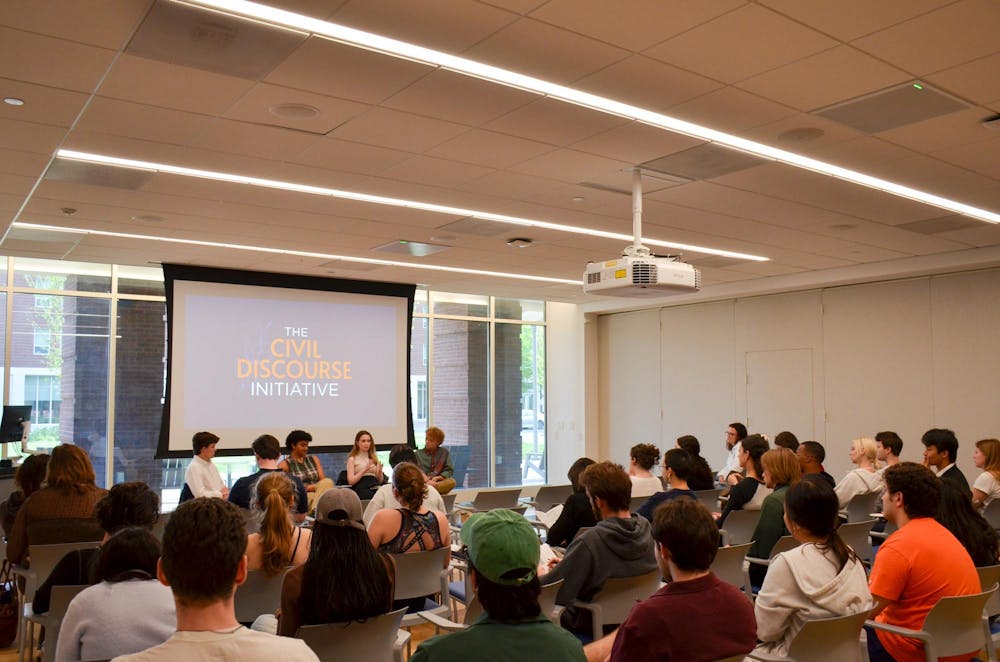
Three student panelists gathered Wednesday to discuss Immigration and Customs Enforcement and the issue of immigration under the Trump administration at an event hosted by the Civil Discourse Initiative — a student Contracted Independent Organization focused on engaging students with a variety of political views.
Moderated by Xavier Days, director of operations for CDI and second-year College student, the panel included fourth-year College student Christoph Schoer, third-year College student Beckett Smith and first-year College student Nafeesa Naz.
Throughout the discussion, panelists focused on the economic impacts of immigration. Schoer said in an opening statement that he believes immigration has a net positive impact on the United States. He cited research from the Wharton School of Business at the University of Pennsylvania and the National Bureau of Economic Research, which found a small but positive effect on wages as a result of immigration.
Smith, self-described as “fiercely anti-immigration,” said that he believes immigrants take domestic workers’ jobs at lower wages, and, therefore, drive down wages for the labor force.
“I see it as an exploitative sort of capitalist regime to import cheap labor at the expense of domestic workers,” Smith said. “People coming from these third world countries, they don't expect a wage if they have no legal status. There's no way to ensure that they're being paid at the minimum wage. And I think overall, it brings wages down.”
Although there is some debate among economists about the impact of immigration on wages, studies generally find that immigrants do not cause a sizable impact on wages or employment of U.S.-born workers.
Schoer disagreed with Smith, arguing that simple economic theory which demonstrates that a larger labor supply drives wages down does not necessarily apply, because immigrant workers typically work in jobs that are complementary to domestic workers rather than taking jobs directly from U.S.-born citizens.
“Oftentimes immigrants come here and they satisfy jobs that complement the labor of native-born Americans,” Schoer said. “What this means is that the productivity of each American worker increases because of immigration … It seems to me, just empirically, factually, that immigration is good for our economy.”
In response to a question from Days regarding ICE’s current functions, Naz argued that the organization should work to mitigate violent crime but undergo significant changes to its practices.
“ICE has gone way too far in their handling of [concerns about violent crime]. I think we can find common ground, [in that] maybe we shouldn’t have criminals coming into the country like that,” Naz said. “But … I think we can agree that ICE has really pushed the limits, and ICE has become deeply inhumane.”
Schoer also called conditions in ICE detention centers “inhumane” and “unethical,” citing the agency’s treatment of pregnant women, extended detentions of children and deaths of detainees while in ICE custody.
Panelists also spoke on recent state actions — Gov. Abigail Spanberger (D) signed an executive directive Feb. 4 which ended all existing partnerships between local officials and ICE agents. Smith argued that cooperation between local law enforcement and ICE agents makes operations safer, claiming that if police in Minneapolis, Minn. had worked with ICE, there would have been fewer clashes between agents and protesters.
Two U.S. citizens were shot by ICE agents during Operation Metro Surge in Minneapolis, which local police did not participate in or assist with. Minneapolis has a separation ordinance barring police from participating in law enforcement action aimed at enforcing federal immigration laws, even if officers had wished to cooperate.
In discussing Spanberger’s decision to end these partnerships, Schoer also noted that a small number of ICE detainees have criminal records. He argued that an increased presence of ICE agents would not have a positive impact on the state.
“The question is, to start with, when ICE comes into our state, does that make people more or less safe? I think the answer is less. A common argument to put forward is that they're taking criminals. 74.2 percent of people detained by ICE have no criminal record, and only 5 percent are convicted of a violent crime,” Schoer said. “They say they're taking murderers and rapists. Evidently, this is not the case. They're just taking people right? This doesn't make us safer.”
CBS News reported Feb. 9 that fewer than 14 percent of immigrants arrested by ICE in 2025 had violent criminal records.
Panelists also had the opportunity to share their view on an ideal U.S. immigration system — Schoer and Naz said that the country should take as many immigrants as possible, while Smith said that he believes there should be no immigration.
Fourth-year College student Joanne Lee said she attended the event to hear the panelists’ views despite feeling that the topic could become uncomfortable.
“Honestly, I felt … pretty uncomfortable while I was here, with some of the things that were said,” Lee said. “But I couldn't get myself to leave either, because I was very interested in what everyone had to say and what the next question was going to be.”
Correction: A previous version of this article stated that Schoer cited research from the Wharton School of Business in Japan. Schoer was citing research from the Wharton School of Business at the University of Pennsylvania. The article has been updated to reflect this change.
Read More

U.Va. and United Way of Greater Charlottesville launch ‘Give Where You Live’ donation partnership
By Vrinda Vashisht | 18 hours agoThe program is set to run through Dec. 18, and its start date coincided with United Way’s 35th annual Laurence E. Richardson Day of Caring.

Student Council passes bill to create ad hoc committee to review UBE proceedings
By Edward Christopher and Anna Ivanov | 18 hours agoThe Commission will craft a report on the University Board of Elections’ current structure and governance practices, putting forth proposals for corrective action based on its findings.
Board of Visitors discusses the implementation of AI in research and academics
By Jaylynn Perez | YesterdayThe Board also received an orientation on changes to NCAA athletics, completed its annual Atlantic Coast Conference certification, heard a report from Aaron Bloomfield, Faculty Senate chair and engineering professor, and discussed the University’s ongoing searches for a provost and several deans.


