
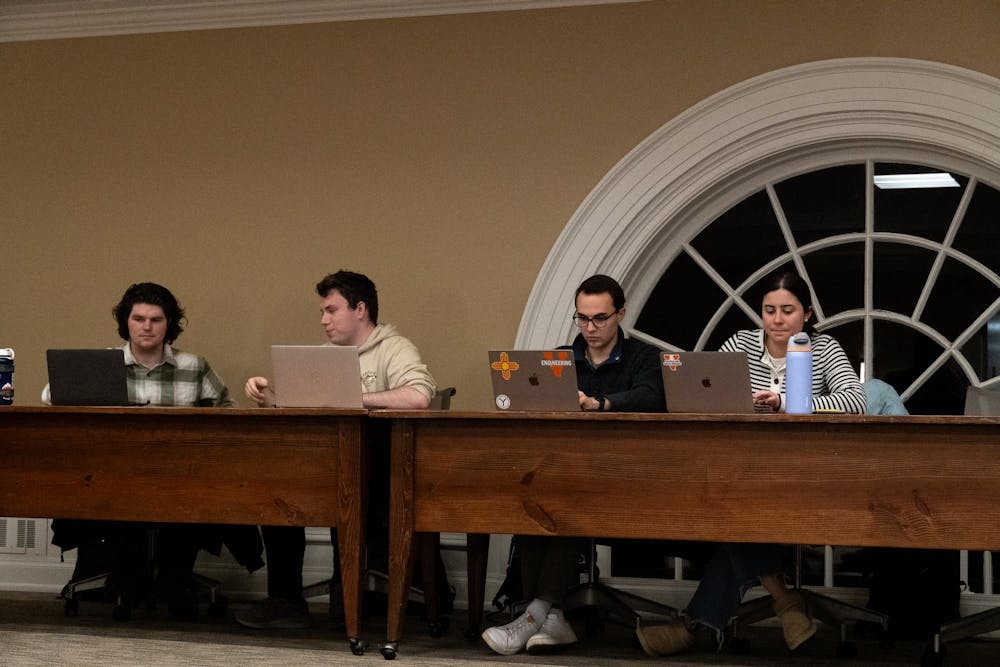
During Sunday evening’s Honor Committee meeting, the Committee discussed amending the honor bylaws to redistribute the Vice Chair for Investigations’ workload during the initial sanctioning procedures to other positions. This would help alleviate the uneven distribution of duties in the Informed Retraction process. The Committee also discussed plans for handling case processing during the summer.
Over the past couple of weeks, the Committee has been exploring strategies to alleviate the workload put on the Vice Chair for Investigations — a position currently held by third-year College student Cody Scarce.
The bylaw proposal presented by Seamus Oliver, chair of the Policies and Procedures Subcommittee and fourth-year College representative, has two primary components. First, it allows the Vice Chair for Investigations to assign honor investigators prior to a student’s IR decision. It also moves many of the IR intake procedures from the responsibility of the Vice Chair for Investigations to the Vice Chair for Sanctions.
Under the current bylaws, last updated Jan. 20, the Vice Chair for Investigations can appoint honor investigators after a student’s IR decision. The proposal would allow the Vice Chair for Investigations to delegate investigators to gather additional information from the reporter or more witnesses prior to the students' IR waiver decision if it would benefit the case. This change would shift the fact-gathering responsibilities to the investigators earlier in the process.
“If a report is more on the sparser side, [we could] assign preliminary investigators to follow up with the reporter and ask some of those important follow-up questions … to have a better understanding of events if the student chooses to [utilize] an IR,” Oliver said.
Additionally, the Vice Chair for Investigations currently provides students with an IR letter and an IR intent form. The IR letter outlines alleged offenses, the general sanctioning procedures, and a student's eligibility to complete an IR. Students must submit the IR intent form and then the completed IR form to the Vice Chair for Investigations. The Vice Chair for Investigations reviews the IR form and requests additional edits if it does not meet specific requirements.
The proposed bylaw change would maintain the Vice Chair for Investigations’ role of issuing IR forms to accused students but would transfer all intake responsibilities — including receiving intent forms and reviewing IR submissions — to the Vice Chair for Sanctions, a position currently held by third-year College student Genny Freed.
The proposal also includes the elimination of the admission meeting, which is a current policy where students and reporters are encouraged to meet during the IR period. The student is expected to admit guilt, take accountability for their actions and discuss potential amends with the reporter to restore the community of trust. Instead of an admission meeting, students will submit a written admission to the reporter through email.
“This change would be just a requirement that the student admit in writing to commission of the events, which would be done to the reporter over email, with the [Vice Chair of Sanctions] bcc’d in advance of the acceptance of the IR form,” Oliver said.
Oliver said that the removal of the admission meeting would significantly streamline the IR period, as this meeting frequently has caused extensive delays.
“By eliminating the need for that synchronous meeting altogether, you can shrink the number of necessary tasks for the IR period and be sure that we're getting through the IR period more efficiently … so we can get cases both off the [Vice Chair for Investigation’s] plate and the [Vice Chair for Sanctions’] plate,” Oliver said.
The Committee and the Policies and Procedures Subcommittee had mixed opinions on the proposal. One concern that was raised by the subcommittee was varying degrees of quality in case investigations based on which cases get preliminary investigations with investigators selected by the Vice Chair for Investigations. Alexander Church, fourth-year Engineering representative, shared his thoughts on how the benefits of the admissions meeting might outweigh the drawbacks.
“I think there is benefit to a face-to-face meeting. One … question that I [have] … is, how do we weigh that benefit of the in-person meeting versus the drawbacks of the logistics of the scheduling,” Church said.
Another primary topic of discussion was how cases should be processed over the summer. Church mentioned that one barrier to case processing is that investigators and advisors are prevented from working cases during the summer due to prior commitments, such as working a job or studying abroad. He shared that he has advocated for summer case processing in the past but understands that it comes with both positives and negatives.
“The reason that I advocated for doing [summer case processing] before … is [because] the alternative to that is you call the student, you inform them they've been reported, and you say there's nothing you can do about it for three months, which is awful,” Church said. “[However] I do believe that it's better to admit it than try to make things happen and stretch [case processing] out over a few months.”
Penelope Molitz, vice chair for the undergraduate community and fourth-year Education student, shared one possible solution to addressing staffing shortages and maintaining case processing during the summer — to teach a cohort of advisors during the spring under the notion that they will work on cases during the summer.
The Committee shared that although they will not be the ones who will be responsible for summer case processing following the conclusion of this Committee's term April 6, they are responsible for the resources the next Committee will have over the summer.
The Committee is planning to continue the conversation on summer case processing in subsequent meetings.
The Committee will meet next on Feb. 15 at 7:00 p.m. in Newcomb Hall 480. Students can attend in person or over Zoom. Zoom links can be found on their website. Students can ask questions or provide comments to the Committee during the public comment section at the beginning and end of each meeting.
Michael Racz is a staff writer on the news desk. He is a second-year student in the College majoring in Biology with plans to go to Medical School. Outside of The Cavalier Daily, Michael is a member of the Emergency Medicine Scribe Program and the Alpha Epsilon Pi fraternity. He enjoys writing about health topics and student self-governance.
Read More

The Cavalier Daily joins amicus brief supporting student press at University of Alabama
By Jaylynn Perez | 1 hours agoThe Cavalier Daily joined 39 other collegiate news organizations and 15 student editors from across the country in signing an amicus brief Sept. 2.

Student Council considers creating an ad hoc committee to review UBE proceedings
By Lucia Gambacini | 15 hours agoConsideration of the bill was postponed until the next general body meeting.

Health System Board Finance Working Group passes remote participation policy
By Lily Kostro | 15 hours agoThe policy states that a member of HSB may participate remotely in meetings not open to the public, provided the member notifies the rector that they are unable to attend in-person due to an emergency, personal matters or a disability.


