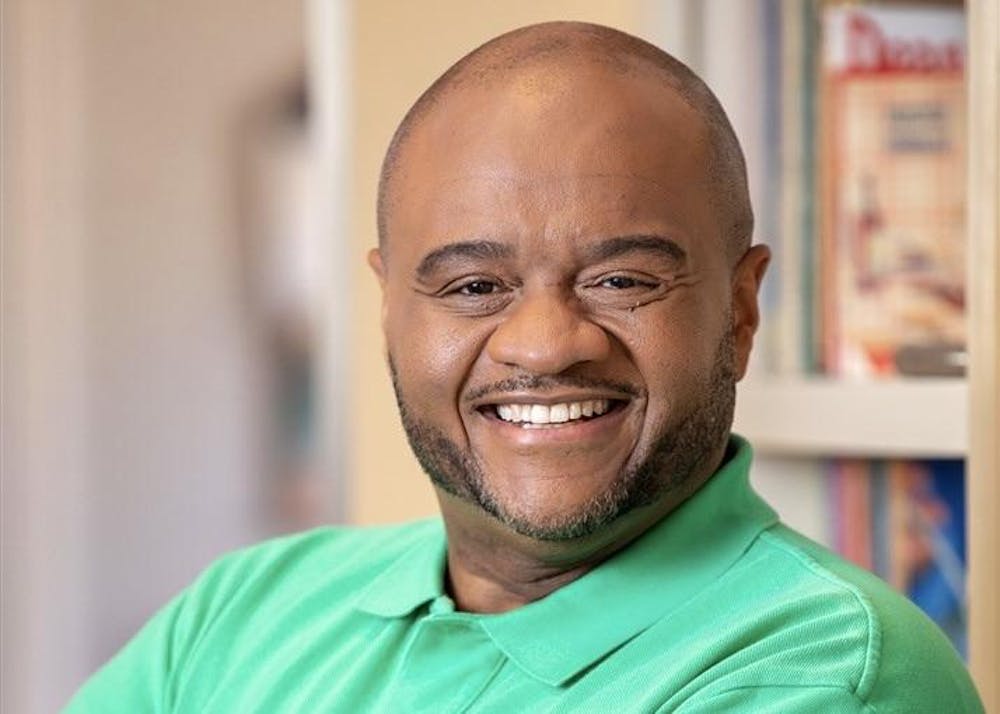
The City of Charlottesville operates under a “mayor-council” government, in which the mayor holds limited executive power, and appoints a city manager to oversee the operations of the city and execute the City Council’s plans. But this doesn’t stop Mayor Juandiego Wade — who was reelected for a second two-year term Jan. 5 — from engaging with the community. Although many concerns could be redirected to the city manager’s office, Wade believes in working closely with stakeholders and serving as a representative for locals to contact when they have questions.
“Charlottesville is so small, when people have issues, like for the snow and things, they contact me … I don't say, ‘well, don't contact me. This is not my job,’” Wade said. “I facilitate that, let them know I received it and how to take care of [their issue].”
Wade was reelected to the City Council by voters in November and was reappointed as mayor by fellow City Council members last month. Before his first election as mayor, Wade served two years as vice mayor. As Wade steps into his second term, The Cavalier Daily sat down with him to discuss his accomplishments from his first term and his goals for the next two years.
Wade’s leadership vision when he began his first term as mayor in 2024 centered around listening to the community — now, two years later, he has realized concerns shift regularly and vary broadly.
“[Concerns] really [depend] on what's going on,” Wade said. “It may have been surveillance, it may have been [immigration enforcement], it may have been a shooting … it ebbs and flows based on what's going on in the community.”
Throughout his first term, the mayor has noted some issues which are raised consistently among the community. Local residents, Wade said, are particularly concerned about the University’s growth and subsequent impact on prices and housing affordability.
It remains challenging for the city to reduce these impacts because the University’s financial resources allow the institution to continue expanding without permission from the city, according to Wade. However, he noted that the University also has positive effects on the city, including providing employment and bringing in new residents — Wade himself originally moved to Charlottesville to earn a master’s degree in Urban and Environmental Planning from the University.
“We're going to continue to reach out [to U.Va.], try to coexist, because we're going to have to,” Wade said. “Neither one of us are going anywhere. And I'm looking forward to, as a graduate of the University … working with President Beardsley and the Board [of Visitors].”
On the issue of housing affordability, Wade noted that the city has between 220 and 230 homeless people sleeping in shelters or outside each night. In October, Wade and the rest of City Council approved purchase of a 3.8-acre property which will have a shelter with a clinic and mental health resources — he noted this as the city’s most recent notable accomplishment towards addressing homelessness. As he works with partners to convert the existing office building on the property into a shelter, Wade said he hopes to work with the University on this project.
“[The shelter project] is a place where we hope that the University of Virginia, with their immense resources, can say, ‘you know what, we have a $15 billion endowment. We'll give you $10 million to fix that up, as a contribution, as a goodwill,’” Wade said.
Transportation, Wade noted, is an area in which he hopes to make significant progress in his upcoming term. This year, he and City Council are proposing an additional 10 transit drivers in the annual budget, with the aim of decreasing wait times to 15 minutes at each stop along the city’s most-used bus routes. A local group advocating for hiring additional bus drivers said in early 2025 that wait times average over 30 minutes.
Wade added that the city has already increased the number of city transit drivers to 66, up from between 50 and 55 drivers. City Council is also working to encourage residents to use alternate methods of transportation such as bicycles or buses, he said.
“We want to give people options instead of their car, and that has to be transit,” Wade said. “Transit has to be readily available, and they [have to] know that they can get on it and it'll be there in 15 minutes.”
A central part of making cars less attractive for locals and students, he said, was a new zoning ordinance that the City Council passed in 2023, while Wade was vice mayor. The ordinance was delayed by a lawsuit which argued that the city had not followed state law in adopting the plan, but was resolved in October 2025.
The ordinance focuses on increasing housing density in the city, which Wade said historically has built single-family homes on large lots, contributing to housing shortages in Charlottesville. It also de-emphasizes parking lots and roads, focusing instead on providing more accessibility for bicycles and buses, and prioritizing residential or commercial buildings instead of large lots.
“That new zoning ordinance [is] probably the most progressive in the United States,” Wade said. “The problem with the cost of housing here is supply and demand. We just don't have enough, and so if we increase the supply, prices will come down … We believe we're on our way [to] doing that.”
Although much of Wade’s work focuses on local issues, there are times when he and the City Council choose to speak on national issues — most recently, they spoke on immigration enforcement. The Council voted to pass a resolution Feb. 2 which condemned federal immigration enforcement’s recent actions in Minnesota. Although the city does not have authority to regulate national Immigration and Customs Enforcement officers, Wade said that he felt the resolution was an important statement.
“It got to the point where we felt like we had to say something about the violence in Minneapolis and the tactics that ICE was using,” Wade said.
Moving forward, the City Council plans to communicate these concerns to Charlottesville’s representatives in state and national government.
As Wade begins his second term, the City Council is in the midst of developing this year’s budget. In this process, he hopes to prioritize working with stakeholders to make decisions about budget changes. He noted the Council is going to be working with the school board, which requested a $5 million increase in its budget this year, and the Council, more broadly, is currently considering adding an additional $1.4 million to the budget for the fiscal year 2027.
“We have a decent amount of increase in the budget, but we [are] still going to have to make some tough decisions, because of collective bargaining, because of the new transit [drivers] … , because of so many programs that the federal government used to fund that they are no longer doing, but [are] still an integral part of what we are in the community,” Wade said.
Reflecting on his first term, Wade noted that he appreciated the time he had to learn the role and understand what it means to be mayor of a community he describes as highly engaged. Wade retired from his full-time career as a Social Services Career Center coordinator for Albemarle County last year and looks forward to the opportunity to be even more involved during his second term.
“Every day is different. It's never boring,” Wade said.
Read More

Tao Tan discusses financial future of U.Va., rising college tuition trend nationwide
By Lily Kostro | 11 hours agoTan explained how tuition costs will shape the future of academic institutions such as the University.

U.Va. Health cuts scribe hours as AI documentation tools expand across Health System
By Vrinda Vashisht | 11 hours agoScribes in the undergraduate medical scribe program said in interviews with The Cavalier Daily that a new emergency department schedule that began Sept. 15 has reduced or eliminated certain scribe shifts and has decreased scribe availability to clinicians in the Emergency Department.

How does the Honor Committee manage its endowment?
By Isabela Delgado | YesterdayThe Honor Committee manages an endowment upwards of $200,000, and for its 2026-27 academic term, it has budgeted $204,500 — just over its available endowment.