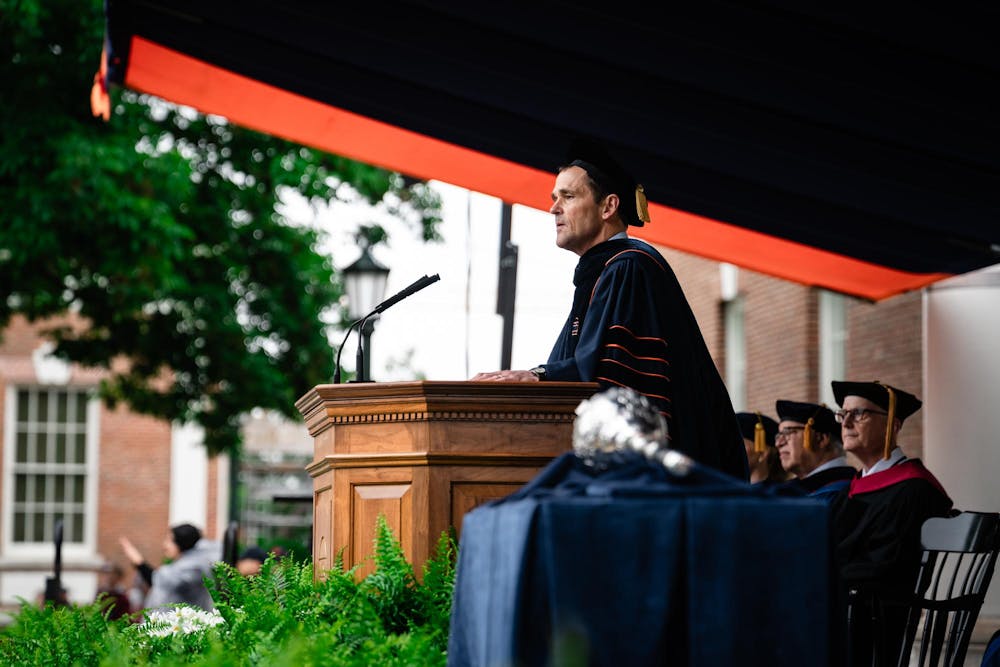
Former University President Jim Ryan was honored with the Legend in Leadership Award at the Yale School of Management 11th annual Higher Education Leadership Summit Jan. 27. Yale Daily News reported that Ryan was honored alongside Harvard University President, Alan Garber, because they both demonstrated public resistance against the Trump administration’s pressure on the two universities throughout this year.
Jeffrey Sonnenfeld, Yale senior associate dean for Leadership Studies and Management Practice professor, said to Yale Daily News that the ceremony was held off the record, to allow leaders to speak “candidly.” In a statement to The Cavalier Daily, Ryan, who is also a Yale class of 1988 alumnus, wrote he was honored to be present Jan. 27.
“I was honored to receive this award from my undergraduate alma mater and a university I still admire very much,” Ryan wrote. “I was especially honored to be in the company of past award winners and current award winner Alan Garber, who was my colleague at Harvard and remains a friend I hold in the highest regard.”
Ryan resigned June 27 following pressure from the Justice Department. Between April 11 and June 17, the Justice Department sent seven letters to the University, with six of them looking to ensure diversity, equity and inclusion initiatives had been dissolved. The final letter claimed Ryan and the University had not dismantled race-based admissions and that “time [was] running short” to meet the Justice Department’s demands before they were to withhold millions of dollars in federal funding.
At the time of Ryan’s resignation, the letters from the Justice Department had been one of the sole public insights into scrutiny the University faced from the Justice Department. However, Ryan wrote a letter to the University’s Faculty Senate Nov. 14 recounting the events leading up to his resignation from his perspective, and included details regarding both the federal government’s and Board of Visitors’ overstep into University policies throughout the spring and summer of 2025.
Specifically, Ryan said in his letter that former Board Rector Rachel Sheridan had hired Wilkinson Stekloff law firm four days prior to his resignation, and Sheridan suggested Ryan speak with Wilkinson about what it may look like for him to fight the federal government. Ryan wrote that at the time, he did not know Wilkinson was an attorney hired by Sheridan and working for the Board. According to Ryan, Wilkinson only spoke to him to persuade him to resign — rather than about how he could fight the Justice Department.
Ryan’s letter to the Faculty Senate highlighted that a major reason behind his resignation was that he felt he could not fight the Justice Department without the support of the Board.
“After pursuing as many options as we could to forestall my resignation, around 4pm one of my closest and wisest colleagues said: ‘If you don’t have any Board support, it’s over. You can’t fight this on your own,’” Ryan wrote in his letter to the Faculty Senate.
Sonnenfeld also reported to Yale Daily News that Ryan’s admirable leadership stems from putting the wellbeing of the University above his personal benefit by choosing to resign rather than putting the institution at risk of losing federal funding.
In his resignation letter to the University community June 27, Ryan emphasized his devotion to the University and that his decision to resign came out of his desire to protect the University members who rely on federal assistance.
“I cannot make a unilateral decision to fight the federal government in order to save my own job,” Ryan wrote. “To do so would not only be quixotic but appear selfish and self-centered to the hundreds of employees who would lose their jobs, the researchers who would lose their funding, and the hundreds of students who could lose financial aid or have their visas withheld.”
Garber, like Ryan, has faced similar federal scrutiny throughout 2025, though a key difference between the two leaders is that Garber remains the current president of Harvard.
The Justice Department demanded Harvard discontinue the use of DEI, increase viewpoint diversity within its departments and audit international students to ensure they comply with American values before admittance in April. In response to these requests, Garber released a letter stating he would not comply with what he characterized as "unprecedented demands.”
“Although some of the demands outlined by the government are aimed at combating antisemitism, the majority represent direct governmental regulation of the 'intellectual conditions’ at Harvard,” Garber wrote.
Garber’s resistance to the Justice Department was met with an immediate $2.2 billion freeze in federal research funding. Harvard again responded, but this time by suing the Trump administration, and in September, the U.S. District Court in Boston ruled in favor of Harvard. The court determined that the Justice Department’s requests for policy changes at Harvard were a violation of First Amendment rights and academic freedom, and the decision restored Harvard’s federal funding.
Both Garber and Ryan were unanimously approved by the Yale faculty board for their awards Jan. 27. The summit, which has a stated purpose of bringing together university presidents and other leaders to discuss the environment within higher education, was themed "Rebounding from Surviving to Thriving: Higher Education Regaining its Footing.”
Lauren Seeliger is a news editor of the 137th term and enjoys covering U.Va. Health and University governance. Lauren is a fourth-year Behavioral Neuroscience student from Fairfield, Connecticut.
Read More
The “One Year Series” — unpacking a year at the University since Ryan’s resignation
By Grace Little | YesterdayJim Ryan, former University president and School of Law professor, resigned as president June 27, 2025.
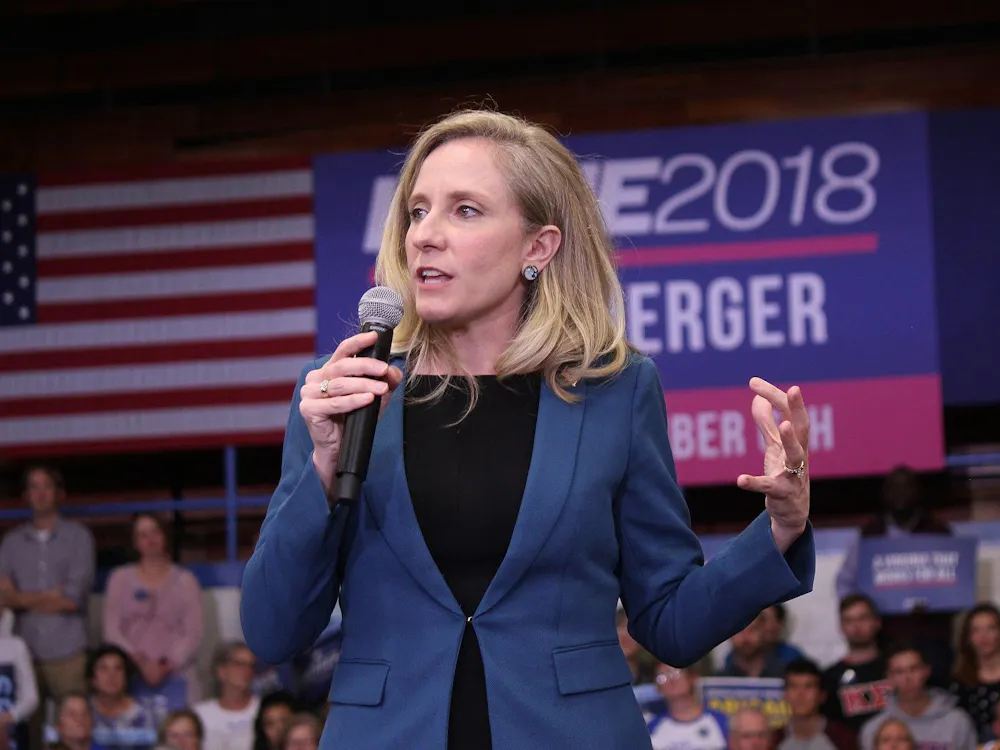
A look at the changes in higher education since Gov. Spanberger took office
By Jaylynn Perez | 2 days agoWithin hours of taking office, Spanberger appointed 27 members total across the governing boards at the University, George Mason and VMI.

Early voting begins in Virginia’s August primary — here’s what’s on the ballot
By Luca Bailey | 2 days agoVirginia’s congressional primaries will take place Aug. 4 this year, marking the first time in over a decade that the Commonwealth is not holding its nominating contests in the month of June.