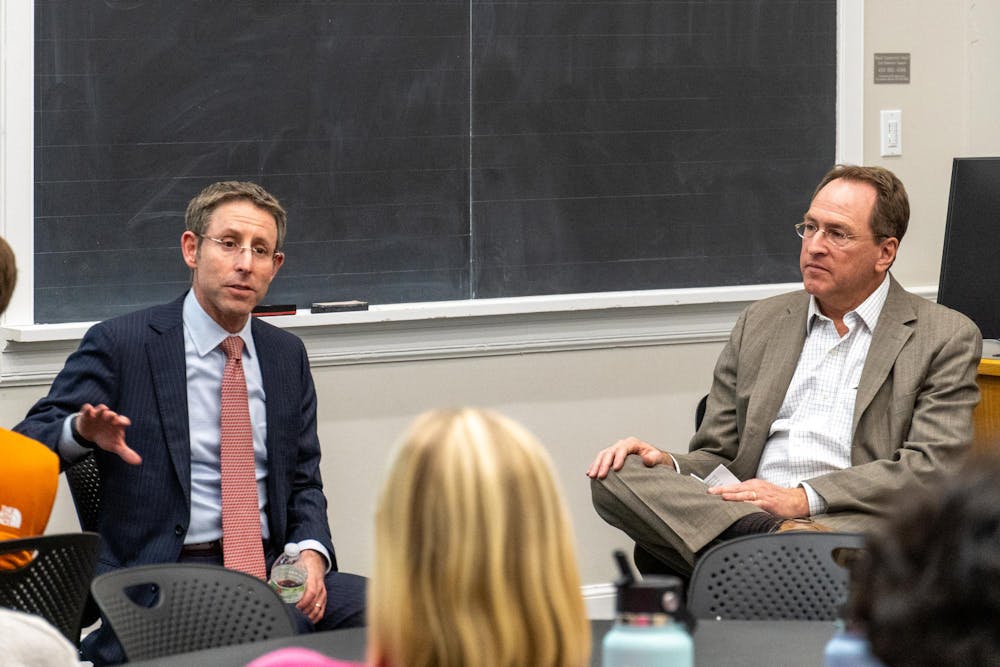
Judge Daniel Bress, of the Ninth Circuit U.S. Court of Appeals and Law Class of 2005 alumnus, joined Assoc. Politics Prof. Gerard Alexander for a discussion Feb. 10 on federal immigration law. Among the topics discussed were U.S. Immigration and Customs Enforcement, how current controversies on immigration policies have manifested themselves into court cases and the nature of Bress’ work as an appellate court judge.
The event took place in Monroe Hall and was cosponsored by The Blue Ridge Center, the University’s Undergraduate Law Review and Phi Alpha Delta — a pre-law fraternity at the University.
Following their conversation, students participated in a Q&A session in which several students asked Bress to elaborate his positions on issues such as due process in immigration courts. Bress emphasized his confidence in the federal judiciary while highlighting the differing treatment of criminal defendants and individuals in immigration proceedings in the United States.
The discussion largely centered on what Alexander called the “hot button issue” surrounding ICE’s procedures and enforcement practices — particularly debates over due process and executive authority in immigration enforcement. When asked whether these debates have surfaced in recent notable court cases, Bress said that he believes they have.
“I think that the problems in court you deal with are a mirror image of what you see in society,” Bress said. “When you see something in the news in this day and age, it is very easy to … turn that into a lawsuit.”
Bress pointed to cases involving lawful permanent residents — including green card and student visa holders — as an example of how debates on immigration policies play out in court. According to Bress, these individuals have permission to be in the U.S. if they meet certain conditions, such as visa renewal requirements. He explained that disputes have arisen when the federal government revokes that permission. This often leads to detainment by ICE without trial, sparking concerns that such treatment constitutes unlawful imprisonment.
Alexander asked Bress who typically represents lawful permanent residents in immigration court. Bress said that, since the right to an attorney does not apply to immigration proceedings, the answer varies. Public interest firms, non-profits and pro-bono immigration lawyers will often take up this work.
Alexander outlined the general outline of the federal judicial branch and said that as an appellate court judge, Bress reviews U.S. District Court rulings when the losing party appeals on the grounds that a ruling was unfair. There are multiple appeals courts across the country where each has jurisdiction over a circuit — a particular region of the United States.
One key characteristic of the Ninth Circuit — which includes California and Arizona — is that both states border Mexico. For this reason, Bress said that the Ninth Circuit handles a higher number of immigration cases with a caseload in the Ninth Circuit totaling more than other circuits.
According to Bress, some immigration disputes do not come from the District Court and instead come from the Board of Immigration Appeals. He said that these cases can involve asylum seekers whose applications were denied by the executive branch and are reviewed by the appellate court — which reexamines legal decisions rather than retrying cases. The Ninth Court’s caseload also includes criminal cases involving unauthorized border crossings and import-export violations such as human or drug trafficking.
If someone in the Ninth Circuit challenges federal immigration policies for being unconstitutional or conflicting with current law, Bress said these challenges — the ones “you see very much” in the news — go directly to the Appeals Court without first being heard in District Court.
Bress also told Alexander that, in an era where many have lost faith in the legal system, he believes that the federal judicial branch is well-designed despite its imperfections. He said that he takes care to ensure due process is fair when making judicial decisions, but emphasized that the process does not need to be perfect.
“I want to make sure before I issue [court decisions] that [there] has been a good and fair process,” Bress said. “It doesn’t need to be a perfect [due] process because if we insist on that we’re going to have major consequences from a public safety standpoint, but the law insists on some really rigid protections.”
Some examples Bress gave of these protections are the right to trial by jury, the need for law enforcement to obtain a warrant before searching individuals’ belongings or making an arrest and the “exclusionary rule” — which states that evidence obtained illegally by law enforcement is not admissible in court.
During the Q&A section, one student asked Bress how common criticisms of immigration law proceedings — including concerns that ICE can issue its own warrants and legal counsel is not a guaranteed right — affect Bress’s faith in the legal system.
According to Bress, the key distinction between a criminal defendant and individuals in immigration proceedings lies in the level of protection and support each receives. He explained that criminal defendants have been afforded greater due process rights than defendants in immigration court.
Another student asked how immigration law determines whether the experiences of immigrants seeking asylum meet the legal standard for protection. Bress explained that some experiences — such as being targeted by their home country on the basis of protected characteristics — justify the federal government granting asylum, while other forms do not satisfy the criteria. Bress reminded students that most immigration policies are created by Congress and that judges are responsible for applying those standards.
First-year College student Zayd Benjelloun attended the event and asked Bress about the case of Mahmoud Khalil, a Columbia University student and pro-Palestinian activist whose F1 student visa was revoked by the State Department. ICE agents arrested Khalil without a warrant March 8, 2025, and detained him in a Louisiana facility, where an executive branch immigration judge ruled that Khalil must be deported. Bress explained that judges are unable to comment on specific cases.
Once the event concluded, Benjelloun said that — despite the fact that he wished Bress could have engaged more directly with his question about Khalil — as someone interested in becoming an immigration lawyer, he enjoyed learning about Bress’s judicial background and his approach to immigration cases.
“I really enjoyed hearing [about] his experience as a judge … basically how he handles his jurisdiction,” Benjelloun said.
The Blue Ridge Center will co-sponsor another event with College Republicans Wednesday, where they will be joined by Robert Doar, president of the American Enterprise Institute, for an in-depth discussion on how policy is made in Washington, D.C. in today’s politicized environment.

Luca Bailey is a third-year Politics student from Free Union, Va. As a staffer on the news and video desks, he has covered topics ranging from the General Assembly and state elections to local politics and University governance. He is also The Cavalier Daily’s beat writer for the Charlottesville City Council.
Read More

Student Council considers reduced 2026-27 academic year budget
By Lucia Gambacini | 18 hours agoRepresentatives ultimately adopted an amendment to the proposed budget, but tabled consideration of the legislation to this Tuesday’s meeting.

Students pay University Mandatory Fees — what do they cover?
By Isabela Delgado | 2 days agoThe amount a student pays in fees is dependent on several factors, such as a students’ residence in- or out-of-state and their school of enrollment.

Honor Committee introduces proposal to change sanction appeal process
By Isabela Delgado | 3 days agoThe proposal includes the addition of a governing body that would oversee the appeals process and decide if a student's appeal is deemed legitimate.