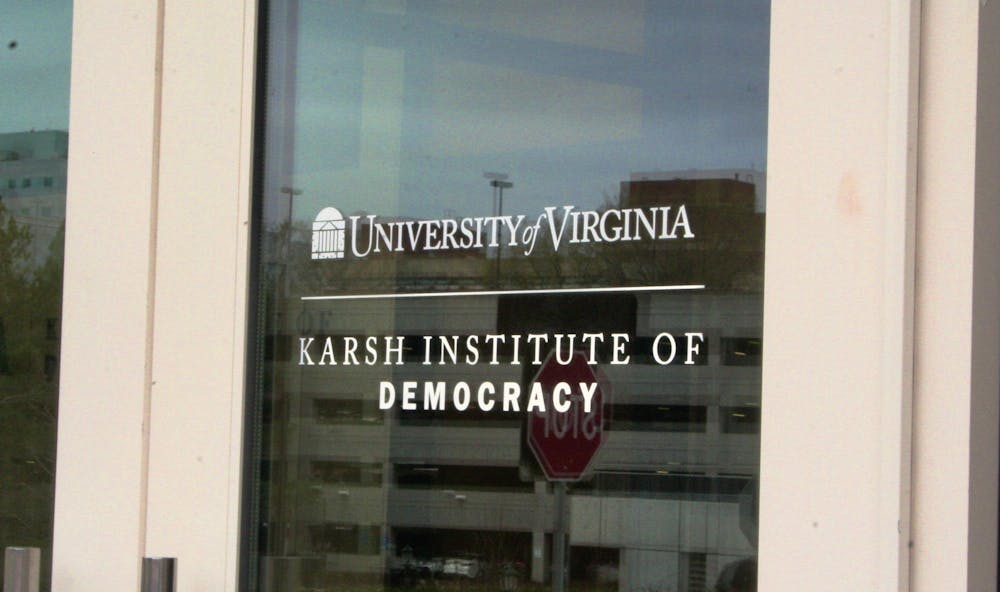
Melody Barnes, executive director of the Karsh Institute of Democracy, joined the University’s Jefferson Literary and Debating Society Friday evening for an address on some of the Karsh Institute’s recent accomplishments and its purpose of bringing people together to explore the problems within democracy. Barnes reflected on the professional experiences that led her to found the Karsh Institute and presented on its initiatives and relevance.
The Society hosted Barnes as the first in a series of events for its Distinguished Speaker Series — a series in which experts in politics, law and history will address the Society on the importance of their work.
According to its website, the Karsh Institute is a University organization which seeks to identify and generate solutions to problems faced by American democracy. Further, it connects students and researchers with each other and with outside communities through teaching and public engagement.
The Karsh Institute began as the Democracy Initiative — a $10 million project to position the University as a “global center” in democratic research. Barnes said that the Karsh Institute now seeks to build on this original research mission by using that research to facilitate the creation and implementation of solutions to democracy’s challenges. It does so through engagement with University community members like academics and students.
”This distinction matters,” Barnes said. “Often people look at [U.Va. and think] that we sit on a hill … divorced from the world around us. Instead, what I … believe is that we have some of the best minds in the country and we can leverage [that] to have an impact beyond the … University.”
Barnes summed up the mission of the Karsh Institute by describing its four interconnected areas of focus. The first is the realization of a democratic culture of respect in which citizens see one another as “legitimate participants in civic life.” The second is the facilitation of healthy, respected democratic institutions to combat declining levels of public trust. The third is the encouragement of accurate, reliable information including trustworthy journalism and public data. The fourth is a focus on understanding how democracy and the economy are interconnected in affecting public participation.
The Karsh Institute pursues these goals through a variety of means, according to Barnes, including research — one example is its Virginia local news ecosystem study in which the Karsh Institute conducted a comprehensive study to identify the 277 local media outlets across the Commonwealth and assess the information it is providing the public.
Barnes also noted the Karsh Institute makes an effort to communicate its findings in an accessible, understandable manner for members of the public. It does this, in part, through its newsletter of more than 20,000 subscribers.
The Karsh Institute also encourages learning and civil discourse through programs such as its Civic Cornerstone Fellowship. The Fellowship is a program in which students sign up to share a meal and discuss current political issues in groups of 10 over the course of a semester. Barnes said that, for its pilot program, the Karsh Institute was expecting roughly 50 students to sign up. Instead, 300 students participated and reported that they felt the program helped them build important skills associated with charitable disagreement.
Barnes also reflected on her career in public service and in the private sector. She began her career working at Shearman and Sterling, an international law firm, and then worked for the House Judiciary Committee. Barnes then served as Chief Counsel to former Sen. Ted Kennedy (D) in the Senate Judiciary Committee, worked as an Obama Administration official and as Executive Vice President for Policy at the Center for American Progress.
Barnes described her career as being at the “intersection of law and policy and civic life.” She said that while it may seem as if she has worked in many “different worlds,” the “common thread” in her work is a belief that Democracy must be actively practiced instead of passed from one generation to another.
“[Democracy] is imperfect … contested and … under real strain right now,” Barnes said. “At the same time, I firmly believe … that it is resilient and it is adaptable, and it is full of possibility.”
The presentation was followed by a question and answer session in which numerous students engaged with Barnes by asking for her thoughts on the solutions to societal issues such as declining voter apathy. One student asked Barnes how, as individuals, we can promote civic engagement at a time where democratic institutions feel untouchable and removed from daily life. Barnes responded that if good civic habits are built in individual communities by organizations — such as ´Warm Cookies Of The Revolution’ and the Rockefeller Brothers Fund — she believes the habit of respectful disagreement can extend to higher levels of politics.
“Once you start to build that muscle, then it seems more feasible and possible [to] engage [respectfully] on the state level, [to] engage on the federal level,” Barnes said.
Third-year College student Kyra Graham, a member of the Society in attendance, said she thought that Barnes’ remarks were powerful and that she always enjoys hearing from the Society’s distinguished speakers.
”I think it was fascinating to hear what [Barnes] was talking about,” Graham said. “Each speaker shares a part of their own lives, which I always find to be the most inspiring part of the speaker series.”
Graham also said that, as a pre-law student, she appreciated hearing about Barnes’ work as an attorney and how it led to a career in public service.
”She started at [Shearman] & Sterling in New York City and from there, she kind of took off,” Graham said. “It just shows how much life can change.”
The next speaker, Law Prof. Rachel Brewster, is slated to address the Society at 7:29 p.m. April 3 in Jefferson Hall.

Luca Bailey is a third-year Politics student from Free Union, Va. As a staffer on the news and video desks, he has covered topics ranging from the General Assembly and state elections to local politics and University governance. He is also The Cavalier Daily’s beat writer for the Charlottesville City Council.
Read More

After Supreme Court upholds birthright citizenship, students express relief and disappointment
By Jaylynn Perez and Luca Bailey | 6 hours agoStudents at the University are expressing a range of emotions, with two who spoke to The Cavalier Daily signaling relief at the Court’s decision, and one expressing opposition.
Welcome back, Hoos — here’s what you missed this summer on Grounds
By Grace Little | 6 hours agoLooking to late August, classes will commence Tuesday, and various University groups will reconvene after adjusted summer schedules.

U.Va. School of Medicine names two new department chairs, explains selection process
By Michael Racz | 4 days agoIn an interview with The Cavalier Daily, Colin Derdeyn, interim dean of the School of Medicine, explained the selection process of the two chairs and the new chairs’ plans for their departments.