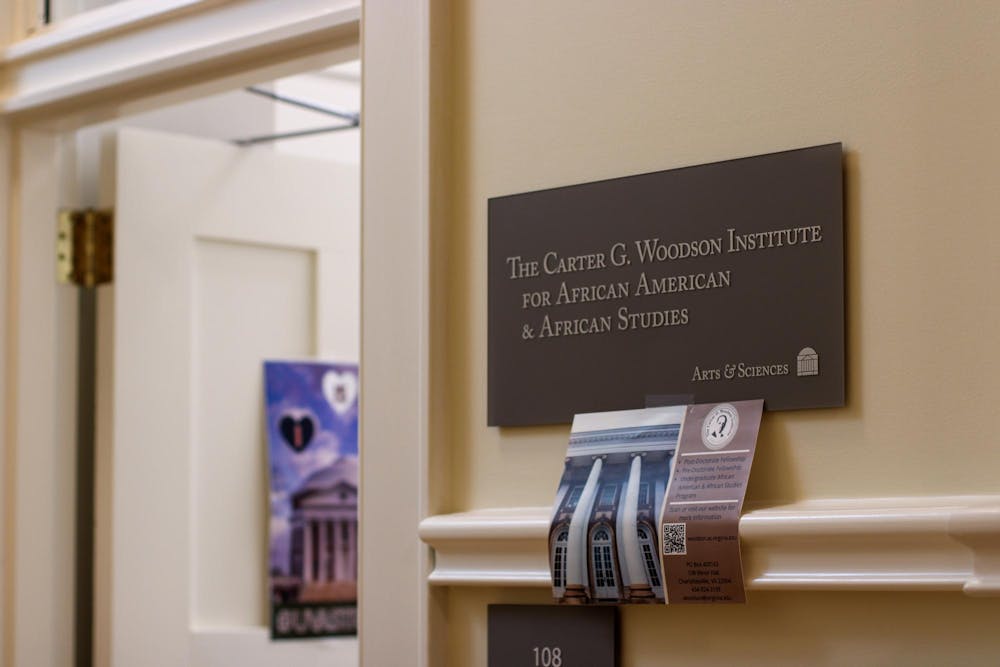
Nearly 20 University students, fellows and faculty members funneled into Minor Hall 110 — home of the Carter G. Woodson Institute — Tuesday evening to tune in to the third leg of the Institute’s four-part Black History Month event series. Dr. Robert Trent Vinson, director of the Carter G. Woodson Institute for African-American and African Studies, delivered a presentation highlighting Woodson’s role in establishing Black History Month and continued influence on shaping the global understanding of Black history.
Situated within the African American and African Studies department, the institute pursues its mission of making Black history accessible to the University community through a variety of avenues. Besides offering courses that cover “the whole Black world” across disciplines, mentoring 16 international research fellows per year and collaborating with the Jefferson School African American Heritage Center, the institute hosts events year-round that honor and celebrate Black history.
The room was thoughtfully curated for the event, with seating set up facing Vinson’s digital presentation — titled “Education for Liberation.” An array of assorted refreshments was set out on a table in the back of the room for guests to enjoy both before and after the talk. Once attendees were settled in their seats, Kevin Gaines, the Julian Bond Professor of Civil Rights and Social Justice, gave Vinson a warm welcome.
According to Vinson, he centered this year’s talk around Woodson to commemorate the 100th year of Black History Month. Born to formerly-enslaved parents in 1875 in Buckingham County, Virginia, Woodson went on to lead a life of advocacy for racial justice and the broader acknowledgement of Black History Month.
Beyond obtaining a plethora of degrees up to his doctorate and publishing five books, Woodson directly initiated significant strides in Black education. To list a mere few of his contributions, he helped to found The Association for the Study of African American Life and History, developed a master’s program in African-American Studies as the Dean of Graduate Education at Howard University and eventually started his own publication, “The Negro History Bulletin.”
Vinson opened the talk by situating Woodson’s early childhood with anecdotes from his very first influences — his parents. The first was of his mother, Anne Eliza Woodson, where he illustrated a jarring image of her on the auction block with her mother during her enslavement. Vinson recounted that as Anne watched her own mother being sold to a slaveowner, she noticed a statue that portrayed George Washington pointing south. This image, Vinson explained, was a tangible metaphor for the hypocrisy of the principle of “freedom” that the United States was built on.
“The interpretation [that] Woodson's mother had at this moment [at] an auction, as her mother is sold, is that George Washington, the so-called founder of the nation, a slave holder, pointing south, was an indication that the founding ideals of this nation did not apply at all,” Vinson said.
Vinson followed this with a piece of advice from Woodson’s father, James Henry Woodson, who encouraged Woodson to fight for his freedom and integrity against a system built to oppress him — a sentiment that would frame his perspective on Black education and Black identity throughout his life.
“The story that Wilson is getting from his father … is that don't let anyone regard you as just chattel,” Vinson said. “Go beyond the chattel principle, that you're more than an economic unit of labor, that you are a person and that you matter, and that you have dignity, that you have to move in ways that insist on your humanity.”
Beyond the influence of his parents, Woodson’s educational journey was informed by a breadth of experiences, spanning from his time as a coal miner, to a school teacher, to a scholar who obtained four total degrees, from his initial Bachelor’s degree up to his doctorate.
One of Vinson’s focal points throughout the talk was Woodson’s call for the United States to play “catch-up” after its long, layered history of cruelty and discrimination against the Black community.
“I think U.Va. has a particular responsibility, [and] universities like this, [with a] long history of exclusion, where it was literally white men, their histories, their priorities, were privileged because they were the only ones here, and so there's some catching up to do, not just in terms of representation,” Vinson said.
Vinson then went on to connect Woodson’s identification of racial structures within the education system, which he attributed much of to the Enlightenment era’s attempted erasure of African civilizations. According to Woodson, the education system is where widespread racist ideologies are first laid. As Vinson explained, rather than being an empowering and comprehensive resource, Woodson found education for Black students to be a guise to indoctrinate them with an inferiority complex.
“There [would] be no lynching without it already taking place in the classroom,” Vinson said, quoting Woodson. “There's this connection of history and power that [Woodson] is very attuned to, these foundational epistemological and historical claims that provide this ideological justification and a global color.”
As depicted in Woodson’s most famous publication — “The Mis-Education of the Negro” — Vinson described that this mis-education exists as a means to silence the Black community, depriving them of the knowledge and tools needed to challenge discrimination in society.
“When you control a man’s thinking, you do not have to worry about his actions,” Woodson said in “The Mis-Education of the Negro.”
To combat this oppression, Vinson emphasized the notion of a “positive assembly” throughout the talk — the practice of the Black community continuing to reclaim their agency by telling the history of their ancestors, rather than allowing narratives to be shaped by glamorized historical records.
“For [Woodson], it's essential to connect the diaspora with Africa [on] the state side,” Vinson said. “So Woodson's positive assembly of Black study is primarily around institution-building and the creation of accessible histories for anyone to engage.”
To conclude the event, Vinson detailed Woodson’s diligent work in spearheading the federally recognized commemoration of Black accomplishment and resilience — originally called “Negro History Week” — which would officially become Black History Month in 1976.
Vinson emphasized that Black history is ongoing and that Woodson’s work from nearly a century ago has been carried forward by other scholars like Amina Mama. Woodson’s legacy has and will continue to work toward his overarching goal — that the world will eventually no longer need a separate month dedicated to honoring Black history, but that it will do so every day of the year.
“Black History Month is part of that commemoration work across generations creating what Woodson called ‘Watchmen on the Wall’ — everyone engaged to remember, reclaim and reshape liberatory black historical conditions,” Vinson said. “Woodson's idea of Black history, [that] he articulated, was that it will be [celebrated] 24/7, 365 days per year, that ultimately our histories … would not need a separate month set aside for particular observation.”
Throughout the talk, attendees listened attentively to Vinson, many even taking handwritten notes. Several attendees offered thoughtful interpretations once Vinson opened the floor for questions and commentary.
For Naseemah Mohamed, assistant professor at the Carter G. Woodson Institute, Woodson’s “resilience” was the primary takeaway from the talk. She noted that through his push for the “recalibration” of history and Black peoples’ role within it, he built a legacy for himself that is important to celebrate alongside the ancestors he advocated for. Mohamed echoed Woodson’s hope that in the future, Black history will be center-stage for more than just February, but each and every day.
“One day … Woodson said that we don’t need to have a Black History Month, because Black history is everyone’s history,” Mohamed said. “It’s this country’s history, it’s the world’s history, because Black people have always played a role in the world.”
Vinson hopes that the Black History Month series furthers the institute’s mission to amplify representation of all facets of the University community, and that their commitment to comprehensive representation works to propel the University’s culture of “belonging.”
“Those histories and cultures really matter, particularly for those people who identify with those cultures or communities. Yeah, they need to be seen,” Vinson said. “So I think that's the importance [of] the ongoing work, because we talk a lot here at U.Va. about belonging. I love that term. I want folks to feel that.”
Read More

Play the organ
By Elizabeth Adams | YesterdayThe college side quest does not need to be the multi-semester jaunt that my organ adventure has become, and it certainly doesn’t have to make sense.

Girls Who Lift brings gender inclusivity to the gym
By Sadie Adams | 2 days agoBy providing this safe space in the gym, Girls Who Lift encourages more women to take up weightlifting as a hobby.

Cville Sabroso Festival brings a taste of Latin American cultures to the Ting Pavilion
By Summer Hoffman | 4 days agoInside the Ting Pavilion, a sea of Latin American artisans, food vendors and performers greeted festivalgoers.