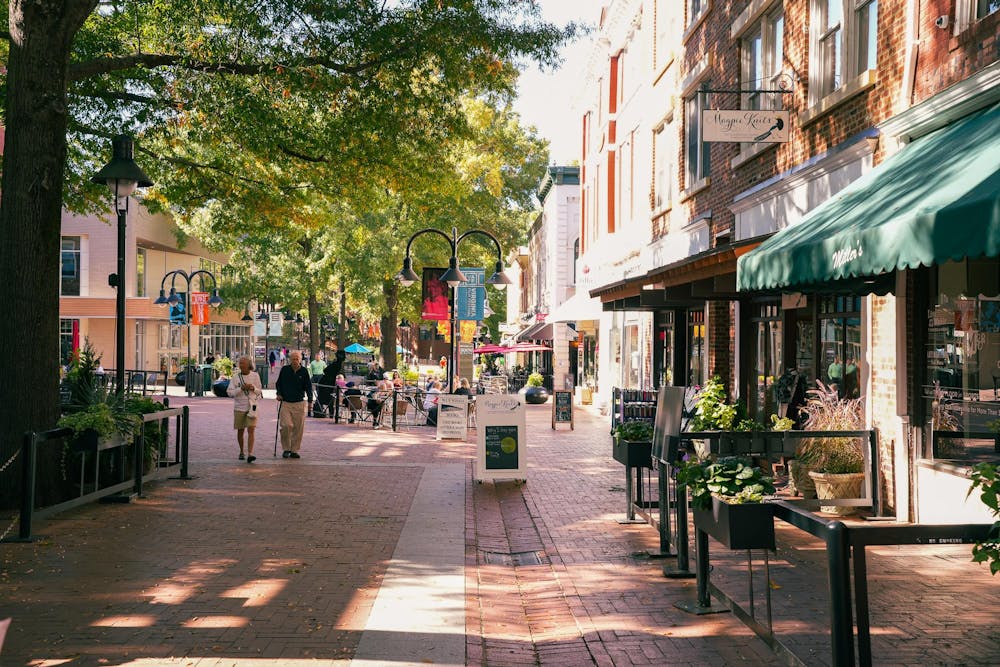
Strolling through Charlottesville’s Downtown Mall, you are bound to spot a variety of sights, but one thing you will not find is any cars. On July 3, 1976, with the help of architect Lawrence Halprin, Charlottesville converted its East Main Street into the Downtown Mall we know of today. Crucially, Halprin took the drastic and uncommon step to block the district off from cars and create a pedestrian-only space. In doing so, he constructed a downtown that not only economically saved businesses by establishing a walkable space for customers, but also revitalized the city culturally — in a move many other U.S. cities can learn from.
In the 1970s, Charlottesville's central core was struggling. Many of the businesses downtown were losing customers to the recently opened and more accessible Barracks Road Shopping Center. With the growth of the suburbs and the emergence of federal policies like the Federal-Aid Highway Act of 1956, the U.S. was shifting to becoming a car-centric country. As a result, many community members experienced an added distance from the inner city. This made the journey downtown for a fresh pair of pants or a haircut no longer economically feasible. The Charlottesville City Council understood this, and decided that parts of Main Street would be blocked off as the paved road was converted into a brick walkway.
To accomplish this, they hired Halprin, a renegade thinker and renowned landscape architect in this car-dominated era. Drawing inspiration from Copenhagen, he designed the area with a European style of free pedestrian flow and communal gathering space. To this day, Halprin’s architecture supports the maintenance of the Downtown Mall as the city’s economic, social and cultural hub. Thus, other U.S. cities would be wise to learn the many benefits of a walkable downtown, including increased pedestrian safety, community engagement, citizen health and economic growth.
Perhaps the most underappreciated advantage of walkable cities is their ability to promote community engagement. When planners designate communal areas like town squares or blocked-off streets, it provides a common place for citizens to gather and experience events together. It is no surprise that in Scandinavia, where large parts of Charlottesville’s downtown drew inspiration from, there are much higher levels of civic trust in institutions. A study from the American Enterprise Institute further shows a link between access to amenities like cafes, parks and public squares — all staples of a walkable city — and higher levels of trust between residents. More than three quarters of high-amenity urbanites and suburbanites trust their neighbors a fair amount according to the American Community Life survey, compared to around 60 percent of those living in low-amenity cities and suburbs.
These social benefits extend to the health of citizens as well. Studies from the National Library of Medicine show a strong connection between automobile-centered communities and reduced physical activity, such as walking or exercising in outdoor spaces. In contrast, pedestrian-friendly designs increase the physical activity of residents in their daily routines, contributing to, among other things, lower obesity rates. Relatedly, due to Charlottesville’s walkable layout, the City has received a high walk score of 84 out of 100. Although difficult to determine exact causality, the City enjoys a significantly reduced obesity rate compared to other Virginia counties and higher life expectancy than the national average.
Additionally, these benefits reach beyond the social sphere — there are also profound economic advantages. Walkable downtowns have been shown to help small businesses, with research conducted by Korean urban planning scholars indicating that pedestrian-friendly designs positively impact local restaurants and shops by increasing foot traffic, sales and property values. In a world dominated by the ease of online shopping, walkable downtowns supply a key advantage to small businesses — the possibility of customers stumbling in and finding a product they like. Absent are the name brands of Barnes & Noble or McDonald’s, and in its place are vibrant local cafes and shops which continue to prosper under Charlottesville’s innovative design. The implementation of Charlottesville’s walkable infrastructure has allowed these small businesses to survive against chains found at Barracks and online shopping.
As a result of these attractive markets, which highlight local culture as opposed to consumerist venues, property values in walkable cities are often higher. By favoring the pedestrian in infrastructure decisions, officials can raise property values without the need for costly road infrastructure projects like highways or interstates. Higher property values increase tax revenue for local projects and programs while attracting more regional investment. Enormous, sprawling American cities like Memphis, Tenn., or Atlanta could take steps to improve pedestrian infrastructure to help stimulate local economic activity and raise government revenue.
While taking steps to build pedestrian infrastructure may seem like a daunting task for these major cities, relatively small measures can make a significant difference. Upgrades like adding sidewalks, instituting curb ramps and blocking off downtown roads can help to deliver the major benefits of pedestrian infrastructure for cities across America.
In a world increasingly isolated and fast-paced, pedestrian infrastructure in Charlottesville stands as a bulwark with health, social and economic benefits.The rest of the U.S. must take a lesson from the page of Charlotteville, and begin to construct walkable downtown areas in their own respective cities.
Nat Taylor is an opinion columnist who writes about politics for The Cavalier Daily. He can be reached at opinion@cavalierdaily.com.
The opinions expressed in this column are not necessarily those of The Cavalier Daily. Columns represent the views of the author alone.
Read More

TAYLOR: Do not sell your soul for the résumé
By Nat Taylor | 20 hours agoWhile no company is perfect, truly ignoring your moral integrity only leads to psychological distress and the erosion of the personal values that our University is meant to help build.

WELLS: The shame is not Cornell’s alone
By Stephen Wells | YesterdaySo why do universities look the other way? Why do they endlessly tolerate the gross conduct of fraternities that operate in a despicable manner right under their administrations’ proverbial noses?

ADDISON: Criticism without introspection is a waste
By Lucas Addison | 2 days agoThe Community of Trust must be more than a phrase we invoke to describe ourselves. It must be a standard by which we hold ourselves accountable.