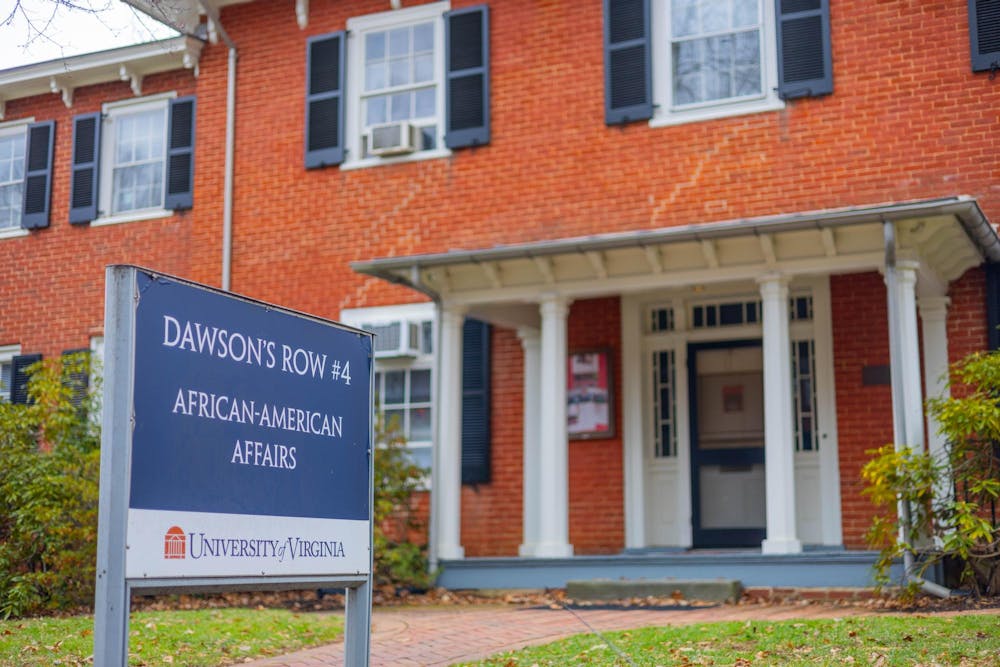
As the University commemorates Black History Month, the University’s Carter G. Woodson Institute for African American and African Studies is centering its Black History Month events on the 100th anniversary of Negro History Week — a weeklong observance founded in February 1926 by historian Carter G. Woodson to recognize African American history and achievements. Negro History Week later received recognition as Black History Month under President Gerald Ford in 1976. The Office of African-American Affairs and Luther Porter Jackson Black Cultural Center will also host a range of events throughout the month of February.
According to the director of the Carter G. Woodson Institute Robert Vinson, the Institute serves as the University’s primary center for research, programming and special projects in African American and African Studies. Vinson wrote in an email to The Cavalier Daily that the Institute focuses on work related to the lives and experiences of people in the Global African Diaspora — people of African descent living outside Africa and the communities they form worldwide.
“Our basic philosophy is that the Woodson Institute practices the principles of Black History Month year-round,” Vinson wrote. “Black History Month simply provides an opportunity to demonstrate this daily work to the broader University and Charlottesville-Albemarle community.”
Vinson wrote that this year’s events reflect Woodson’s vision of Black history as a global and community-driven intellectual project — the events celebrate both the local Charlottesville-Albemarle community as well as the storied global history of the month.
Born in New Canton, Virginia in 1875 to formerly enslaved parents, Woodson believed Black history was essential to understanding the broader history of the United States.
“The first celebrations of Negro History Week occurred during a moment of political consciousness, institution building and demands for increased representation during the 1920s,” Vinson wrote. “For Woodson, education was the means to achieve these ambitions.”
The Institute’s events for Black History Month include four major offerings, and opened Feb. 4 with a lecture by Wake Forest University Asst. History Prof. Guy Mount, who examined the concept of the Black Pacific — the presence of the African diaspora in the Asia-Pacific region — and Woodson’s time teaching in the Philippines in the early 20th century.
A discussion between Yolonda Coles Jones and Carlehr Swanson Wednesday will focus on the role of gospel music and other Black musical traditions in shaping community in the Charlottesville-Albemarle region. Another lecture Feb. 18 by Vinson will explore Woodson’s vision for a global perspective on Black studies, positioning him not only as the “Father of Black History” but also as an early advocate for Pan-African perspectives.
The series will conclude Feb. 25 with a virtual panel hosted by the Julian Bond Papers Project — a digital initiative to make the collection of works by Julian Bond, civil rights activist and first president of the Southern Poverty Law Center, available to the public and accessible to community historians, transcriptionists and student apprentices. The project is affiliated with the Woodson Institute and housed in the Special Collections Library.
The panel will be moderated by Deborah McDowell, director of the Julian Bond Papers Project and former director of the Woodson Institute. According to McDowell, the panel will highlight how Julian Bond embodied Woodson’s legacy and how his work continues to teach about the connections between Black history and public education.
The panel will also feature scholars from University of California, Princeton and University of Utah who will discuss archived writings and speeches from the Julian Bond Papers, including Bond’s 1979 speech, “Education is the cutting edge of social change.”
Vinson noted that the first Negro History Week celebrations in the 1920s often took place beyond formal classrooms and were led by Black-owned publications — including Woodson’s “Journal of Negro History” and “Negro History Bulletin” — as well as local Black history clubs and study groups. He wrote that the original Negro History Week showed how local communities shaped their own learning to supplement historical narratives taught in formal school curriculum. Vinson gave examples of local communities taking ownership of education by hosting Black History clubs and study groups.
Beyond the Institute’s events, Vinson emphasized that Black History Month at the University is more than a series of events, but rather a reminder of the ongoing commitment of education, celebration and community engagement.
“It is important that Black History Month programming occur in a University setting to remind scholars, educators, students and administrators … that the work of education, of celebration, of pride and self-determination is not limited to the duration of a singular event … but is a continual process and lifelong commitment,” Vinson wrote.
In addition to the Institute’s events, the OAAA will also host a range of events under the theme of “Reimagine” to focus on love, community and heritage during Black History Month.
OAAA’s events begin Thursday with “Reimagine Love,” a Valentine's Day card-designing event at the Luther Porter Jackson Black Cultural Center. OAAA will also host a Martin Luther King Jr. commemorative walk Sunday with members of the University’s Black Voices Gospel Choir.
Additional events will include an OAAA and Luther Porter Jackson Black Cultural Center faculty and staff appreciation luncheon Feb. 18, followed by “Reimagine the Concert Experience,” featuring a Tiny Desk-style performance with Loose Champagne — a student-led band — later that evening.
On Feb. 24, Multicultural Student Services and OAAA will co-host a movie binge-a-thon at the Multicultural Student Center, showcasing films that highlight Black history, culture and experiences.
The month will conclude with “Reimagine Play,” a game night hosted by OAAA, Luther Porter Jackson Black Cultural Center and the University’s History Club Feb. 25, followed by OAAA’s recurring card game of bridge at the Multicultural Student Center Feb. 27.
Students and community members can find further information for Black History Month events on the Carter G. Woodson Institute’s website and the OAAA events on the University’s calendar.

Jaylynn Perez is a third-year College student from Chesapeake, Va., majoring in government and Public Policy and Leadership. She currently serves as a news senior writer and video staffer, after previously serving as senior associate editor for the news desk. She enjoys covering topics such as University governance and local politics.
Read More
Provost search committee seeks Faculty Senate’s Executive Council input on qualities for next provost
By Jaylynn Perez and Cassidy Hazel | 6 hours agoBrie Gertler, interim executive vice president and provost, also provided updates on the University’s developing approach to artificial intelligence.

U.Va.’s Larry Sabato weighs in on midterms, issues warnings for Democrats ahead of 2028
By Luca Bailey | 6 hours agoSabato shared his insights into how the country’s 2026 midterm elections are unfolding heading into the final weeks of the campaign.
Parking on Grounds — what has changed this semester?
By Charlotte Gabriel | YesterdayAccording to University students interviewed by The Cavalier Daily, several expressed frustration with high parking prices on Grounds, as well as the difficulty in finding available parking in general.