
Many undergraduates arrive at the University with some inkling as to what organizations they wish to dedicate their free time. Some make music. Others run for Student Council. Still others join the frenzy of Greek life.
Some of them build cars. Then, they test them. If they stick around through the spring, they race them, too.
This is Virginia Motorsports — a Contracted Independent Organization at the University consisting of 128 members. The team competes in Formula SAE, an international student design competition where college students design, build and race formula-style electric racecars. Virginia Motorsports builds one car each season from scratch, reusing some old components from previous seasons.
This unique organization attracts primarily Engineering students, thanks to its presence at University engineering expos. Besides a faculty sponsor, the team is primarily student-run — older members take on specific pieces of the design, ranging from aerodynamics to cooling to drivetrain and everywhere in between. Younger members spend their first semesters on the team learning and figuring out what pieces of the project intrigue them the most.
For incoming members, the prospect of building a racecar from scratch might appear daunting. Virginia Motorsports addresses this challenge by acknowledging the learning curve, accepting anyone who is interested in the program without cuts and relying on an improved onboarding process to help new members get up to speed.
Nived Sanjay, a third-year Engineering student, project manager and the VP of sponsorship, noted that this process — primarily weekly meetings run by project leads as well as activities designed by leads to help new members learn how each piece of the project operates — negates the need for prior curricular or extracurricular knowledge.
“If somebody comes in and they’re really confused … and they don’t really know anything about motorsports, but they know this is something that they want to try out, they can get a taste of our design process and learn some of the practical skills,” Sanjay said.
For those willing to commit to this process, Virginia Motorsports offers the chance to participate in competitions against other college programs. This year, the team has been given a particularly special opportunity.
Joey Arrington, founder of Arrington Engines, former NASCAR driver and son of Buddy Arrington — also a former NASCAR driver — built the engine for the car that holds the modern stock car land speed record of 244 mph. A native of Rocky Mount, Va., Arrington is looking to break that record — partnered with the VA250 Car Project, Arrington has his sights set on 250 mph.
VA250 is the Virginia-based initiative celebrating Virginia’s 250th anniversary. The program seeks to highlight Virginia’s excellence in a number of fields, including racing and engineering. In recognition of this, the program plans to build a stock car in Martinsville, Va. that will take a shot at the record in Cape Canaveral, Fla. — known as “Space Florida” — from March 24-26.
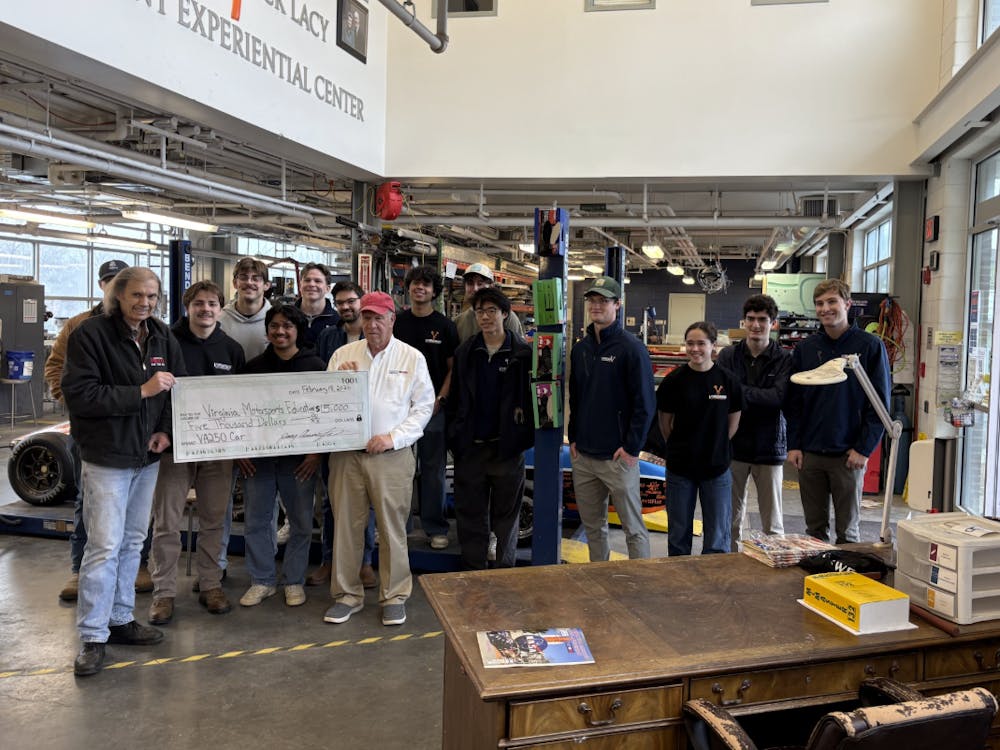
Arrington and the VA250 Car Project enlisted Virginia Motorsports to assist with wind tunnel aerodynamics analysis, vehicle design and performance analysis. Feb. 18, Arrington took a tour of the Virginia Motorsports shop at Lacy Hall, where the club meets and constructs its cars, and presented them with a $5,000 check for their efforts.
“Anytime I get a chance to try to associate myself with a facility like this, we try to make the most of it,” Arrington said following the tour. “There's … so many opportunities here, bright minds, bright ideas, new ideas.”
The students will have the chance to travel to Florida and see the record attempt in-person. They will also bring along some of their own cars to Cape Canaveral to test, something that might benefit them as they prepare for the competition season.
As far as the car-building process goes, the fall semester is primarily focused on design. The design process is thorough, requiring 3D printing, simulations, welding and a host of other processes all undertaken by the students themselves. In the spring, the literal rubber hits the literal road in competition.
Ryley Butler, a fourth-year Engineering student who serves as the president and the cooling lead, emphasized the importance of the competitions as the ultimate goal of the program.
“We have our big one … in June in Michigan, and that’s where we race and compete against about 100 other teams,” Butler said.
The major competition takes place June 16-20 at Michigan International Speedway. Colleges across the country — and the globe, in the case of a Singaporean team — bring their cars to Michigan to compete.
Many of these programs — which include Michigan, Georgia Tech, Illinois, Rochester Institute of Technology and Carnegie Mellon — have well-established motorsports programs dating back to the 1980s and ‘90s. The Virginia team, only in its sixth year of existence and its third year building electric cars, faces stiff competition as it looks to establish itself as a major player in college motorsports.
Cameron Long, a third-year Engineering student and the VP of alumni relations, pointed to a lack of expertise, sponsorship and alumni networks as major challenges they face relative to other programs.
“All those really established teams have decades and decades of alumni that they can pull on,” Long said. “We’re very much a recent team where even the people who have graduated are still very early in their careers.”
Alongside the competitive challenges come challenges associated with growth — particularly money management. The team receives funding from the University through several streams, but as a 501(c)(3) nonprofit, they rely on sponsors and donors to support their material-heavy projects.
“We manage a lot of money, and so we need help doing that,” Sanjay said. “We’re all engineers, we don’t really know what we’re doing.”
The challenge grows as the team expands. The team sits at 128 members, up from 115 last year and roughly 80 the year before. For some of the members, joining Virginia Motorsports was a no-brainer — a result of a longtime interest in cars originating prior to college.
“I’ve been a car guy for my whole life,” Sanjay said. “Coming on on the first day … I was like, this is something that I want to be invested in. And then it actually ended up panning out to be, like, what I really wanted it to be.”
For Cooper Berggren, a fourth-year Engineering student, the VP of Member Involvement and the Aerodynamics Lead, motorsports were a family affair — his older brother was a member of the University of Washington program. Still, it took him some time to carve out a space on the team. Once he did, it was in aerodynamics, a place where had no academic experience.
“That’s kind of the beauty of Formula here,” Berggren said. “If you want to get involved, it’s up to you … you can join any team you want. I’m mechanical engineering, but I’m the aerodynamic lead … there’s no crossover there.”
For those who commit to the organization, the results can be rewarding. A $5,000 check from a legendary engine builder and a chance to associate themselves with a historic attempt at racing history tell just part of Virginia Motorsports’ story. In due time, these students hope their cars will consistently compete at the top of their class in Michigan. In pursuit of that goal, the members of Virginia Motorsports hope the Virginia student body will support them as they continue to grow.
“We are active at engineering expos,” Butler said. “Just come out and see what we're doing.”
Read More

No. 9 field hockey strikes early, lands intense bounce-back win against No. 11 North Carolina
By Adair Reid | 2 days agoWith defensive finesse and an electric offense that came out swinging and kept up the pressure, Virginia put North Carolina and the conference on notice, defeating the Tar Heels at Chapel Hill for the first time in 20 years.

Virginia fights to five sets, but Buckeyes complete the sweep
By Joby Jung | 2 days agoOhio State (7-3, 0-0 Big Ten) waltzed into the Aquatic and Fitness Center and took two back-to-back wins against an injury-riddled Virginia (4-5, 0-0 ACC).

Late drama denies Virginia men’s soccer’s ferocious comeback against Wake Forest
By Mofeoluwa Akande | 2 days agoAll four of Virginia’s losses have been the result of 80th minute or later breakthroughs by their opponents.


