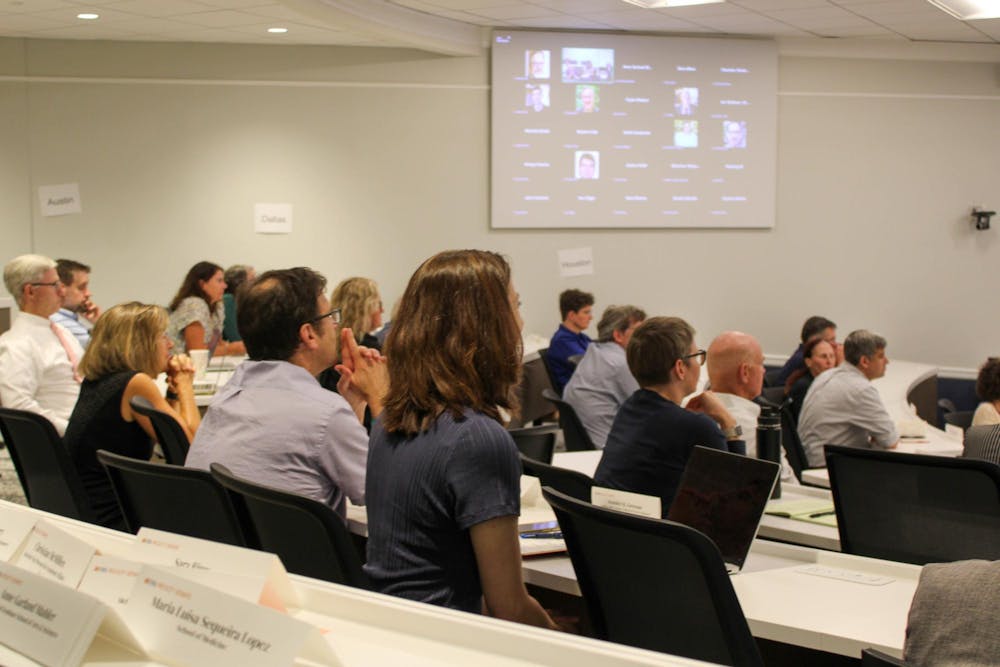
The Faculty Senate’s Executive Council met Friday to discuss how the Senate plans to approach a relationship with the newly-constituted Board of Visitors, ultimately deciding to invite Rector Carlos Brown and Vice Rector Victoria Harker to an upcoming full Senate meeting. Senate leadership also heard from Stephen Mull, vice provost for Global Affairs, regarding the University’s international presence in terms of offices abroad and faculty research. Additionally, the Senate discussed two bills in the Virginia state legislature which could impact the University.
During an open forum discussion period at the meeting, Senate leadership discussed a potential resolution brought forth by Senate members, which would call for the Board to rescind its March 2025 resolution to dissolve the Office of Diversity, Equity and Inclusion. Eric Ramírez-Weaver, co-chair of the Senate’s Diversity and Inclusion Committee and associate professor of Art History, said that the resolution came in light of the U.S. Department of Education’s decision to rescind a Feb. 14, 2025 “Dear Colleague” letter which asked schools to eliminate diversity programs.
A recent proposal from the U.S. General Services Administration would require federal funding recipients to certify that they are not engaging DEI programs. GSA is accepting public comments on the proposal through March 30 — another reason for the proposed Senate resolution, Ramírez-Weaver said.
Although the Council would vote only to put the resolution on the full Senate meeting agenda, Senate Chair Jeri Seidman noted that passing any resolution would be the body’s first interaction with the Board.
“Whatever we do [now] is the start of a conversation and the start of a relationship [with the Board], and I’m not sure that a resolution is the way we want to start a relationship that is collaborative,” Seidman said.
Ultimately, the Council decided that Seidman would reach out to the Rector and Vice Rector of the Board to invite them to speak with the Senate, rather than putting a resolution on the agenda Friday. Seidman told The Cavalier Daily Saturday that both Brown and Harker had responded to her message positively.
Later, Mull shared updates on three key University offices abroad in China, South Africa and Italy. The University’s presence in China, based out of its Shanghai office, is in the process of expanding to serve as the U.Va. Office for Pacific Asia. Mull said that this will allow regional ambassadors in the office to expand recruitment efforts, academic partnerships and alumni engagement throughout Pacific Asia while continuing their work in China.
Mull also announced that the University’s first permanent office in Africa, located in Cape Town, South Africa, opened informally this month and will serve as a hub for University study abroad programs and research opportunities across the continent. The office will open formally Sept. 9.
In contrast with the relatively newer offices in China and South Africa, the University already has a substantial structure and presence in Italy, Mull said. He noted that the School of Architecture established a new academic center focused on studies in Venice and Vicenza in September, which is part of a broader ecosystem of University programs and partnerships in the country.
Now, Mull said, the Global Affairs office is focusing on coordinating and developing the numerous existing programs under one University office presence in Italy.
Senate leadership later discussed two bills that moved through the Virginia General Assembly, whose legislative session concluded Saturday. The bills of interest included House Bill 1385 and Senate Bill 494. Andrew Block, executive council member and Law professor, said that SB494 is the stronger of the two bills. The Senate bill, introduced by State Sen. Creigh Deeds, would increase terms for Board members to six years, preventing future governors from filling all seats on the Board during their term.
The bill would also allow the Board to commission a study to review how universities exercise legal representation and issue a recommendation. Previous versions of the legislation allowed for the Board to hire its own independent legal counsel, but this language of the legislation did not make it through. Both HB1385 and SB494 passed the Senate and House and are awaiting Gov. Abigail Spanberger’s (D) approval — she has until April 13 to sign or veto any bills into law which were passed by the General Assembly.
Jim Lambert, Engineering professor and faculty representative to the Board, updated Council members on recent Board activity, including a recent resolution which charged the Audit, Compliance and Risk Committee with a review of the presidential search process. Lambert noted that the Board affirmed University President Scott Beardsley’s appointment and said that the review will focus on potential processes for future searches.
The full Faculty Senate will convene for its next meeting March 20 at 2 p.m.
Read More

U.Va. Health first in Virginia to use a temporary heart pump in a pediatric patient
By Isabela Delgado | 15 hours agoAccording to the National Institutes of Health, the Impella device is a miniature catheter-based device, in which a long tube is “placed in the left ventricle across the aortic valve" to pump blood and maintain a systemic circulation.

Student Council considers reduced 2026-27 academic year budget
By Lucia Gambacini | YesterdayRepresentatives ultimately adopted an amendment to the proposed budget, but tabled consideration of the legislation to this Tuesday’s meeting.

Students pay University Mandatory Fees — what do they cover?
By Isabela Delgado | 3 days agoThe amount a student pays in fees is dependent on several factors, such as a students’ residence in- or out-of-state and their school of enrollment.