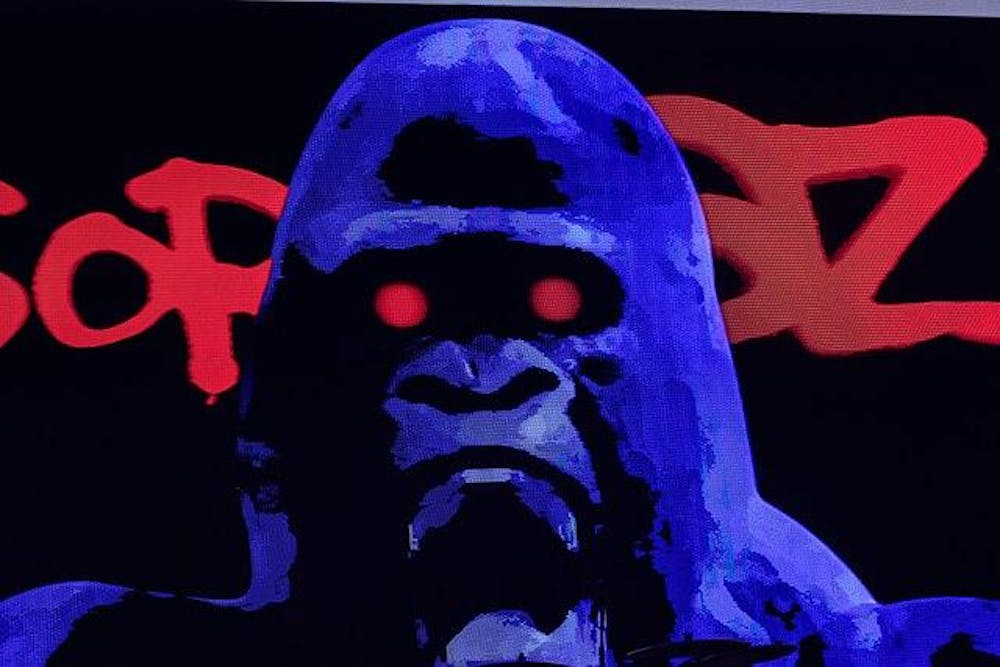
The genre-bending English cartoon band Gorillaz released their anticipated ninth studio album titled “The Mountain” Feb. 27. Created by “Blur” frontman Damon Albarn and illustrator Jamie Hewlett in 1998, the band gained notoriety in the early 2000s for testing the boundaries of alternative music, with this project carrying that trend forward in a remarkably new fashion.
Gorillaz is composed of four virtual cartoon members — 2-D, Noodle, Russel Hobbs and Murdoc Niccals — designed by Hewlett and musically represented by Albarn. Throughout the album, audiences follow the foursome to India, and an accompanying animated short film, “The Mountain, The Moon Cave and The Sad God,” depicts their journey up this titular mountain. With 15 songs all featuring artist collaborations and exploring themes of mortality, afterlife and rebirth, “The Mountain” sums to a transcendent journey that clocks in at a little over one hour long.
The album is directly inspired by a trip that Albarn and Hewlett took to India in 2023 after the death of their respective fathers and Hewlett’s mother-in-law. There, the two strongly connected with the region’s religions, especially Hinduism's spirituality-centered approaches towards the afterlife and rebirth. The duo also found meaning in India’s sonically rich landscape, recording parts of the album in Jaipur, New Delhi, Mumbai and other cities in the country. The cultural influence is both integral to and apparent on the album, featuring numerous collaborations with prominent Indian musicians including Asha Bhosle, Ajay Prasanna and Anoushka Shankar. The album is a beautiful, funky tapestry of language and sound, and may be Gorillaz’s most emotionally compelling work to date.
The album’s introduction, aptly titled “The Mountain,” opens with a dreamy, nearly five-minute stretch of classical Indian instrumentals, layered with sitar, bansuri and tabla. The song lacks lyrics until the end, when the late Dennis Hopper comes on the track, repeating overlapping mediations sampled from an earlier 2005 Gorillaz collaboration. Albarn weaves performances from other deceased musical collaborators through the album, including Bobby Womack, Tony Allen and Mark E. Smith, heavily blurring the lines between life and death on only the first tune.
Despite dealing with themes of death and grief, the album is surprisingly upbeat, featuring boppy synth tracks such as “The Moon Cave” and “The Happy Dictator,” a deceptively optimistic number in which a dictator lulls his citizens into ignorant complacency, hypnotically repeating “I am the one to give you life again / I am the one to save your soul, amen.”
Even songs that speak about death directly, like “Orange County” are filled with hope rather than melancholy. Backtracked by a cheerful whistle and twanging sitars, Albarn sings “You know the hardest thing/ Is to say goodbye to someone you love / That's the hardest thing.” The song feels more fitting for an indie darling film soundtrack than an introspection on the death of a father, which according to Albarn and Hewlett was intentional, as the two have said that they did not want to present a dark or fearful view of death. Instead, they focused on creating a musical journey that celebrates the transition out of mortality and approaches death as a celebration, not with trepidation.
In typical Gorillaz fashion, there are a handful of songs with heavy trap and hip-hop elements. A particular standout is “The Manifesto,” featuring 23-year-old Argentine rapper Trueno and a posthumous appearance by Detroit rapper Proof. The first half of the song is primarily sung in Spanish, one of five languages performed in the album, with an energetic, Latin sound bolstered by various Indian musicians, including sarod players Amaan Ali Bangash and Ayaan Ali Bangash. The second half builds into a beat drop that goes into Proof’s verse, pulling in trap beats and heavy bass. “The Manifesto” is an example of the masterful genre blending in “The Mountain,” never feeling overstuffed or bloated despite running over seven minutes and featuring Argentine and American rap, Indian instrumentals and Albarn’s soap-box singing style.
Unlike Gorillaz’s 2023 album “Cracker Island,” “The Mountain” does not feel bogged down by its unceasing collaborations. Every artist supplements Albarn’s vision, creating an album that completely pulls off its unique blend of genre and culture. According to Hewlett, the record is completely new and different from anything they have done before. That sentiment appears to be echoed by fans and critics alike, with some praising “The Mountain” as already being one of Gorillaz’s best LPs, drawing comparisons to fan favorite “Plastic Beach.”
The final stretch is slower and more meditative than the rest of the album, fully realizing its themes of death and rebirth with lyrics like “You were never meant to be here / And the sword you hold in your hand / Well, it's mighty blow will set you on / Your patterned path into the next life,” in the penultimate song “The Sweet Prince.”
Ending the album is “The Sad God,” an introspective yet playful number that leaves listeners with a final, parting message. “The Sad God” is told from the perspective of a God who regrets the gifts he’s provided to humanity. Albarn mournfully sings, “I gave you atoms, you built a bomb / Now there is nothing and I have gone,” and “No more prayers sent up into space / Only screens left to see your face.” For as much as the album celebrates human history and creativity, it is also a cautionary tale against the future, from authoritarianism in “The Happy Dictator” to a perversion of technology in “The Sad God,” which Albarn expanded on in an interview with Vogue India.
“If AI is a self-generating facsimile of our current reality, then we have to prove that we still reign supreme when it comes to imagination,” Albarn said.
From beginning to end, “The Mountain” is ripe with imagination, creating both a dream-like meditation on mortality and a celebration of life, equal parts infectious and emotional. “The Mountain” begins and ends with the rhythmic strumming of sitars, allowing listeners to experience a full-circle reincarnation as they inevitably stream the album on repeat.
Read More

A&E Book Club: Define ‘March,’ please
By Eloise Diffley | 6 hours agoConnected by the many uses of “march,” this list of literature blends the ancient world with modern writers, stories of innocence with war and tyrants and weddings with funerals

Hoo’s Watching: On months of women’s history and years of men
By Caroline Lee | YesterdayThe good news, however, is that if 2025 was a year for the man, 2026 is taking on a more diversified portfolio, with plenty of women in the coming months’ titles.

‘Bridgerton’ season four is a deep exploration of class divides and social boundaries
By Paige Campbell | YesterdayNearly a year and a half after the release of season three, Executive Producer Shonda Rhimes has returned with perhaps the most eventful installment of “Bridgerton” yet.