Editor’s Note: Theo Moll is Sports’ Senior Columnist for the 2026 spring semester. His columns are published biweekly.
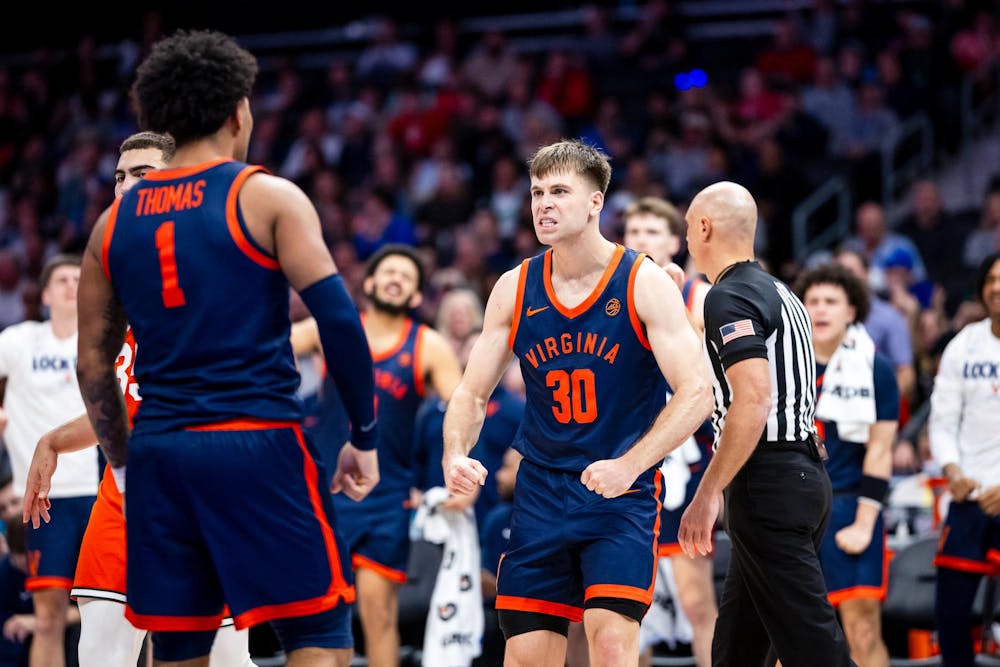
Coach Ryan Odom stood still. He watched the inbound like it was a movie recorded years ago, rather than a play happening live, mere feet in front of him. Not a word leaving his mouth. Not an expression shown on his face. Not a point, nor a gesture nor any sign of, well, life from the typically-lively leader of the Virginia program.
Notre Dame freshman guard Jalen Haralson was the inbounder. He stood patiently behind the Cavalier defending him — junior guard Sam Lewis — as the Fighting Irish attempted to create space for a three-point shot.
Such a setup, with the opponent inbounding from under its own basket, is a basketball commonality — the result of many a tipped pass or botched defensive rebound. This time, however, redshirt freshman forward/guard Martin Carrere met two Notre Dame screens — losing his man and thus creating an opening for the Fighting Irish. Carrere’s closeout was futile, as Notre Dame converted from beyond the arc.
Why did that three-pointer leave Odom so unresponsive — so inanimate? Well, it extended Virginia’s deficit to a near-insurmountable 19-point margin. Never in the coach’s brief tenure with the program had the Cavaliers trailed by such an extreme mark. The motivation for Odom’s lifeless reaction — be it an admission of helplessness or a demonstration of composure — is immaterial. In that moment, his program found itself trapped in a hole of adversity. And Virginia had already dug far too deep.
No team ever hopes to find itself down 19 points. But the Cavaliers learned a valuable lesson that night in South Bend, Ind. — one that cannot occur without a few preceding missteps. It is perhaps the single-most important skill demanded of a successful NCAA tournament team. Jan. 27, Virginia basketball learned how to play from behind.
It is a topic with which — in the month following — the program became much more familiar. From Jan. 27 through Feb. 14, the Cavaliers played six games. They trailed for longer than they led in four of them. Those matchups are a four-point win against Ohio State, a three-point win at Florida State, a seven-point win at Boston College and — in the matchup that saw a stoic Ryan Odom watch the Fighting Irish pile on to an ever-increasing lead — a double-overtime victory over Notre Dame.
This fall, fans dubbed Virginia football the “Cardiac Cavaliers” for its late game, heart-stopping heroics. Perhaps that sentiment made its way across Massie Road, from the Hardie Football Operations Center to John Paul Jones Arena. Nerve-racking as they may be for the Virginia faithful, such tight contests equipped Odom with a much-needed toolkit for tournament basketball.
It may seem ridiculous to construe a 19-point first half deficit as a positive. After all, the Cavaliers did away with conference No. 7 seed NC State and No. 3 seed Miami in relatively calm ACC Tournament affairs. Virginia has won 13 straight games against teams not ranked No. 1 in the country. Why is such a contest — one that saw Odom and company down 19 at the hands of an unformidable conference opponent — anything but a black mark on an unsuccessful season?
Of course, had the Cavaliers shot a higher percentage from the field or been more effective on defense — put simply, if they had played better basketball — they would not have found themselves down 19 points in the first place. This is the most common take on Virginia’s January clash with the Fighting Irish, and it is a valid one, at that.
But there are more ways to interpret a college basketball game than there are names buried in Tony Bennett’s recently-unveiled court signature. The following statements can be simultaneously true. One, the Cavaliers could have and should have avoided such a deficit. Two, their January and February “cardiac” affairs are an integral experience for any team in search of tournament success. One need not look deep into the archives to see why.
Winning in March is never easy.
Last season, Florida cut down the nets following a 36-4 campaign. They entered the NCAA Tournament as a No. 1 seed — important because the Gators thus only matched up with equally- or lesser-seeded teams, a reality that almost certainly will not hold true for Virginia. The round of 64 posed no challenge for Florida. The rest of the weekend would tell a different story.
The Gators next faced a No. 8-seed UConn team. What began with a back-and-forth first 20 minutes quickly turned into a Husky-dominant second-half. Florida would not gather a second-half lead until just three minutes remained on the clock. The Gators’ matchup with No. 3 seed Texas Tech posed an even greater challenge. With under three minutes remaining in the second half, the Red Raiders led by three full possessions, at 75-66. Florida would go on to win 84-79.
Tournament game after tournament game, the Gators pulled together miracle victories. In their final two tournament contests, Coach Todd Golden and his team met No. 1-seeds Auburn and Houston. Florida trailed the Tigers by 10 and the Cougars by 12 — the latter of those in the second half.
Guess who won both games.
And it was not just the Gators who played from behind in last year’s tournament. Texas Tech overcame a second-half 16-point deficit to take down Arkansas in overtime. Houston’s Final Four matchup with Duke saw the Cougars trail for almost the entire game — the steepest Blue Devil lead being 14 points, also in the second half.
All in all, NCAA Tournament games are the furthest thing from stable. March Madness was awarded such an epithet for just that reason — contests turn upside-down with the flip of a switch.
This is not to say that the Cavaliers will hold an NCAA Championship trophy like Florida did last April. Their journey begins with a Friday contest against Wright State and, as always, hinges strongly on the teams that advance in Virginia’s Midwest region.
But one thing is for sure. As they take on more formidable opponents in more meaningful games, the Cavaliers will not lead every second of every contest. Much like last year’s champions, Virginia will fall behind at different points throughout various matchups. And that is okay — now Odom, his staff and his players know what to do.
With that in mind, maybe a 19-point comeback — tied for the steepest deficit overcome in program history — is a more valuable lesson than some may think. Maybe going to five overtime periods and counting for the first time since the pre-Tony Bennett era is a worthwhile experience for the program. Maybe winning eight contests by five points or fewer — contests in which every second of each 20-minute half truly matters — will pay dividends as the Cavaliers enter the climax of every college basketball campaign.
Through the early season, Virginia was dealt a curse of success. At some point, the program would pay the price — better it happened that January night in South Bend than in a mid-March win-or-go-home affair. If last year’s NCAA Tournament proved any lesson, it is that good teams need to learn how to play from behind. The Cavaliers showed up to class early.
Read More

Cavaliers keep cards clean, cruise to victory at Canadian Collegiate Invitational
By Joby Jung | 18 hours agoWith three finishers in the top five and the overall individual and team win, the Cavaliers cleaned up on their trip up north.

SAAC aims to promote connection, advocacy and citizen-athlete development
By Adair Reid | YesterdayPresident Noah Dyer will represent Virginia on the ACC SAAC, interacting with the NCAA on policies and regulations that impact student-athletes.
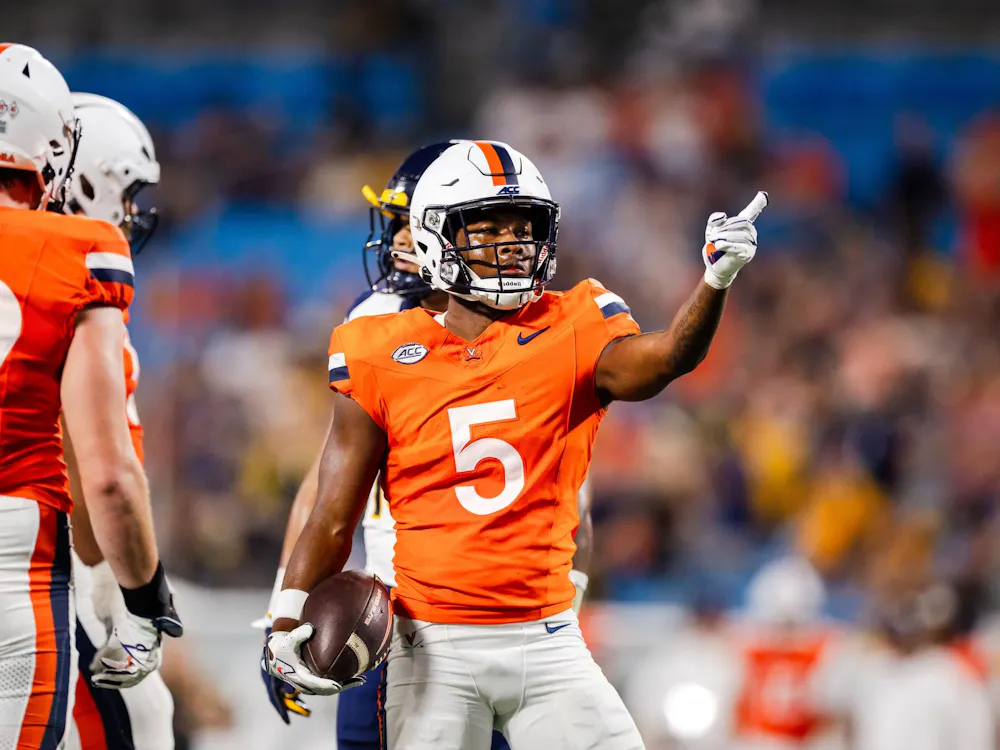
West Virginia big plays — and a lack thereof for the Cavaliers — proved a downfall
By Drew Dillman | YesterdayIn the Queen City, the Cavaliers failed to produce plays fit for a king — while the Mountaineers racked up big plays and took the win.