Some of my fondest memories come from hair salons. I can still feel the booster seat settled beneath my thighs before I was big enough to sit in the chair. I can still see the stylist behind me, rat-tailed comb pinned between her teeth, scooping copious amounts of hair gel out onto the back of her hand. I can still smell the aroma of peppermint and herbs saturating the room, knowing I will be sitting in that salon chair for hours to come.
To say hair is a pillar of the Black community is an understatement. Black hair comes in many different styles, textures, colors and lengths — from protective styles like braids and locs to looser, more natural styles like afros and twists. It is the very thread that has connected Black people throughout generations — the piece between Black Americans of the 21st century and the very slaves that landed in the Americas in 1619.
However, despite the memories and sense of gratitude that I store in my hair today, for a very long time, I felt differently. Like many other Black girls, there came a day when I recognized that I stood out — when I looked at all the TV screens and movies and realized that Barbie doesn’t have cornrows with brightly colored ball hair ties and barrettes at the ends.
We live in a world where Black hair isn’t celebrated on the big screens — movies and TV shows tend to focus on white characters, and when they do feature Black characters, they’re almost always given minor, underdeveloped roles. Even more so, many Black characters on the big screen almost never wear their hair naturally, making it exceptionally difficult for young Black girls to find themselves, and their hair, represented in characters.
Beyond the media, there also came a day when I realized that the other girls in my classes didn’t come to school with tightly plaited hair that their mothers spent all night working on, that while my night was spent sitting between my mother’s knees on the carpet of her room, my classmates were watching late-night television. Without people who look like me represented in the media, nor in my inner circle, there came a day when I realized that my hair was uniquely my own. But instead of feeling special, it made me feel incredibly odd.
I was embarrassed whenever my hair made noise from all the beads. I was embarrassed by the smell of ironing combs and fruity shampoos and conditioners. I was embarrassed by the questions my classmates asked. Each new hairstyle came with questions from “How does your hair just change like that?” to the infamous “Can I touch your hair?”
I became uncomfortable every time it felt like people only focused on my hair — something that made me “different” — over who I was as a person. I began to hate everything in relation to my hair — talking about it, thinking about it and I especially hated getting it done. Every new class became a humiliation ritual, a circus show in which I was the main attraction. And every year until high school, the circus would come back to town. My hair became the elephant in the room. So I avoided it by all means.
At times, I felt completely alone — probably because up until high school, I was usually the only Black girl in my class. I had no one to talk to about how I was feeling about my hair, the way I talked or about my culture at all.
It took a long time, too many years of stressful hair-straightening processes, for me to appreciate my hair exactly as it is. In order to fully appreciate my tresses, I had to fully understand the history and culture that came with them. On my journey, I decided to engage with more Black media, listen to music by black musicians like Stevie Wonder and Lauryn Hill and follow social media creators who looked like me, such as @phaithmontoya and @ava.tocloo. My older sister became one of my biggest inspirations — I would see her confidence grow with each new style she donned.
Since Black hair isn’t a topic discussed in school, I had to do a lot of research on my own. I learned that many hairstyles have deep roots in slavery and Black history. Slaves used to stylize maps into their braids for when they needed to escape slavery, and even used braids to carry small items like seeds that they would need on their journey.
In more contemporary times, Black hair has been used to symbolize a closer connection to ideas of freedom and resistance, as seen in styles like afros. Once I truly understood the background of these styles, I was able to appreciate my hair and wear it with pride.
My journey was not always linear, but the circuitousness of the journey gave me the patience I needed to discuss my hair with confidence and love.
In addition to my increased cultural understanding, I also found that hair is best appreciated when it makes you feel beautiful. For me, this acceptance was accelerated by finding a style that fit me best. After about 12 years and what felt like millions of hairstyles, I discovered that locs — a protective style made up of matted, rope-like strands — were my crown.
After speaking with some of my other Black friends, I found solace in knowing that I wasn’t the only person to have a complicated relationship with these twisted strands of DNA. Finding people who understood what I was going through was one of the best things to ever happen to me.
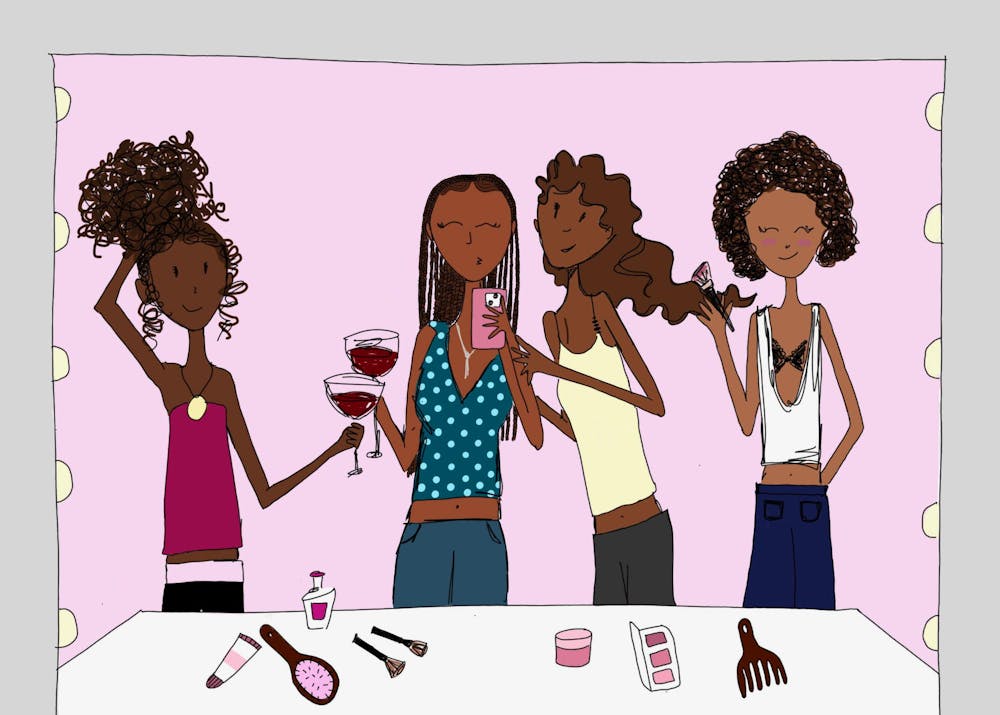
Today, I love being able to look at all my friends and appreciate their different hairstyles. One of them wears her hair in relaxed waves, some others have tightly coiled curls and another has locs just like me. We all wear our hair proudly, chins held high, with big, bright smiles — something my younger self could only dream of.
It is at those times I reflect back to times of loneliness as a child, where I felt like the odd one out in every environment. I remember nights where I would dream of having friends who looked like me and understood me, just to wake up to the same homogenous nightmare that was my reality. Now, it is an honor to be surrounded by people who don’t just love their hair, but who constantly push me to love my hair as well.
Black hair is a conversation. A conversation you have with your stylist about what you think would work best for your scalp. A rowdy conversation over FaceTime with your sister about her fresh silk press. A conversation with your niece about what kind of bows and barrettes she wants to wear for the day. A conversation with yourself in which you realize the hair on top of your head means more than you ever thought it would.
I learned that every conversation about Black hair reveals that hair is not just about aesthetics and practicality, but about who gets to live comfortably. It raises questions about what deserves to be policed and points to the history of criticizing black aesthetics to begin with. It opens the door to a history of struggle between Black people and the pursuit of practical autonomy.
Not every hairdo is a statement, a declaration against the world. Sometimes it is just a return to comfort, a re-discovery of what feels natural. The recognition that wearing your hair naturally isn’t just about defiance, but about freedom, serves as a revelation for many Black girls — including myself. The freedom of being able to wear your hair however you want without rules and regulations, to present your authentic and natural self to the world around you is a blessing that I will always appreciate.
This history does not just live in textbooks — it lives in me. It lies in the chair that spins me toward my reflection at the end of every appointment. I move in front of the mirror and smile at my fresh hair. Staring back at me, I see the little girl who felt so uncomfortable in her skin. She would never believe that leaving the hair salon, I feel excitement. I’m excited about the way I look. I’m excited about how confident I feel. Most importantly, I’m excited about my hair. I look really good.
These days when I leave the hair salon, I pay for my style and walk back to my car. I put on my favorite playlist and roll down the windows to feel the air brush over my freshly-parted scalp. I am no longer six years old, teetering on the edge of anxiety every time I get a new hairstyle, but showing my hair off to my mom is still my favorite thing.
I bet, inside of her too, was once a little girl who felt her hair made her different — lesser than. So when I finally pull into my driveway and walk through my front door to show her my beaming smile and freshly done hair, it is about so much more than just my tresses. At that moment, the little girls inside each of us finally find the solace they had been searching for for so long.

Phoenix Banks is a senior associate on the life desk. She is a second-year College student, majoring in English and Media Studies. Phoenix is from Chesapeake, Va., and she enjoys writing about student perspectives, specifically students of color. Outside of The Cavalier Daily, Phoenix is involved in V Magazine, WXTJ and The Virginia Black Review.
Read More

Sarah Deloney’s path to — and from — her diagnosis
By Astrid Cheng | YesterdayAfter three years of persistent pain, Deloney was finally able to find an answer — Nutcracker Syndrome.
Animal lovers come together at Charlottesville-Albemarle SPCA’s third annual Fall Fest
By Lily Notter | YesterdayFall Fest is the CASPCA’s largest adoption event of the year.

No diet, no glory: My complicated relationship with dieting and eating
By Phoenix Banks | 2 days agoMy weight and what I was going to do about it have been a topic of conversation my entire life.