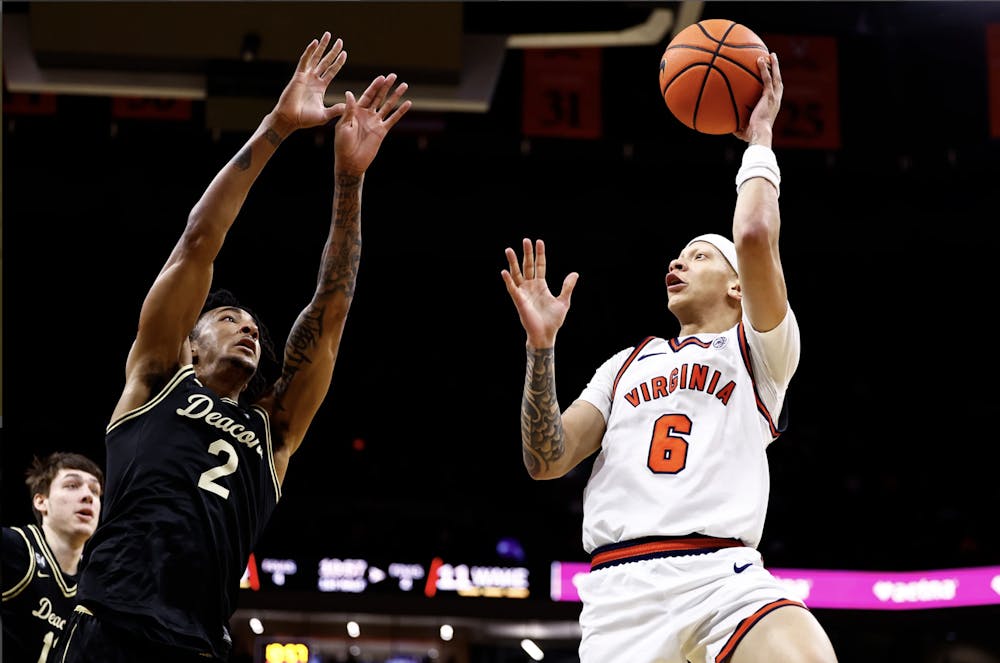
Three days removed from a sobering blowout at Cameron Indoor Stadium, No. 13 Virginia needed to reverse course against Wake Forest Tuesday night at John Paul Jones Arena.
The Cavaliers (26-4, 14-3 ACC) delivered with a 75-70 win, improving Virginia to 15-1 at home and locking up the No. 2 seed and coveted double-bye in next week’s ACC Tournament in Charlotte, N.C.
Tuesday night offered further proof that Coach Ryan Odom’s group can weather adversity, even when its perimeter shooting remains maddeningly inconsistent. The Cavaliers shot a frigid 3-for-17 from deep in the first half, an 18 percent clip that continues a troubling pattern. Virginia still managed a 32-24 lead at half, carried there by a suffocating defense that held the Demon Deacons (15-15, 6-11 ACC) to 23 percent shooting and just seven made field goals in the opening 20 minutes.
“The first half was a little bit slower,” Odom said. “Our defense kind of kept us in it offensively. We couldn't get our shots to go. We were offensive rebounding early in the half, but that kind of dried up for us.”
But Wake Forest made the Cavaliers earn every inch of the win in the second half. The Demon Deacons shot 53 percent from the field after the break and received a 26-point performance from senior guard Mekhi Mason, who went 9-for-12 from the floor with four made threes.
Mason, paired with standout sophomore wing Juke Harris’ 21-point effort, accounted for more than half of Wake Forest’s total output and repeatedly trimmed what appeared to be comfortable Virginia leads back down to a two-possession game.
“We wanted to make it hard, certainly on Harris as hard as we could,” Odom said. “I thought early in the game, in the first half, [we] did a pretty good job … Mason just had a whale of a game, and he got free a couple of times. And sometimes when that happens you see a bigger basket. He made some nice plays for them.”
Each time the Demon Deacons shaved the margin to single digits, the Cavaliers found an answer — which in the second half included revitalized distance shooting. Graduate guard Dallin Hall buried a three to push the lead to 11 early in the second half. Freshman forward Thijs De Ridder connected from deep to restore a nine-point cushion after a Wake Forest run.
The Cavaliers finished 10-for-32 from beyond the arc, extending their school record of games with 10 or more made threes to 19. Virginia attempted 30-or-more three-pointers for the 12th time this season — but its overall three-point percentage remains a concern heading into Saturday’s Commonwealth Clash rematch against Virginia Tech.
Although the first-half marksmanship was particularly alarming, White offered an encouraging wrinkle on the offense throughout the game. He finished with 14 points on 6-for-12 shooting, connecting on just two of his seven total three-point attempts. Rather than continuing to force it from deep, White continually attacked downhill, providing Virginia with the kind of rim pressure it sorely lacked when the outside shot was not falling.
“I was impressed how fast [White] was,” Forbes said. “I didn't quite see that on film. I knew who he was coming out of North Dakota [State], but [he was] fast.”
Wake Forest’s offensive game plan posed additional problems for Virginia. The Demon Deacons frequently stationed their center away from the basket — pulling the Cavaliers’ bigs to the perimeter and opening driving lanes for Mason and Harris.
“[The coaches] just told me to do a little bit of both, be outside to contest his three but also contest the shots around the rim,” freshman center Johann Grünloh said. “It was a good game plan, especially against me and [Onyenso], because you can't always be in the paint.”
Grünloh finished with 12 points, nine rebounds and three blocks, continuing to serve as Virginia's defensive fulcrum. Senior big man Ugonna Onyenso added three blocks of his own in just 13 minutes, and the Cavaliers combined for nine as a team — a rim protection effort that compensated for the defensive lapses Wake Forest exploited in the half court.
Virginia’s 43-33 rebounding advantage, including 12 offensive boards, proved decisive. Grünloh credited the coaching staff for re-emphasising the glass after the team noticeably slipped in recent outings.
“In the last two or three games … we [have not] crashed like we used to,” Grünloh said. “I think we were top three in the country on getting offensive rebounds, and the best getting offensive rebounds from threes, and kind of let off in the last couple of games.”
Once again, De Ridder kept the scoreboard moving for the Cavaliers. He notched a team-high 16 points, seven rebounds and went 6-for-8 from the stripe — including four consecutive makes in the final four minutes of the first half to stretch a two-point lead to eight.
Virginia finished 15-for-23 from the line overall — a 65-percent mark that leaves room for improvement — but makes came when it mattered most. Hall went a perfect 4-for-4 in the final seconds of the game after sophomore guard Sebastian Akins pulled Wake Forest within three, sealing the result from the free-throw line.
The victory helped wipe the slate clean, providing some catharsis after the events of the weekend. It also secured the No. 2 seed in the approaching ACC Tournament, representing a remarkable achievement for Odom’s year one side.
“It's a huge accomplishment,” Odom said. “You think back to June, nobody outside of the locker room thought we had a chance to finish second, and probably at that point, nobody inside the locker room knew if we had a chance, you know, to do something that special.”
The Cavaliers now turn their attention to Saturday’s regular-season finale against Virginia Tech — a bookend with great consequences.
“Obviously, Virginia Tech's a good team, they're playing for positioning within the conference, and obviously the NCAA tournament as well … we had a three-overtime, crazy game with them,” Odom said. “And so we want to focus on doing our best and getting prepared for them, sending our seniors off in a good way, and then turning the page and getting ready for the conference tournament.”
Read More
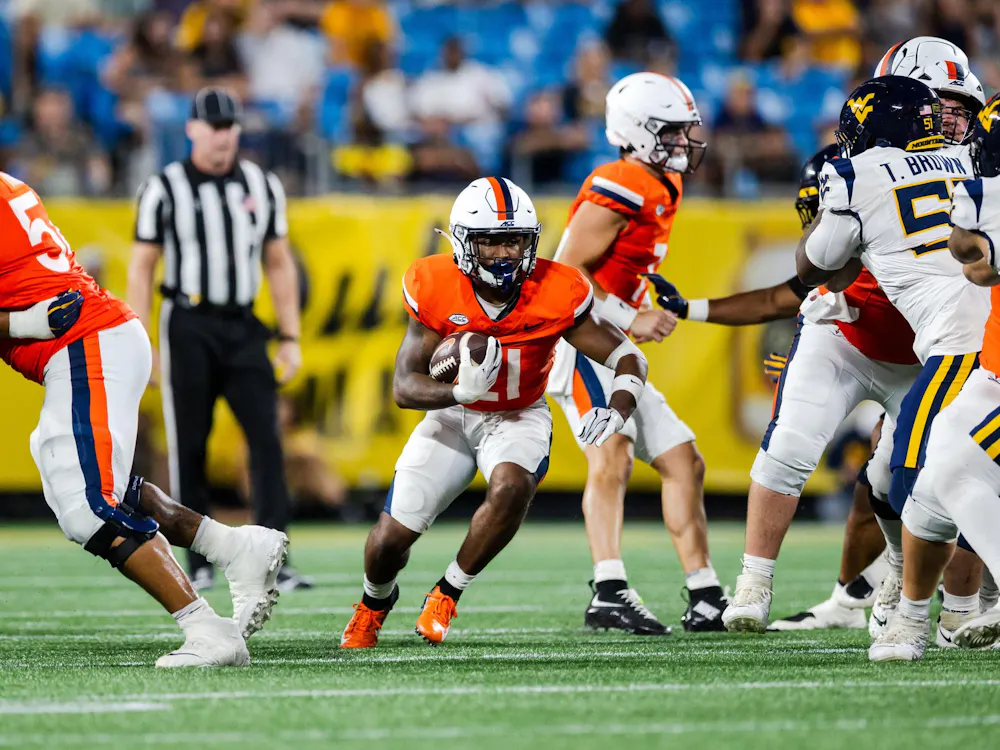
After loss, Virginia looks to ‘feed the monster’ — the Blue Hens are the first course
By Ben McNiff | 23 hours agoVirginia faces Delaware Saturday — the kickoff is slated for 6 p.m. at Scott Stadium. It will be their final non-conference matchup of the season, with a road trip against Florida State looming.

Cavaliers keep cards clean, cruise to victory at Canadian Collegiate Invitational
By Joby Jung | YesterdayWith three finishers in the top five and the overall individual and team win, the Cavaliers cleaned up on their trip up north.

SAAC aims to promote connection, advocacy and citizen-athlete development
By Adair Reid | 2 days agoPresident Noah Dyer will represent Virginia on the ACC SAAC, interacting with the NCAA on policies and regulations that impact student-athletes.