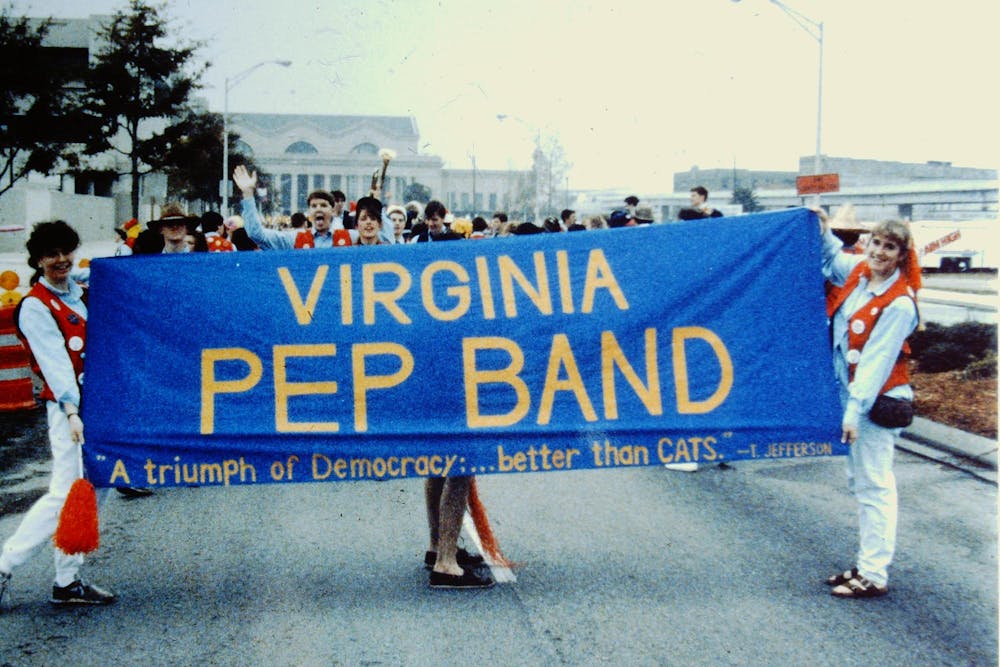
Before the Cavalier Marching Band became the face of school spirit on Grounds, the Virginia Pep Band entertained fans, students and alumni for 30 years until it was banned from University events in 2003. The documentary “Pep Banned” — directed by Class of 1982 alumnus Chris Farina and former Media Studies professor Bill Reifenberger and executive produced by Class of 1983 alumnus Ron Culberson — revisits the band's rise and abrupt removal. March 28, the film will play at the Paramount Theater, bringing the now-defunct group’s music back to Charlottesville through this documentary.
The Virginia Pep Band, founded in 1974, was a fully student-run organization that performed at football games and other athletic events. The band was known for its scramble-style performances — a deliberately unstructured, freeform marching style built around humor — and routines that would poke fun at opposing schools, politics and campus culture. This style often sparked controversy, particularly with opposing schools.
Culberson, former member of the pep band, recalled a halftime joke about Liberty University that drew backlash from former Liberty University president Jerry Falwell after the band quipped that Liberty did not discriminate against minorities as there were “no minorities there to discriminate against.”
“That's the kind of stuff that would happen. I think there was a little bit of rebelliousness in us,” Culberson said. “We kind of saw that as a badge of honor. If they felt they needed to complain, we probably made a good point. But it was all cloaked in the idea of just making people laugh … We weren't setting out to offend anybody.”
This freeform, comedic marching style defined the band for decades, but its satirical routines increasingly drew scrutiny. Tensions over the band’s performances came to a head in 2002 following the Continental Tire Bowl halftime performance. During the performance, pep band members acted out a skit parodying the television show, “The Bachelor,” in which a male University student chooses between two female contestants. One was from the University, while the other was an exaggerated caricature of a West Virginia University student.
Following the performance, former West Virginia Gov. Bob Wise demanded that former University President John T. Casteen apologize for the band’s antics. Although the band had faced the possibility of disbandment for years, University administrators abruptly banned it after this final controversy, much to the surprise of many members.
“The way it happened, the way that they got rid of [the band], was a total surprise,” Culberson said. “One day, the band arrived to get some instruments out of the locker, and the locks had been changed … There [was] always this cloud hanging over them, that they may get disbanded.”
While the band’s humor often caused conflict, Culberson said that its eventual shutdown left members disappointed. According to Culberson, even though many of the band’s most controversial antics were approved by the University, the group dissolved in 2003 in favor of a more official marching band.
“One of the biggest disappointments … was that we were completely student-governed, but then U.Va. decided they didn’t want that,” Culberson said. “The interesting thing is every time the band got in trouble, the joke that they used had been approved … That was always the band's intention was we did what we were told, but we still got in trouble.”
However, looking back on the history of the band, the outcome may have been inevitable. The band had faced close calls before, but as the controversies piled up, Culberson said, the fit no longer worked.
“There was a growing sense that [the University] could actually get rid of [the band] … The football team had gotten much better, and I think there was a sense from the [athletic] department that we were a liability and they weren't willing to take on that liability anymore … It may be that times had changed so much that it was not a good fit anymore.”
In the years following the ban, the idea for the documentary emerged during a 2014 friendly reunion between Dan McKeon, former pep band member and Class of 1984 alumnus, and Culberson. As they shared their favorite pep band stories, McKeon’s wife, Kit, said that the story would make for a great documentary. The film ultimately became a way to preserve the band’s story and the sense of community it created.
Around the same time that the idea for the documentary began to form, the pep band prepared to donate its archival materials to Edgar Shannon Library, formerly Alderman Library. Culberson sought permission to use them for the documentary project.
“My wife and I scanned 6,500 documents, letters and photographs, and we took pictures of things we couldn't scan,” Culberson said. “In the last four or five years, we've really been working hard on getting [the project] completed.”
The film’s use of photographs and archival footage was especially important, as much of the band’s history has yet to be widely documented online. The film does more than recount history — it celebrates the lifelong community and spirit that defined the band, preserving its legacy long after its final performance. Through interviews with pep band alumni, the documentary traces the group’s evolution across decades. In doing so, the film captures a lasting message about community, showing how the band gave those who felt out of place a sense of belonging to something larger than themselves.
“There's a sense of community that people felt as part of the band,” Culberson said. “[The pep band] was my place … I really thrived there, and I think a lot of people did. … I think it's about finding your place and being able to express yourself in the way that works for you. … One of the lessons I think is the importance of finding your people.”
Ultimately, the filmmaking effort reflects the film’s deeper purpose — not to revisit controversy, but to preserve a community that shaped generations of students.
“Pep Banned” screened at the Virginia Film Festival Oct. 26, and is set to return to the Paramount Theater March 28. The screening offers a chance to reconnect with a piece of University history that gives a glimpse into a found family, one defined by humor, connection and resilience. In doing so, the film preserves the story of the pep band, allowing new generations to experience its irreverent, communal and unforgettable spirit that continues to resonate long after the final note.
“My hope is that this preserves [the band’s] story because it's been 25 years or so since they've existed,” Culberson said. “And so a lot of people don't know them and haven't experienced it. So my hope is at least the movie will live on, and people will get to experience the story.”
Read More

Virginia Film Festival unveils full lineup for 39th rendition
By Matthew Wang | 21 hours agoThe Festival’s 39th rendition, which will run for five days from Oct. 21 to Oct. 25, will feature a myriad of films from Virginia and across the world, as well as live discussions and panels with celebrated filmmakers and industry professionals.

‘Digger’ digs deeper than its absurd premise
By Victor-Jenay Cortijo Lopez | 23 hours ago“Digger” takes audiences through a surreal, confusing, hilarious and dark rabbit hole.

An essential guide to the Charlottesville music scene
By CC West | 4 days agoWhether someone is a composer, a dedicated listener or looking to grow their music knowledge, here are some ways to find new harmonies throughout a student's years on Grounds.