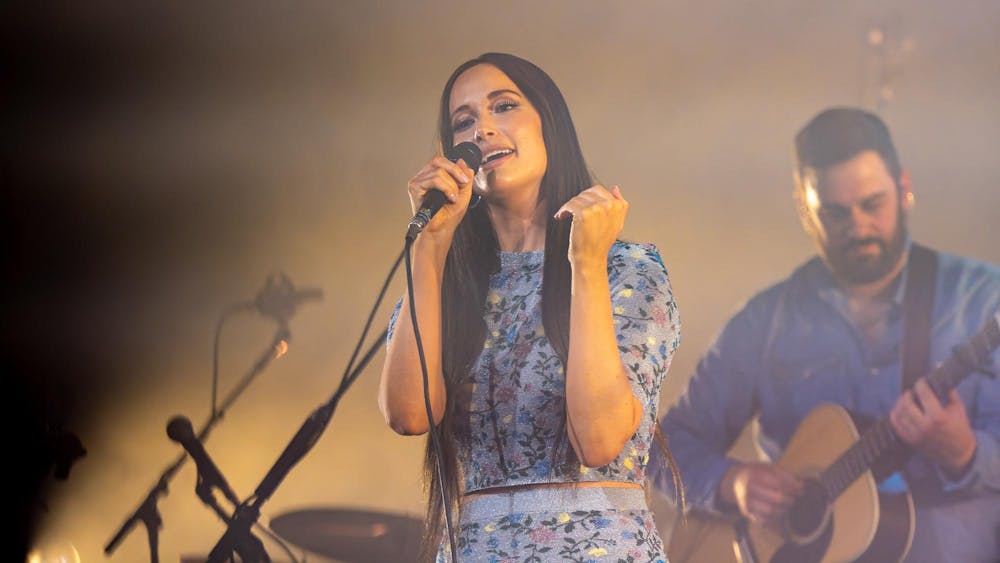
Kacey Musgraves has always been very good at being exactly who she wants to be. From her 2013 hit “Follow Your Arrow,” which made waves for its progressive subtext, to her 2018 Grammy Album of the Year “Golden Hour,” she has explored country, pop, folk and more while becoming known for genuine and vulnerable songwriting. Her 2024 album “Deeper Well,” however, lost a little of that earlier-career lyrical complexity, veering somewhat saccharine.
Nevertheless, Musgraves fans should be rejoicing after Friday’s release of “Middle of Nowhere.” While not as singularly unique as the sweeping disco-pop “Golden Hour” was in 2018, her seventh studio album is a nuanced portrait of an older, wiser and sadder woman who is still unequivocally herself. The album captures the varied physical and sonic landscape of her home state of Texas through features with other Texan artists, Mexican regional influences, references to coyotes and more. Against the Texas plains stands Musgraves, navigating being single and — almost — finding peace.
The eponymous first track finds Musgraves “somewhere in the middle of nowhere” and content. In what feels like a callback to “Golden Hour” track “Lonely Weekend” — where she sang “I keep lookin' at my phone, puttin' it back down” — Musgraves here says “if you tried to call, I wouldn't call you back / Even if I could.” Meanwhile, the switch to three-fourths time on the chorus keeps the otherwise mellow song surprising.
Next comes “Dry Spell,” a reminder of how funny and provocative Musgraves can be. The track blends traditional country images of trucks and boots with sexual metaphors to describe her almost year-long dry spell. Though she sings “911, it’s officially a cry for help,” her drawn-out emphasis on certain words alongside a smooth guitar line weaving in and out of focus make the song feel more sexy than lonely. Musgraves seems to be in on the joke of potential downsides to solitude and not ashamed of where she is romantically.
This sentiment appears across various songs, but shows up in full force on “Loneliest Girl,” arguably the strongest track on the album. Here, Musgraves calls herself “the loneliest girl in the world” with pride. She does not have to deal with a partner’s personal or familial drama, or have awkward conversations. The most poppy song on the album, it sonically resembles “Golden Hour,” which also showed Musgraves’ aptitude for conveying nuanced emotions through up-tempo tracks.
“Loneliest Girl” is not simply a subtle dig at how much relationships can suck. “I ain’t even mad at all the people in love,” she sings during the chorus, “I can pour whatever I want in my cup.” Musgraves chants that being single is not better than being in a relationship — it is simply better for her right now. Even still, the song is further complicated in the third verse, when she admits to not being able to stand the possibility of another heartbreak. Her quiet voice sounds weighed down by the sadness of past relationships, alluding to the idea that seeing others in love does come with a twinge of fear as well. “Loneliest Girl” feels like a more mature version of “Follow Your Arrow” — another expression of the value of doing your own thing, but also an admittance that independence can be influenced by negative experiences as well.
“Loneliest Girl” comes in between two other noteworthy songs — “Coyote” featuring Gregory Alan Isakov and “Everybody Wants To Be A Cowboy” featuring Billy Strings. Neither artist contributes more than backing vocals, but thematically, this choice underscores the lyrics well. On “Coyote,” Musgraves compares a former lover to a lonesome coyote. When Isakov’s deep voice comes in as Musgraves recounts what her past partner says to her upon reuniting, the effect is melancholy and spooky.
Billy Strings’ feature on “Everybody Wants To Be A Cowboy” carries the same impact. The track begins as seemingly a mediation on fake adopters of cowboy aesthetics — “Everybody wants to be a cowgirl / ‘Til it’s five in the morning and it’s cold as hell / And the work ain’t gonna do itself.” The last line of the chorus, however — “everybody wants to be a cowboy these days / Until it’s time to stay” — reveals that the song is about something deeper. With the ghost of Billy Strings’ voice conjuring up memories of long-ago heartbreaks, Musgraves points to how so many people are unable to truly commit to anything.
Two features on the back half of the album play with other Texas motifs while taking a turn back to Musgraves’ punny tendencies. On “Uncertain, TX” featuring Willie Nelson, the real town of Uncertain becomes Musgraves’ both physical and mental location as she questions whether the love she used to have was ever real. Miranda Lambert — another Texas-born country music superstar — later gets to be a true duet partner on “Horses and Divorces,” where the two women squash their reported long-running feud. Deciding to have the two featured male artists take a backseat and give Lambert more airtime works well to highlight the album’s exploration of romantic isolation.
However, the last track “Hell On Me” reminds listeners that though there is bliss in solitude, completely forgetting the past is difficult, if not impossible. Accompanied by only guitar, Musgraves sings to a former partner about how even though she does not hate them, they left a lasting mark on her. She expresses the complexities of sadness, self-hatred and bitterness one can go through after a breakup without trying to resolve them into a neat learning lesson. Although her last two albums — 2021’s “star-crossed” and 2024’s “Deeper Well” — were about learning to find peace after breakups, those albums overemphasized the idea of reaching a destination of self-actualization. Being in the middle of nowhere seems to have given Musgraves the space to recognize the beauty in a lack of final destination at all.
Read More

Le Marché du Soleil stitches together a community, rain or shine
By Nritho Halima | YesterdayThe event marked the fourth collaboration between Le Marché du Soleil, a vintage and secondhand pop-up shop and Cou Cou Rachou, a Charlottesville bakery known for its close-knit local following.
The Southern’s showcase reintroduced student bands on the right note
By Kelsey McIntyre | 2 days agoThe Southern’s concert presented a moment for bands to come together and perform in front of an audience of dedicated music lovers.

Hoo’s Watching: Fall films to embrace the autumn spirit
By Bridget Baile | 5 days agoHere are three essential watches for any reader as they prepare to witness the leaves outside their windows change from green to orange.